Greetings, Travelers!
It's been almost five whole months since Genshin Impact went live, and the time seems to have flown by! We do hope you're all enjoying a smooth journey through Teyvat. Since the game's release, we have received a great deal of feedback and suggestions from Travelers and we've systematically recorded each one for the developers. We deeply appreciate all the time, energy, and passion everyone puts in to these suggestions.
In the midst of this, many of you have expressed an interest in learning more about how some of Genshin Impact's characters are created. As it happens, one character who has received an especially high amount of attention is Xiao, who has now entered the live game with the release of Version 1.3, "All That Glitters." So, for this issue, we've invited colleagues from the Creative Concept & Writing, Concept Art, and Animation departments to explain a bit about the thought process behind everyone's favorite Vigilant Yaksha.
1. The Vigilant Yaksha Is Born: A Character Woven From Cultural Symbolism
Hello everyone, my name is Zhongyuan from the Creative Concept & Writing department of miHoYo.
The first part of the process when designing characters for Genshin Impact is to pin down who the character is at their core. In this step, we need to establish the features that set this character apart from other characters. Besides ensuring that this character will make a strong impression on people, these features are used to evaluate what this character's position in the world of Genshin Impact will be. Characters are not just lumps of rock that we can place anywhere we want in the environment; they are autonomous individuals, each one with a complex set of past, present, and future interactions with the world of Teyvat. Their core features, then, represent their initial points of contact with the world. They are the guiding principles behind all the character's actions and how they live their life.
Xiao was one of the first Liyue characters we came up with. He began with our colleague CiCi's proposal for a young warrior character, which everyone involved in the character evaluation process approved of. The Art team envisaged him as a young man of great beauty, while colleagues in Creative Concept & Writing hoped to position him as a beautiful adeptus. Both sides were on the same page, and thus Xiao became our very first character planned with the identity of "mighty and illuminated adeptus."
Although this is somewhat tangential, I'd like to take a moment here to give a little more detail on the adepti in the Genshin Impact universe, given that so many players have expressed an interest in this topic. The adepti are based on the idea of demigod-like "immortals" (仙人 xianren) in Daoism, and are referred to by the honorific title "sanyan wuxian" (三眼五显), literally "three eyes and five manifestations" (but localized in English as "mighty and illuminated"). The adepti are classed as non-human, based on the notion that "All who have nine orifices can achieve immortality through self-discipline," a line uttered by the "Monkey King" Sun Wukong in the Ming-dynasty novel Journey to the West. This means that animals are also capable of achieving adeptus status. However, humans have a higher purpose than adepti in the world of Teyvat, so for this reason, only those of non-human status can be referred to as "adepti" in Liyue. The "three eyes" part of the adepti's title refers to the "third eye" possessed by those with the ability to manipulate elemental energy, which for humans takes the form of a Vision. For adepti such as Cloud Retainer and Mountain Shaper, the human understanding is that they must have an "inner eye" that serves the same purpose as a Vision. Xiao, however, typically appears in a human form, so he dutifully wears a Vision to comply with the expected norm.
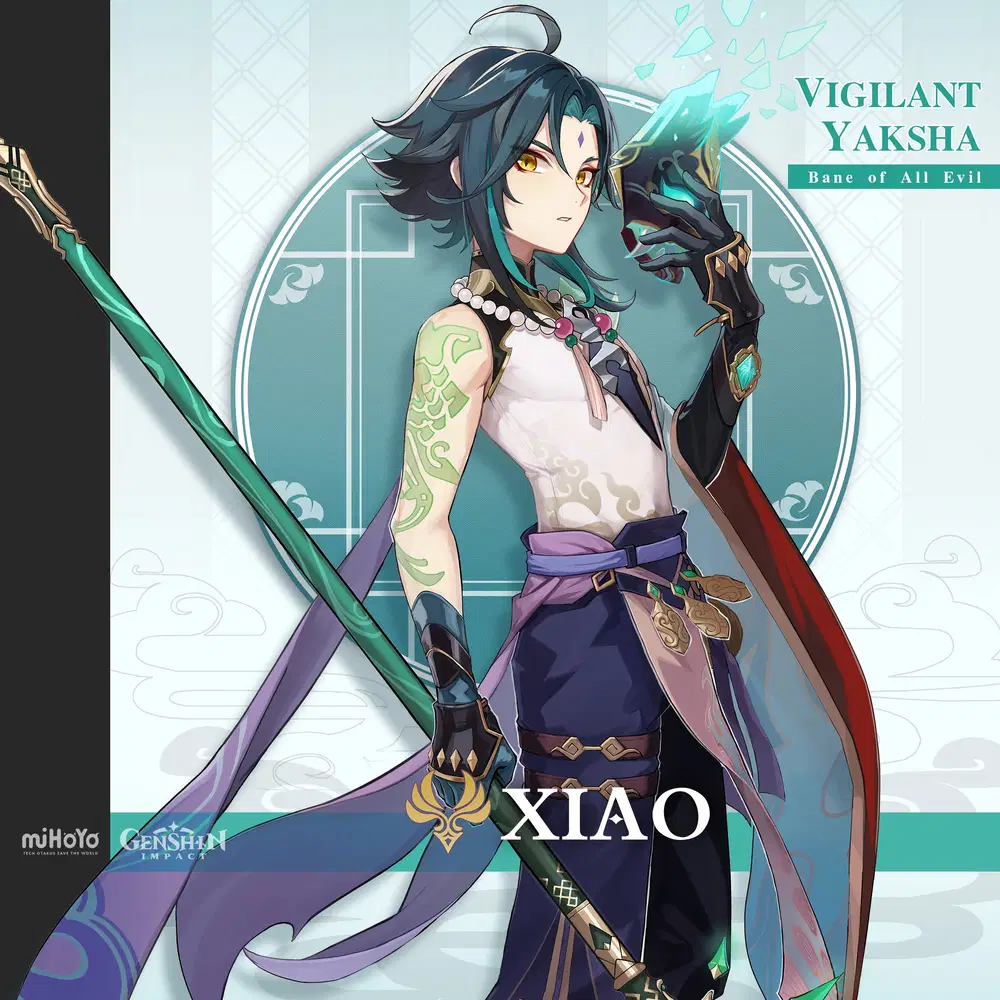
After the character's fundamentals are established, the next step is to design their Constellation and refine their cultural background.
Outside of Genshin Impact, the term "sanyan wuxian" can be traced back to ancient Chinese texts and also appears in supernatural fiction from the Late Imperial period (c. 1368–1911 CE). In both cases, it typically describes the Daoist deity Huaguang Tianwang (华光天王, "Heavenly King of Radiant Light"), also known as Ma Lingguan (马灵官, "Numinous Official Ma"). Huaguang Tianwang is a well-known guardian deity, who appears in the Ming-dynasty novel Journey to the South, in which he has an altercation with Sun Wukong. Research into folk culture also shows there is precedent to connect deities known as Wuxian (五显, "Five manifestations" or "Five Named Xian") with a group of malevolent deities known as Wutong (五通, "Five Powers" or "Five Named Tong"), which includes the one-legged, people-eating, mountain-dwelling demons known as Shanxiao (山魈, "mountain demon").
So, at the most hidden but fundamental level of this character's core, we decided on the name Xiao (魈) and the identity of a guardian-adeptus. The name Xiao is used to hide his past, but also embodies this character at the innermost part of his soul. It is the starting point for all further character development and cultural embellishments.
Another dimension of Xiao's design was that he wields an Anemo Vision and has a fleet-footed and agile combat style that includes the unique ability to propel himself through the air. To stay true to this, we decided to design his Constellation and skills around the idea of the yaksha in Buddhism. This meant we were conflating ideas from different sources; nevertheless, the yaksha had become a well-established figure in Chinese folk legends by at least the end of the Tang dynasty (618–907 CE). The yaksha element ended up being a crucial part of Xiao's design that really helped us flesh him out in terms of his image.
The two archetypal stories of "guardian yaksha" and "numinous official's redemption" both involve a malevolent spirit on a path towards goodness, which was consistent with the general direction of Xiao's character core. Furthermore, his physical agility matched very well with another term for yaksha in Chinese, "Swift and nimble spirit" (捷疾鬼 jieji gui). Through further development of the yaksha concept, we arrived at the decision that the other fundamental aspect of Xiao's identity would be his role as a guardian yaksha in service of a monarch, or in this case, an archon.
One detail is particularly worth mentioning here. There is a well-known group of guardian yakshas in some Buddhist denominations known as the Twelve Heavenly Generals. All but one of them correspond to different animals in the Chinese zodiac, while Mekhila, who would otherwise correspond to the rooster, is instead associated with a bird deity, the golden-winged Garuda, a figure from various Indian religions. The story goes that this golden-winged bird deity was a fearsome predator who ate only evil dragons, until one day the dragon poison he had consumed became too much for him to bear, and he burned to death, leaving only a crystal heart behind. This story seemed to resonate with aspects of Xiao's character. Furthermore, the Chinese name Jinchi Peng Wang Niao (金翅鹏王鸟, "Golden Winged Great Peng") embodies a history of evolution — it represents a convergence between Garuda and the Peng, a Chinese mythological bird, showing that some adaptation occurred in the process of his adoption into Chinese religion. After much consideration, we decided to use the Golden Winged Great Peng as the basis for Xiao's Constellation. In English, Xiao's Constellation has been localized as "Alatus Nemeseos," in reference to the bird deity and Xiao's role as the nemesis of evil.
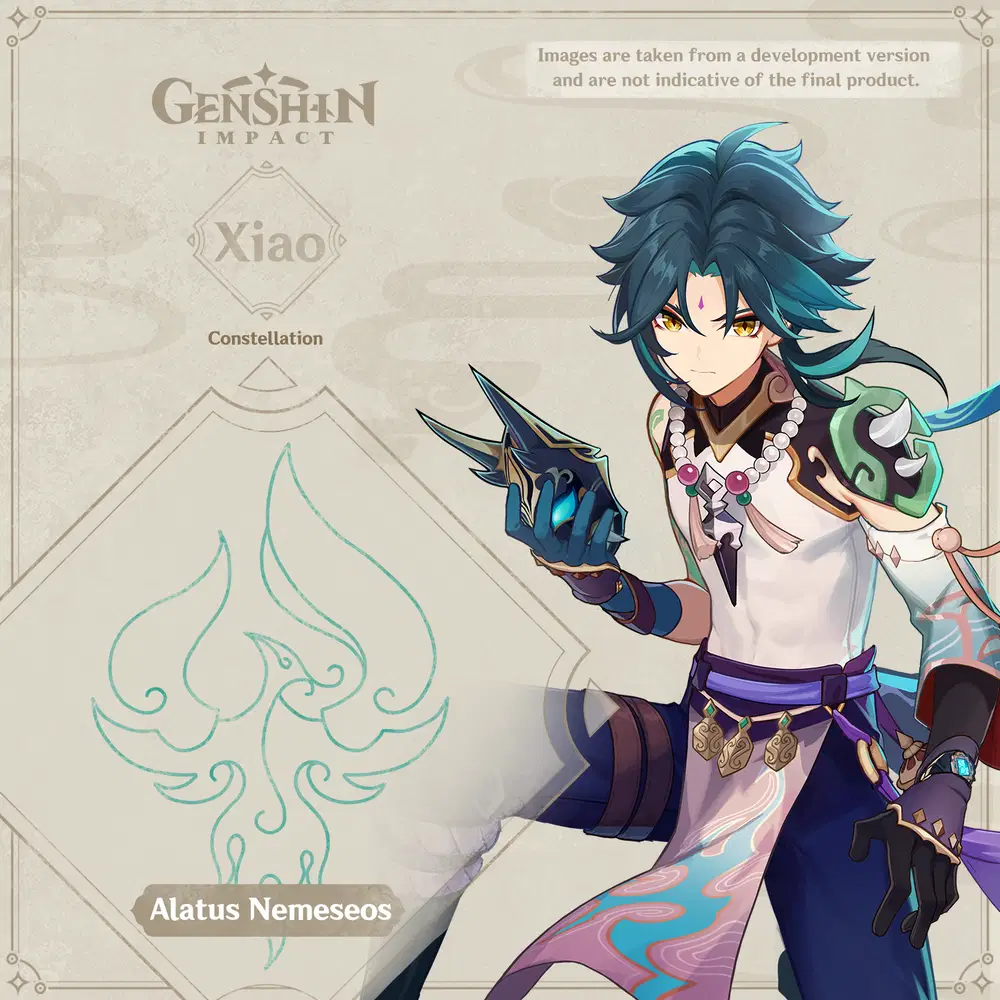
Finally, we conducted an overall review of Xiao's character profile. During this process, we noticed that Xiao's origins were very complex: Some aspects of his identity were based on folk legends while others drew on religious stories. From mountain demon, to Daoist deity, to guardian yaksha, to mythological bird, this was a uniquely rich character formed from the convergence and refashioning of many ideas in one place. More importantly, all these elements were consistent with each other at the narrative layer, creating a strong and cohesive impression of who this character is and adding clear, nuanced substance to his story. This degree of complexity gave Xiao just the depth and appeal that we were hoping for with this character: we hoped to create something entirely new through the convergence and fusion of various cultural elements, and we hope that the end result, Xiao, possesses the power, aesthetic value, and maturity to become a true cultural icon.
The next step was shaping the character's personality and behavior.
After close consultation with Concept Art colleagues, Creative Concept & Writing further fine-tuned the details of this character's content. To pick one example, we all felt that the distinctive image of a young warrior was an important one that we wanted to keep. This begged the question: if Xiao is a warrior, who or what is he waging war against? We quickly got to thinking about a war between the gods. (See section 2 of this article for how Concept Art developed the mask design based on this idea.) One of the basic rules of the Genshin Impact world is that gods cannot be completely destroyed — even if a god's physical form is destroyed, its will and power live on. The remnants and the wrath of the defeated god will remain in the world, waiting for opportunities to cause chaos. To keep Liyue safe from this threat, somebody has to go and keep them at bay.
The decision to release Xiao at Lantern Rite was to tie in with the Chinese custom of driving away evil spirits at the new year, since Xiao's role in Liyue is that of a protector in precisely this capacity.
During festivals, people offer up incense and pray to the adepti for their protection.
But they do not pray to Xiao.
For Xiao is no lucky star that promises fame and fortune — he is a demon-hunting yaksha.
After the lantern lights of Liyue have faded, the thankless battle to protect the city goes on unseen. It is an endless battle, and there can be no victor.
The Traveler's first impression of Xiao is most likely to be of a silent and brooding individual, a courageous and competent fighter, and someone who harbors great suffering. This suffering comes from within Xiao himself. One aspect is that the years of intense, never-ending battle against the remnants of defeated gods have led to him resigning himself to the fact that fighting is all he is good at. The other aspect is that the remnants have a negative effect on him, while the constant killing places a karmic burden on him, causing him mental and spiritual anguish.
This inner suffering is present in the design of his skills: when Xiao uses "Bane of All Evil," he dons his mask, which continually enhances his combat abilities but also continually drains his health. This demonstrates the great suffering he must endure as a consequence of using this power.
After the Traveler has spent some time with Xiao, perhaps they can sense that deep down, Xiao has a gentler side. Xiao is by no means a cruel and callous individual, he is simply reticent to show his emotions to others.
Xiao always keeps his distance from the hustle and bustle of human society. This is not because he doesn't care about humanity, but is due to his role as a protector. He must wage war against dark forces out of sight of humans, and endure a suffering that is incomprehensible to them. Despite this, he does not despise humanity. Humans are the foundation of his millennia-old contract with Rex Lapis, and the reason he silently fights to protect every living soul in Liyue.

The player's first offer to Xiao is to go to the Lantern Rite together to experience the atmosphere. Xiao instinctively refuses requests of this nature— not because he dislikes the idea, but out of avoidance. For Xiao, who has lived for millennia, the human world is a brilliant but fleeting flash of light; a wisp of cloud floating by; a firework on the horizon. And as the one tasked with defending this flurry of activity, he is like a caged beast circling the fire of a stove: fearful, but also full of curiosity. Having watched from a distance for so long, he would not know how to join in with the crowd even if he tried.
The lanterns rise up into the night sky, as if to shine along with the stars. Xiao watches this beautiful sight alone from a mountaintop, and just like anyone else, he senses the sentiment behind them, and he understands that the reason people craft these beautiful things is to remember those who fought alongside him in the past. As one who lived through the events of the past and remembers it all, he is, of course, able to appreciate the well-wishes that the lanterns represent. He understands kindness and gratitude, but doesn't know how to interact with ordinary people, nor does he know what his place is among all the excitement and noise. This lonely state of existence is the source of his melancholy. It has caused time to stand still, leading to him still having a very young mentality even to this day.
During the main Liyue questline, Xiao came to the Traveler's rescue in their moment of peril. In Version 1.3 "All That Glitters," we invite Travelers once again to experience a story that provides a glimpse into Xiao's seldom-shown gentle nature, as well as the trust, hidden deep within his heart, that he places in you.
2. A Young Adeptus: Detail-Based Design
Hello everyone, this is D and SS from the Genshin Impact Art team. We worked on the concept art for Xiao.
After the initial brief, we produced a first draft of Xiao's design based on the young warrior concept. As you can see, Xiao's expression in this version is far from the stern one he wears today. He has a gentler temperament and he is smiling. In this sense, he captures a more traditional notion of what a Daoist immortal (or in Genshin Impact terms, an adeptus) might look like. After more discussion with Creative Concept & Writing colleagues and taking more of his back story into account, we decided on the green version.
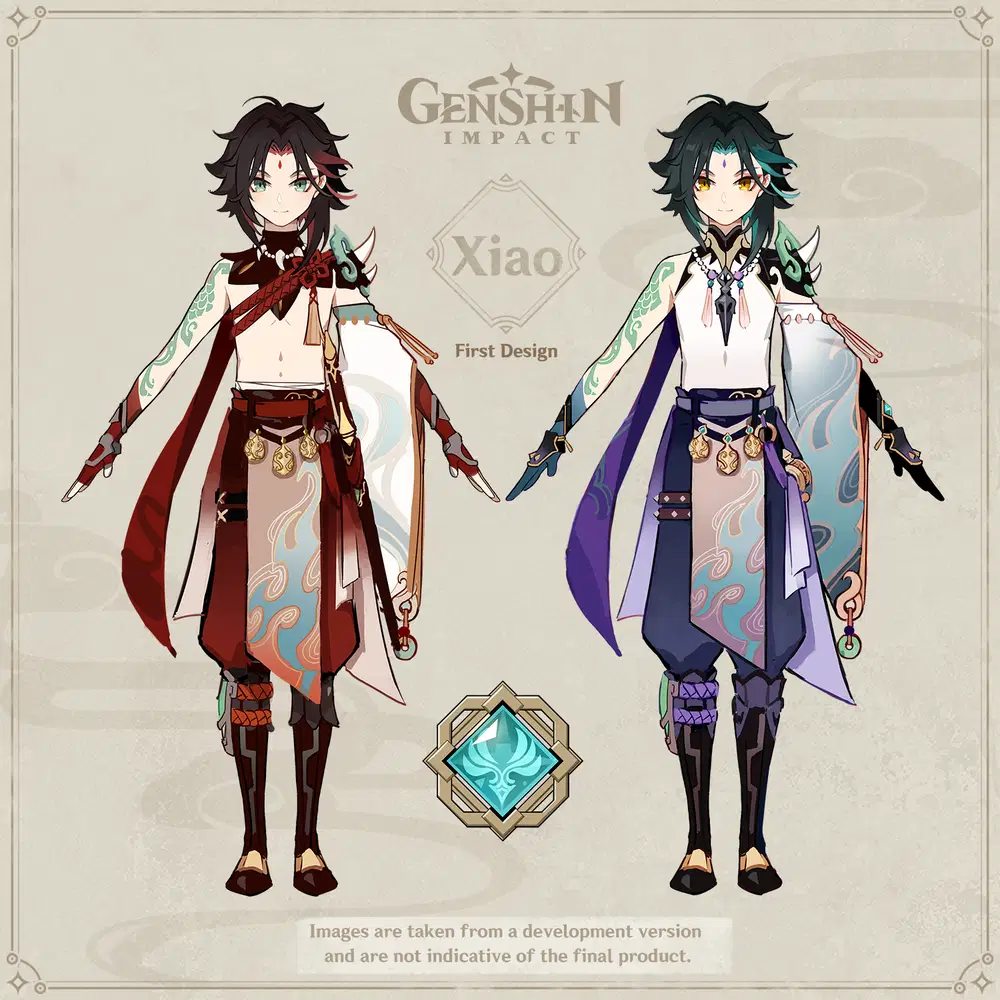
Xiao is an adeptus who protects Liyue, and in the course of his long battle against the remnants of defeated gods all over Liyue, he has become poisoned by their nefarious energy. Based on this background, Xiao's upper body uses white and green, which represent the adepti and correlate to his Anemo Vision. For his lower body, we used darker colors to represent the dark, malevolent power that exists inside him.
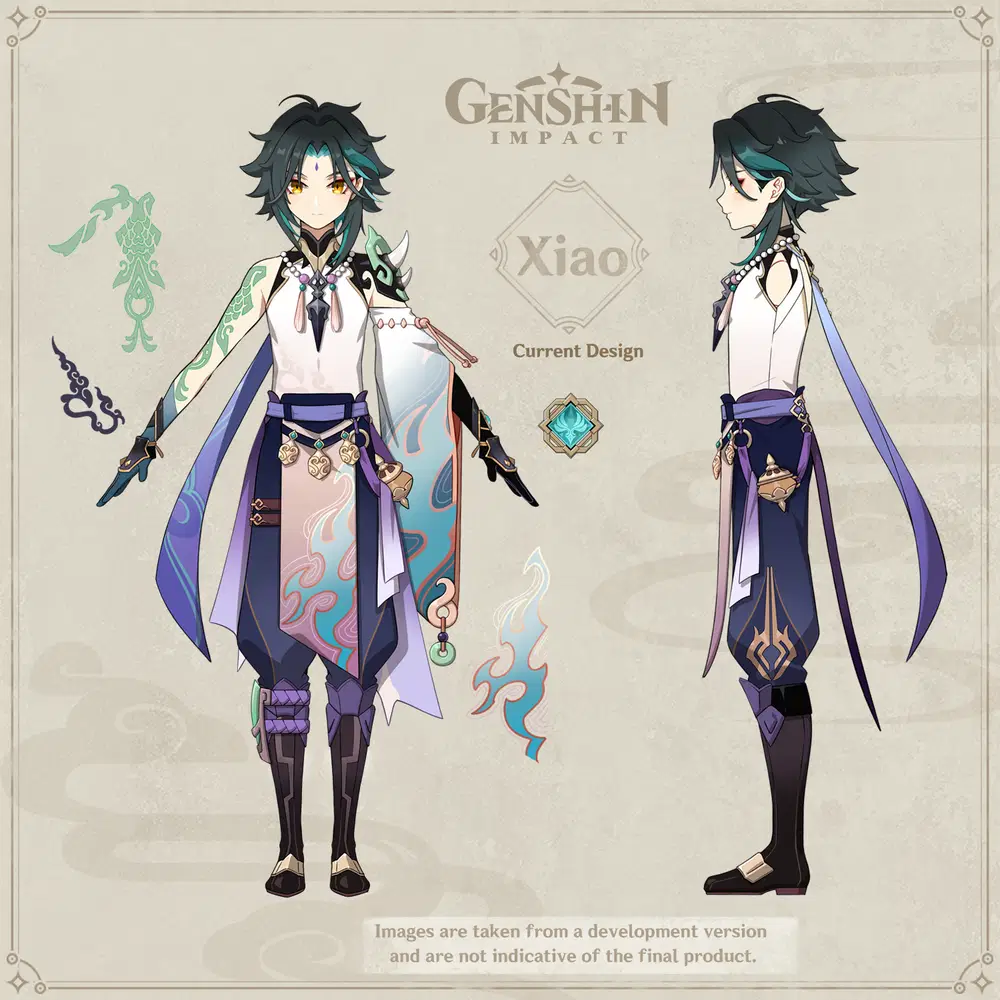
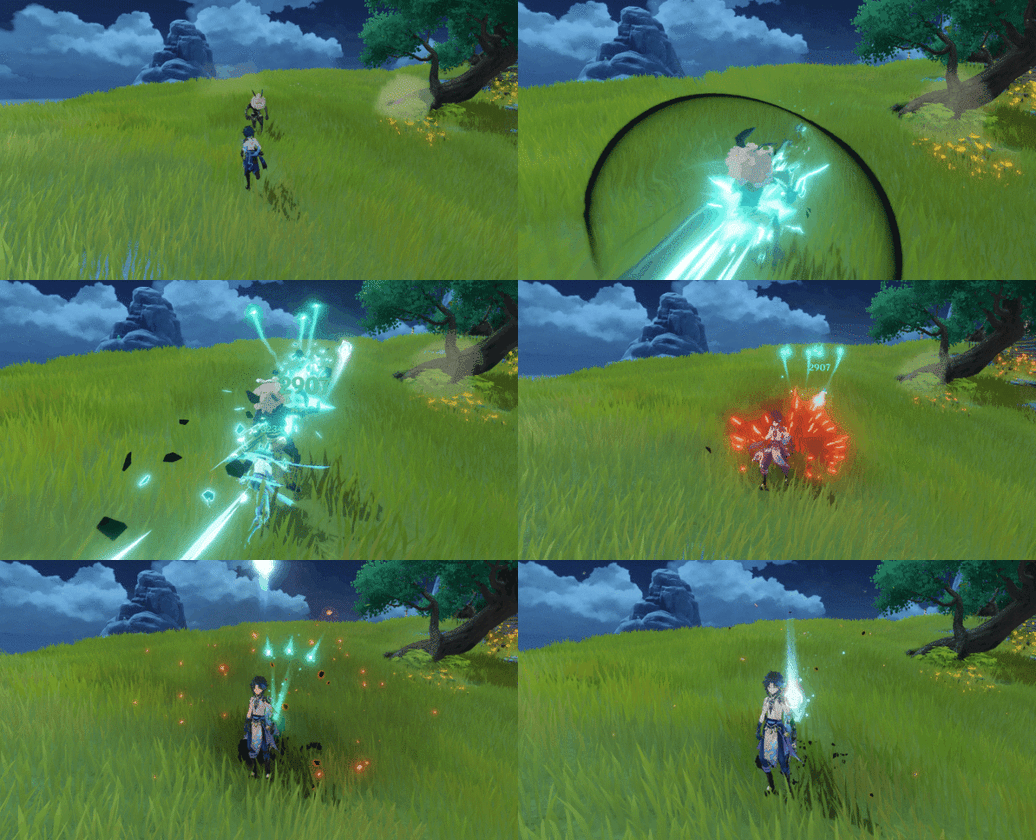
Based on these same principles, we gave him dark hair with highlights, and also created some interplay between light and dark in his attack animations. The darkness represents the destructive power of fierce battle, while the fragments and orbs of light that he gives off come from the fact that he is an adeptus.
Xiao may have the appearance of a young man, but his true age is something over two thousand years.
Fortunately, people do not tend to underestimate him on the basis of his appearance — one only needs to spend a short time with Xiao to recognize that he is not someone to be trifled with.
Xiao is a man of few words. He is highly dangerous, and has the most piercing gaze you've ever seen.
Given Xiao's true age and his identity as an adeptus, we decided to give him some jade jewelry to bring a sense of longevity and mystery. Accordingly, his legs, wrists, and shoulders feature decorative jade as well as various other objects bearing simple motifs. Meanwhile, to match his young appearance with striking good looks, we tailored his clothing (especially on the upper body) using a more modern design, displaying his vibrancy and agility.
On the one hand, Xiao is an immortal adeptus, while on the other hand, he is a young warrior. This is a great variance in image, and it posed a significant challenge for us from an art perspective. Traditionally, an immortal is imagined as a scholarly figure dressed in long, flowing robes with wide sleeves, who is fairly reserved in the movements of their hands and feet. But Xiao, as a master of the dance-like art of polearm combat and a fleet-footed yaksha, required clothing that offers both protection and freedom of movement. Furthermore, we also knew that there were strict limits on any flowing parts of his outfit due to the risk of clipping they would create after 3D modeling.
So we made Xiao's garments close-fitting and short-sleeved, put some light gauntlets on his wrists, and added some religious paraphernalia such as a censer and a vajra. Meanwhile, his streamers and the breechcloths around his waist are decorated with a cloud motif to add a sense of antiquity. In this way, we achieved a union between practicality and ethereality.

"Bane of All Evil" — the four words that sum up what Xiao has experienced over the past millennia, according to Liyue's rulers who know the truth about him
In the design of Xiao's mask, we referenced aspects of the masks traditionally used in exorcism rituals as part of Nuo (傩) folk religion.
The main colors used in these masks are black, blue, and gold, the eyes are bright but not flamboyant, and in general the masks look solemn but also mysterious. The sinister-looking bulging eyes, fangs, and horns instill fear in the viewer. The eye in the center of the forehead represents omniscience and the flame motifs make it all the more imposing, the intent being to cause all onlookers to cower in fear.

Xiao's release coincides with the ancient festival of Lantern Rite. We would like to use this historic occasion as a chance to send our best wishes to everyone — here's to deliverance from the ills that plague the real world as well as those that face us in the world of Teyvat. To fans of Xiao reading this, we hope you feel that learning a little about the design ethos gave you the chance to better understand and connect with this character.