Someone made a comment to me that I was the first person they'd seen explain what Kaeya's relationship was actually based on, and that struck me as odd. Flattering, but odd.
Lots of people explain that Kaeya is or isn't adopted- both Chinese and English- but there's a cultural gap here and some misunderstandings that are easily cleared up, but take a second to explain, so here we go. I'll break it down for everyone. I had this half typed when I got that message, but I think it's time I release it.
This is a LONG post because I want to be sure everyone is on the same page as we go.
So let's start with:
✧ The Basics, Need to Know
Chinese has words that English doesn't and Chinese has words English doesn't.
There's lots of cultured phrases and dynamics that don't have a "clean" translation in English due to historical, slang, or simply lack of comparative words.
Yet funny enough, and yet rarely pointed out, the same can be said about English to Chinese.
According to Google, there are about 106,230 characters in Hanzi.
Only about 6,000 of these are used by casual day to day native speakers.
In English, there are about 170,000 words by comparison.
About 45k of these words are obsolete, leaving about 125k.
The average english speaker needs about 25k of these to be "fluent"
So we have almost four times as many words in English casual native speaking than Chinese does.
It's easy to say even without getting into the specifics that both languages are going to operate differently even outside of a grammatical view. English is going to have words that don't exist in Chinese- and Chinese is going to 'reuse' words to mean similar things. Even then, they can still have words that don't exist in English, so we have to use 'the next best thing' or similar.
This is what localization teams do- they find these phrases, slang, and words and convert them to a more understandable format for the new reader of another language. You can think of it as a conversion of jokes and slang in the same way money is converted.
So words can change depending on the sentence structure or context. We can use words interchangeably to a degree, with some nods to grammatical accuracy. Many words in Chinese change solely based on how they are spoken (Example: mā, má, mǎ, and mà.Link! ) or based on what word is "attached" to it. Instead of inventing new words like English does, they simply use existing words together to form new meanings for them.
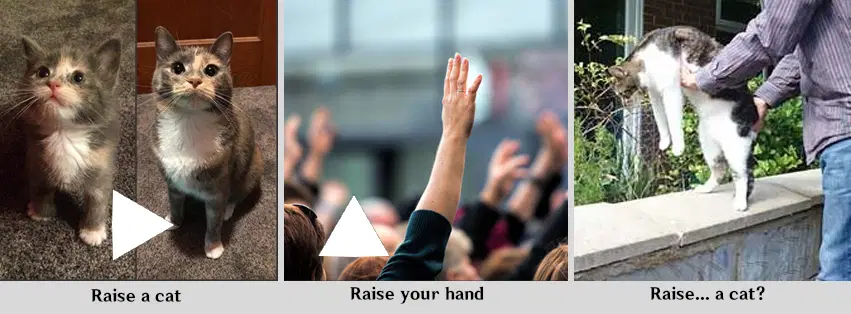
We do this in English too- you can raise your hand or raise a cat. You can excuse someone for having an excuse. Project your voice or work on your project where you read about something you need to read.
Raise, Raise - to lift up or to bring up
Excuse, Excuse - to give a pass or making one
Project, Project - to throw or to work
Read, Read - have taken in literature or the act of doing so.
A visual because we all like those
Context matters just as much in both languages, but in Chinese, the words are far more condensed in number so they're much more specific about tone and the entirety of the story than sentence to sentence. A single word can have numerous meanings, and it's up to you to piece together what that meaning is based on the sentence, if not the whole work itself. This is why many Asian languages are considered difficult to learn to read in- it's memorization of patterns and intention with vocabulary blended in.
So okay that's the basics: Words are Hard. Words have multiple meanings and we don't share everything.
If you're still following, this is where we get to the fun part.
About Feudalism
We have things in our history and concepts that simply never happened in China, and they never needed a word for. So what happens when a Chinese company tries to explain a more Anglo Saxon/ Germanic / Western dynamic structure in Hanzi?
Feudalism, for example, was very common in the west.
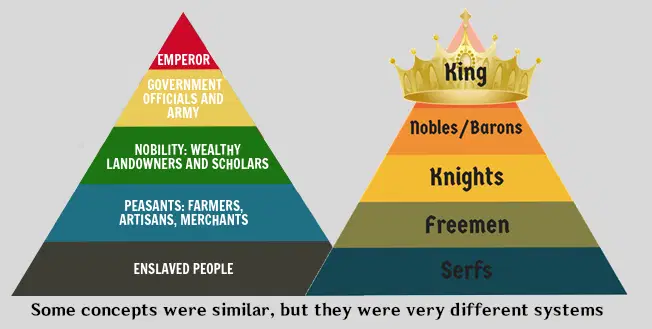
West had kingdoms, fiefs, and all sorts of words and denominations for the relationships between lords and their common people... kings, queens, barons, lords, ect. The Holy Roman Empire ruled over Europe for a very, very long time.
In China, however, this concept was less recognized. Feudalism itself only happened a couple times and not quite in the same way that the Western world did. Instead of a king, they had an emperor, and many of the lower titles were lost or called something else.
another!
Now a feudal wardship, if you are unfamiliar, is usually a 'lesser' persons (a child most commonly) that is taken in by a more capable family to be raised or cared for within their household until they can reach adulthood or independence.
This was done for brides and grooms marrying into more wealthy homes pretty frequently to teach the new member of the house how to be one of them, OR out of obligation to a friend, trade, or distant family. (See: Wuthering Heights, Frankenstein, pretty much any 'historical romance' off the shelves in your local bookstore.)

shout out to my nana
In some cases, it was done out of safety. If your family was about to go to war, you may send your oldest son to a neighboring fief for protection so your entire family line isn't wiped out if things go sideways. In that case, the person hosting the ward would gain control over the ward's properties and titles until they come of age. People actually sometimes traded this because it was seen as a very valuable commodity.
The ward is 'adopted' and seen as an extension of the household, even if they keep their last name and titles respective to their actual home (sound familiar?). However, they are NOT a true member of the family hosting them unless they marry in.
A key difference between a true adoption and wardship is that a ward KNOWS they're a ward. They know they are being housed and hosted by another family and not their own- there is no conception they are adopted.
A difference between a FOSTERship and a wardship is that this is not a permeant home and may never be. They are a seperated and unique entity of the household.
So adopted, foster, and similar not correct to describe a ward. Adoptive only applies if the ward geninely becomes fond of their host household eventually. (Again: sound familiar??)
If you need a more modern example, think of a boarding school.
While attending, you are in the school's care and it is wholly responsible for you. You live there, eat there, sleep there, and are kept safe while being taught whatever it is they teach in schools now days. Wardships are sort of like that but more personal- it would be like someone boarding at their house you for homeschool, instead. You would have a one to one relationship with the head of the family, and they are your guardian. Their children would be your classmates.
The problem is, this sort of wardship didn't really happen in China. They had their own customs and culture for taking in foundlings and such, and don't quite line up with the feudalism concept. There is a word for 'wardship', but their definition of it is not the same as above. They have 监护 . Which is guardianship / conservatorship.
Chinese doesn't really have this relationship to the best of my knowledge and research. (Emphasis on this because I did my best in both languages to find an equivalent but was unable to do so. I asked 3 native speakers, and a handful of generational speakers as well). Child brides existed, but not the second meaning for just taking in a friends kid. They never needed it in history, so it was never defined in hanzi or given a proper title, much like English never had "Sworn" parent (Yifu/Yizi) relationships.
About Mondstadt
Anyone with half a second of time can look a picture of Mondstadt and call it Genshin Germany. It's not wrong to say, but ther's numerous Anglo Saxon references in everything about Mond from all over Europe and even the United States. The land of Freedom, wind, beer, song, and windmills is very iconic for it's non-Chinese influence.
Like I said before, the concept of wardships in stories here in the West is RIDICULOUSLY common. You probably see it all the time and it's just not defined out.
It's not a stretch to say they wanted Kaeya to be a ward based on the Germanic concept of the word (Feudal Wardship)- but like I said above, there's no word for it! So what could they do?
In a historical European setting- how can the Chinese vocabulary explain something that they didn't have? The simple answer is they can't. So they use words that are familiar and similar to them, borrowing what they already know. In a video game, it's practically impossible, not to mention nonsensical, to invent a word for a somewhat fictional historical purpose. So they just... found something similar.
So what is a "feudal wardship" in Chinese- or rather, what does it become?
... They localized it.
Pop Quiz: What's a Chinese concept where an adult takes in / temporarily adopts a son to teach, protect, or care for them until they reach adulthood? This relationship is entered mutually and out of great respect to either each other, or out of obligation to a friend similar to a godparent.
Answer: Yifu 义父 and Yizi 义子 - Sworn Father and Sworn Son.
This is actually a double win because Yifu/Yizi is pretty popular by itself in dramas and stories in Chinese.

✧ Adopted or ADOPTED?
This is where we start to get really sticky and why I went into such a lengthy explanation above.
The word adopted in Chinese is NOT the same as adopted in English.
Like I said above, many words in Chinese get condensed and reused- adopted is one of them.
This is a massive cultural difference between EN and CHS and it's a LITTLE hard to explain without all the preface here- that words have different meanings and contexts depending on the situation and culture it's applying to.
For Foreign speakers:
In English, the word adopted means to take someone in and see them as your family completely and wholly. This is a VERY secure, nonflexible and rigid word with very little leeway or contextual fluff.
When you adopt a cat, it's part of your family and your full responsibility.
When you adopt a child, it's binding, legal, and there is very little room to see them as anything else.
To an EN speaker, there is no difference between your adopted family and your blood family. You do NOT have to take a last name to be considered this way, but it is rather symbolic to do so.
Adopt-ive is a bit looser, but often seen as very similar, and binding. It's purely familial in almost every way and frankly not a common word to use in day to day conversation. It's more a explanation for the words "like a ___ to me" but is NOT supposed to be used for siblings.
We are OFTEN presented stories about someone raised as family discovering they are not in our media and drama (Loki from Marvel, Jon Snow from Game of Thrones) so the subject is automatically assumed to be that way most of the time.
For English speakers:
In Chinese, the word adopted has numerous meanings. It is way more flexible.
While it can mean the same thing, but it is used very commonly used for just hosting someone for a while. It's not inherently the way we see it, and usually isn't unless you're speaking about actual legal matters.
So the sentence "Oh, we took in Jimmie while his parents are overseas" could translate to say "adopted Jimmie" just as easily because the words are considered one and the same. The same could be used for "We took in Jimmie after his parents died" and the word is flexible. They could mean actually adopted, or they could be fostering/warding Jimmie- You would need more context clues to decipher which one.
Now last names are a HUGE deal in Chinese and other cultures. Taking the name is considered to be accepted as the family. This is where they get a bit more rigid. If you don't take the last name- what is the point of adopting you? You're not representing or a member of their family. This is VERY important.
ADDITIONAL: Many cultures (including Asian) will group up in one household with multiple branches of their own or sometimes a friend's family. Each one sort of 'adopts' each other and they live together in a communal sort of environment.
You see this all the time in BL if you read any, and probably don't realize it. Ever seen the MC stay with a close friend sometimes for MONTHS while they get their life in order? That's it! That's the same 'adopt' word we're talking about here. It's SUCH a common concept in Asian media for people staying together. (And they were roommates! basically.)
So when you see something Chinese say "Adopted" it does NOT automatically mean ADOPTED adopted.
Lyney is a good example- literally saying that he was unable to receive help from authorities because he was just 'adopted'.
It's not that the government of Fontaine looks down on adoption or thinks of them as lesser for being adopted, it's just that that's not what the word means in Chinese cultural context. Replace it with 'boarded' or 'hosted' and suddenly the sentence makes more sense to an EN speaker. Poor localization, strikes again!
The authorities couldn't help because, by all intents and purposes, Lyney and Lynette were just staying with someone. They were friends, or strangers, and not legally obligated in any way to their host. There was no grounds to say they were being abused as family because they were not members of that family.
But in Chinese, that word is still 'adopted'.
✧ So What About Kaeya?
Ah yes, the finale. Kaeya.
To put it in very simple terms at the end of all of this- Kaeya is most likely supposed to be a feudal ward.*
It's nearly impossible to prove this is what the Chinese means using the text itself because of all the reasons I've said above. It says adopted. But it doesn't mean adopted. Chinese doesn't have a word for what his relationship really is any more than English has one for Sworn. It's a double localization and that will ALWAYS cause problems.
Here are the context clues to help puzzle this out:
> Kaeya never called Crepus anything of a family figure at all until AFTER he died, and even then, he is unsure which terms to use.
> Kaeya is described as BOTH 'adoptive' and 'sworn' in the hanzi.
> He still calls both Diluc and Crepus "Master" in the same way the staff does in his hangout. Adelinde in this scene, after the guest leaves, tells Kaeya that he will always be part of the Dawn Winery as a collective and that he's never been an outsider.
> Kaeya is called Master and also not by the staff. His title is flexible.
> He did NOT take the family last name. (Kujou Sara, however, did)
> He refers to Diluc as his friend and Sworn Brother rather than adopted/ive actual brother consistently. He has never called him an adopted brother (in the Chinese. EN made that line up.)
> Despite flip-flopping on what to call Crepus, Kaeya consistently refers to his blood father as his father.
> During Ballads and Brews, many characters received a small memory / voice of their family. For Diluc, this was Crepus. For Razor, this was his parents. For Kaeya...? An unnamed voice saying 'this is where you must stay- forgive me, Kaeya' - his actual blood father.
> There is missing nuance in the above and in his story lines- when Kaeya's father left him he did not want to. There is a subtle, easily missed context that he did not want Kaeya to hate him, but he was weaker and it needed to be done. He was hard on him and abandoned him for a reason, even if Kaeya doesn't know what that reason is.
Kaeya is the ONLY character in Genshin to use Sworn hanzi. He's very unique in multiple ways.
Based on context and conjecture, with Kaeya running away and his memories of Diluc as a kid, we can surmise that Kaeya was anywhere from 8-14 when he was dropped off at the Winery. He was old enough to carry out a mission, keep secrets, and draw his own conclusions.
He was old enough to be conflicted over the household that raised him and his blood related one- he had relationships and connections with his blood family.
So is Kaeya adopted?
See the funny thing about reading comprehension and interpretation is you're supposed to decide for yourself.
Yes, because he was taken in and raised by the Ragnvindr family for several years. By Chinese standards, yeah? Kinda? This is obvious to them and seen as fairly normal. This sort of relationship isn't uncommon and it's not as horrendously binding as it is in English.
but also-
No, because it's not the English standard of the word. It's not as western audiences sees that sort of relationship at all. Kaeya was fully conscious he was not a member of the Ragnvindrs and stayed that way.
It's confusing. There's really no helping it because of the words Hoyo chose to use. This wouldn't even be a discussion if the EN team had just used ward, or even foster or godson, in the first place.
However, the bottom line is:
Kaeya cares about Crepus. He respects him and sees him as an important figure in his life. Enough of a positive and beloved person in his mind that it would make him question his loyalty to his actual father and people. He holds a lot of guilt for his death and what happened. He may never know what to call him, but it is someone important to him.
Regardless of how you see their relationship, that is Kaeya.
Our sad little meow meow.
Hope you found this post informative or helpful in some way, I had fun putting it together!
Ship and let ship, my friends. Stay frosty.