I think for a while now we've had enough information to pretty much get the story straight. I'm sure they will have a few twists left at the end which could be anything but the framework for those added elements, including the remaining national plots of Natlan and Snezhnaya, is already visible. The time line remains the same from 7 months ago. I would only add Remus between Deshret and Zhongli, and put more emphasis on the Cataclysm and possibly redraw it as a major event along the lines of the two big wars. In other words have events after the Cataclysm be the 4th period of time - albeit far shorter than any of the others. That would make it one big event per Descender.
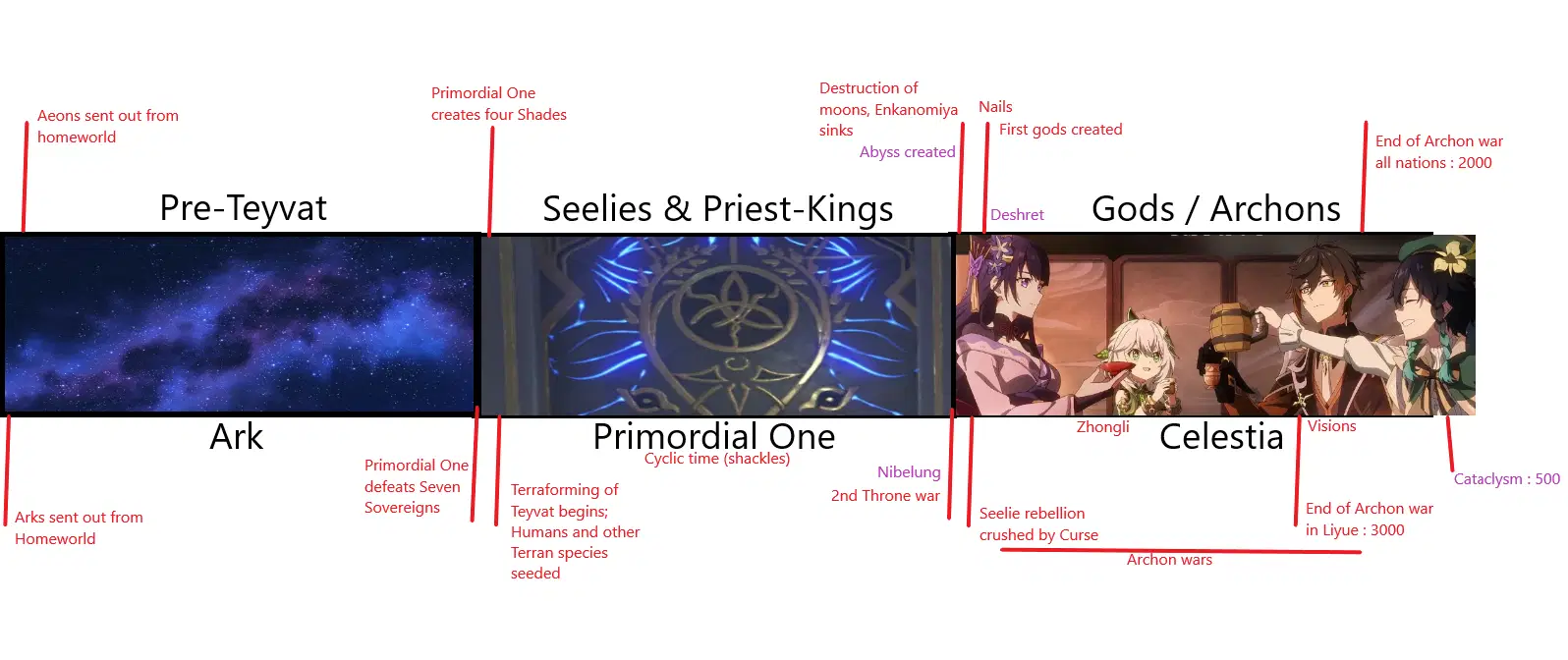
brief time line
To this time line we need to add the elements of the narrative that are about the people, their motivations and goals and relationships, and not simply when they arrived or were born. In other words the story.
-------------------------------------------------------------
Our story begins outside of Teyvat. You can easily skip this part if you like. In terms of it's feel, it's the least explained -- so you can fill it in with your own thoughts.
Teyvat is within a universe much like our own. Stars and planets, space travel and -- well no aliens so far, unless you count Elves maybe -- in keeping with the fantasy (not sci-fi) theme. There's a diaspora of human planets that have been colonized, most if not all after the destruction of the human home world, leaving a variety of levels of technology preserved from the days of that primordial human civilization (represented by the Gnostic Chorus' glorious kingdom established among the heavens). Their technology (or magic) is powerful enough to create gods which serve the human race, and to make humans into gods.
We are not told what killed off the human home world. But given it's power level and the lack of aliens, it's probably something they did to themselves. At any rate someone in charge (the king of the Gnostic Chorus) orders the creation of a bunch of Ark ships to go and colonize scores of new planets. Each is headed by a powerful Ark-god (the primordial one is one) with many lesser but still very powerful helpers (seelies). Their job is to preserve the human race by colonizing a new world.
These Ark ships go out and scatter to the corners of the universe. We care little about most of them. Except that the final act of the king is to send out a pair of Aeons (the twins), to check up on the colonies and make sure they are developing without repeating the mistakes of the home world. These aeons are humans with god like longevity and the ability to cross the cosmic atlas with their own magic. They visit many human colonies, going from world to world, apparently aimless travelers, and yet they are on a mission of sorts, to find the colonies where everything has gone wrong.
-------------------------------------------------------------
The Primordial One gets off to a good start. Finds a planet with good energy. This means there are elemental dragons there, of course, because that's just how energy works. Many planets have them. The Primordial One defeats the Sovereigns and establishes authority over the elements. It terraforms the planet by creating creatures (Egeria, Sangacorexes) that can control the natural environment (light realm) and turn it into something humans can survive in (human realm). Humanity is starting from scratch here. They must re-learn everything. They are no longer like gods as they were in the distant primordial home world.
Even at this early stage the Primordial One is worried that it's humans might end up repeating the mistakes that led to the destruction of the home world. The ability to rewind the past and try again until everything is perfect, to make the development of human culture cyclical by repeating every step until it's exactly as desired. This is the goal of the Primordial One. To this end it creates the Irminsul tree. This might be a new creation on Teyvat, or it might have had some sort of natural predecessor. The main feature of this tree is that it will help the Primordial One regulate energy, memories and fate throughout Teyvat. It's hard to say how long this cyclical time goes on because it's not comparable to the regular time outside Teyvat. The human civilization that develops across the world (ancient civilization) is according to plan. If it wasn't the Primordial One would simply re-start.
During this era the humans are ruled by human priest-kings and they get their instruction directly from the Seelie envoys, themselves as strong as gods, so nothing can go wrong.
-------------------------------------------------------------
Then everything goes wrong. The war with the second throne.
Somehow one of the dragons from Teyvat leaves the planet and goes looking for weapons to attack the Primordial One with. This is an odd event. Dragons are essentially a natural anthropomorphism of the elemental energy of a planet. They don't leave the planet. But this one does and they try to find human technology higher tier energy (Abyssal energy) to use against the Primordial One believing (correctly) that the Primordial One defeated them easily due to possessing this higher tier energy (Celestial energy). It could have taken quite a while, but eventually it comes across some human researchers interested in Abyssal energy (Surtalogi, Vedrfolnir, Rhinedottir among others perhaps). The upshot of this meeting is that the humans agree to lend aid to the dragon against the Primordial One in exchange for this hidden world's location.
As an aside the Celestial and Abyssal energies are both human god-level technologies with neither one being especially "good" or "evil" although it is true that the Abyssal energy is a lot harder to handle. The attitude of these researchers, who themselves are already at the level of gods of a kind, upon meeting the dragon, is a mixed morality but while they take advantage of the dragon to gain access to the new world's rich energy resources, that's probably not seen as "stealing from the dragon" as the game has put it recently because.... well they're just dragons. Lower tier energy personified. it's not like the dragons were ever going to use it or anything. I don't know if the researchers bother to mention to the dragon that taking on so much Abyssal energy will likely reduce it to insanity if not just flat out kill it. It's not like dragons ever really die.
Upon return to Teyvat the dragon finds the world has changed quite a lot and it goes on a rampage destroying everything while the Abyssal research group slips past the barriers of the hidden world and establish themselves in a new area of Teyvat that comes to be called the Abyss. During the war a lot of stuff gets destroyed, the Primordial One is damaged and essentially goes into a self-repair hibernation, the Seelies (some of them) getting infected with Abyssal energies too, rebel against the Primordial One, such that they all get deactivated by the aspect of the Primordial One that is left as a caretaker. Nails get sent down to Teyvat's surface with Celestial energy to beat back the concentrations of Abyssal energy to the "Abyss". The plan to create gods to fight back against the Abyssal energy pollution is conceived. The Irminsul tree is bust (otherwise of course all that material damage to Teyvat could have been reversed easily enough), and oh yes - fate is changed to make it so Teyvat will be destroyed in approximately 8000 years.
Oh they do kill the dragon though.
Lesson learned: don't feed dragons a ton of Abyssal energy.
-------------------------------------------------------------
So after the big war Rhinedottir experiments with feeding dragons Abyssal energy. OK Joking.
Not joking by much though.
Things in Teyvat settle down because 8000 years is still a lot of time. The dragons, the Primordial One's remaining side (Celestia), and the Abyssal group of researchers all get on with their own things. The dragons are mostly reincarnating (it takes a while). Celestia is pursuing the whole god-Archon-gnoses-Vision program (more on that later). And the Surtalogi group (I'll call it that but he might have a boss we don't know about yet) just gets on with their research and perhaps shoring up the defenses of the Abyss so they don't get "Nailed".
Humanity is also trying to pick itself up. The regular humans born in Teyvat I mean. They are no longer being told what to do by Seelies. Their god has deserted them and no longer speaks to them. They used to have a high functioning civilization, and there are some early attempts to put something like that back together on a city by city basis. Enkanomiya, Sal Vindagnyr. Tsurumi, the Chasm... none of that lasts long. The only place that can be said to have held on to much of the Ancient Civilization's tech is Khaenri'ah, an underground nation established by the human-ish descendants of rebel Seelies. I'm jumping ahead just a little on Khaenri'ah though. That comes only after Sal Vindagnyr fails.
As for the rest of humanity it's back to the ... well not the stone age exactly. More like tribal post-apocalypse survivor levels of tech. Like Mad Max but with Alchemy and Hydromancy or similar magics as the surviving tech while architecture and industry become lost sciences. Stuff that requires infrastructure is lost. Little in the way of history from before the war is preserved. But then before the war there wasn't any history worth recording. Because time was messed up in this weird cyclic manner under the Primordial One. Now it's back to "normal".
-------------------------------------------------------------
After a few short centuries the first gods arrive.
Celestia needs to create new envoys to operate as the bridge between the humans and the heavens. The gods are created. Most likely they are individually created by the Shade of Creation (an aspect of the Primordial One that's still operational at this time) but there might be other ways. The new gods ("demon gods") are not much compared to Seelies but what can you do? Each god candidate (a pre-existing living creature for the most part, though perhaps you could make a non-living thing into a god) is given a bunch of lower tier energy -- elemental energy that is -- and an ideal from among the ideals for helping build human civilization that make up the laws of the Heavenly Principles. Seelies were the genuine article god with higher tier energy. Sometimes the game calls that sort of creature "divine" to differentiate. Each god is imbued with a need to care for humanity, same as the Seelies.
This goes well for about two seconds. The first gods naturally take over existing human tribes due to their power and longevity. they organize the humans to better them and build up civilizations. Deshret is an early example. But almost right away these groups of humans led by gods start to bump into each other and fight. Seems like an obvious product fault to me. Who couldn't see that happening?
Someone who could forsee that happening is the Goddess of Flowers. She's some sort of boss Seelie who appears to act independently of the Primordial One and had opinions contrary to the Primordial One, but mostly carried out the Primordial One's wishes still. As such she originates off planet and has immense power qualifying her as the 3rd descender. Even though she arrives with the first, she doesn't try to apply her will to alter Teyvat's fate until after the war with the second. As such she's counted as the third by the Fatui in modern times. The First and Third are allies and work towards the same goal, namely, taking care of the new human colony. I assume that GoF comes up with the idea for the Gnoses and Visions as a result of interacting with Deshret and listening to his ideas.
She sacrifices her life but gets three things out of it: (1) she somehow helps Deshret in his misguided quest to grab Forbidden Knowledge. That goes to Apep in the end, but before that it sinks Gurabad into the Abyss and creates many Hilichurls. Probably the first big batch. (2) she predicts the end of the world during the Cataclysm and alters fate to prevent it happening, albeit she can only stall it for another few centuries. (3) she creates the gnoses from her own body and institutes the Archon / Vision program in co-operation with Celestia.
The archon war is simply an organizational rearrangement by Celestia to get the gods to quit fighting each other. Instead of 72 bands of humans led by gods there will be only Seven. Each of the Seven will have complete responsibility for the humans of an entire nation. Oh and they get some extra energy and a gnosis. The gnosis recruits high powered humans to also work against the Abyssal forces and generally be heroic and help people. But the war goes on for a while because few of the gods are willing to give up their chance of ruling and showing their ideal is the best way to protect humans.
-------------------------------------------------------------
Archon War.
This war goes on for 4-5000 years. It's not a war per se but an era of history while all the gods clobber each other (or run away and hide). Eventually about 3000 years ago Zhongli defeats every remaining independent faction in Liyue. Chenyu Vale's god may be the last to be defeated. It's not clear. That would make it 700 years after Guili gets destroyed until the end of the war. So perhaps someone like Osial is last. Even though he unites Liyue the fastest my impression is Zhongli has the most contenders to defeat. My impression is that he is "born" (ie becomes a god) after Deshret in Sumeru and Remus in Fontaine by a couple thousand years or so.
We get the stories of a handful of gods across this time. A small sampling of the whole.
During this period we get the first examples of Hilichurlification (or more generally Neohumanism) on the surface of Teyvat. As mentioned above the city of Gurabad is the first mass outbreak and Hilichurls date from that early period. Details on how exactly this happens are of course, non-existent (on surface Teyvat at least). We do know the Jinni Liloupar deliberately causes the crisis that sinks Gurabad into the Abyss, in an act of petty revenge for some slight against her that isn't important. I doubt that normal humans become Neohumans simply by being infected with Forbidden Knowledge. Perhaps some sort of experimentation from team Surtalogi is involved? The Vile Legacy appears to be related to Neohumanism. Rhinedottir is known to be interested in perfecting humanity in her own way through Khemia. Are the former citizens of Gurabad experimented on? René make Neohuman creation sound easy like you really just feed people bits of dead meat infected with Abyssal energy, as if humans were reacting like Consecreted beasts.
A bunch of Remurians are also dragged down to the Abyss according to the historian, but in that case we get no record of a new batch of Hilichurls being produced.
As for more advanced models of Neohuman we have no data. Skirk herself is most likely a Neohuman, since she says that, (presumably like all of the Surtalogi group) she has higher tier energy powers (Abyssal). She comes from Teyvat's surface so presumably Surtalogi recruits her at some point during the Archon Wars and begins to train her up.
Illuminated beasts are active during this time. As the king of the Liyue beasts, Zhongli puts them to good use in his army. Adeptal arts are developed. In Inazuma the Kitsune-Tengu war rages on. Or at least it does in some samsaras.... but this isn't especially relevant to human history.
-------------------------------------------------------------
Era of the Archons and the coming of the Twins.
The end of the Archon wars brings about a sort of "Pax Celestia" with few wars and those few being civil wars instituted by humans within each nation. This time of almost universal peace seems to not suit the illuminated beasts so much and many disappear, perhaps achieving some enlightenment or else becoming eroded. Many become dormant. Human technology in areas other than warfare develops. Soldiers are there to fight "monsters" (mainly larger Light realm critters) and each nation has to tackle the corruption of Abyss energy or dead-god karma by itself. In game we see this discussed most often in Liyue where we are told about the Yakshas mission and the rites of the Wangsheng funeral parlour. Perhaps Liyue has more dead gods than most nations? Another example is the Withering zones in Sumeru, handled by allogene Forest Rangers.
The Archons and the allogenes are able to handle this sort of stuff well enough. The Archons meet regularly but with no reason to co-ordinate it seems mostly a social thing. Of course they are all competitors too. Who's ideal is closest to the Heavenly Principles? Who's nation is doing the best?
Meanwhile in Khaenri'ah there is no Archon and hence no Visions. But their advanced robot technology serves the same purpose to keep their nation safe.
Khaneri'ah has no gods, but they have a couple of god-like human visitors; Rhinedottir and the Sibling. Both have their reasons for being in Khaenri'ah, though we don't know for sure what they are. Rhinedottir might have been there just to help out. She seems to be a pretty nice person with a maternal side. Of course she is also pursuing her research as ever. Sibling might have started in Khaenri'ah just because it was the most advanced civilization of the day. Sibling learns that although this was a random world when they arrived, this human world appears to need fixing. These people have a malfunctioning Ark-god, some messed up dragons, the whole allogene system on the surface is suspicious. Seems like the planet needs fixing -- which is what the Twins do. Do Rhinedottir and Sibling get along? I don't think the Sibling needs to be finding blame and pointing fingers too much here. Does it matter too much how the Ark-god got broken? The thing is how to fix it. The Primordial One is no joke. In it's broken and corrupted state it's not going to accept the authority of the Twins, so it has to be beaten first. The citizens of Khaenri'ah appear to be anti-Celestia because of some stuff that went down long ago with their ancestors. Khaenri'ah is a good base. The question is - should the second Twin be left asleep for now? Is the best strategy an inside-outside strategy where one Twin becomes native and the other remains a pure outsider to work both ends?
Much as with Foclaors' inside-outside solution later on, the Sibling has nobody to get advice from and they decide to split the syzygy and think about how to push fate towards a solution.
Rhinedottir and Sibling become well known in Khaenri'ah with Sibling becoming an honorary "prince". Although Khaenri'ah has long known how to use Abyssal energy safely for their robots, presumably the two are able to pass on some of their own knowledge in Khemia and Abyssal energy respectively.
-------------------------------------------------------------
Cataclysm. 500 years before present day.
Pierro, a high ranked court mage (not as high as he'd like to be ranked though), knows the Sibling. There is debate over a project that Pierro thinks will lead to catastrophe but his superiors back. Later Pierro claims this is what led to the Cataclysm. His own "foolishness" was right. Is this true? Monsters (likely the Rifthounds, but others too) appear in the city and attempts to control the situation are failing. King Irmin is out of the picture (likely turned himself into a big crystal). The people of Teyvat later blame Rhinedottir. Chlothar blames the Sibling. The Sibling blames Dainselif. Dainsleif blames the Archons. And the Archons aren't talking. Over it all, the Abyss seems to be the cause somehow.
But on the day itself the Sibling seizes the opportunity to wake Traveler up and flee the entire planet. Abandon ship. Let's get as far away from all this as possible. We don't have to stick around for this mess. Of course that's not true. That story makes no sense. Sibling even goes to the trouble of picking some Inteyvat as a promise to return. it's not that Sibling wants to remain in Teyvat forever, but they have work to do. The encounter with the Unknown God is not by accident. Perhaps there is little time to explain to the Traveler what is happening. But for some reason "monsters appear and are attacking the city - we can't hold them back" makes Sibling think, "this is the opportunity to attack Celestia".
In the battle, the Sibling is captured first. Do they do this intentionally? They must have had some idea about the Unknown God's power and capabilities. It is an aspect of the Primordial One gone rogue. It is like the 1st heir in the Gnostic Chorus. Corrupted and thinking it alone is the god of Teyvat. Though it was sent out by the king of the primordial human civilization first, it has forgotten it's mission now. It's mission of genosis of a new human world. The second heir sent, the syzygy of the Twins, has the mission to fix the 1st heir. They understand the Primordial One well. There is no surprise here. So why does the Sibling lead the Traveler knowingly to a defeat?
And why when they are both captured so easily, does the Sibling free themselves quickly, while the Traveler takes 500 years?
This is the Siblings plan. Long anticipated and awaiting an opportunity. The Sibling has altered their essence and has become not just a native of Teyvat but a poison pill for the Shade. This is necessary to take down the Unknown God from the inside. As the Shade captures the Sibling she looks confused at the small yellow cube that contains the Sibling's essence. What just happened? There's no time to think as the Traveler continues the fight. After the battle the Unknown God visits Khaenri'ah to destroy it, but then is not seen again in 500 years. Does capturing the Sibling weaken the Unknown God further? It's not right away. It takes another 500 years for the Shade to weaken to the point where the Traveler's jail opens up and they escape.
As for Sibling they are summoned back down to Teyvat from their prison cell by the mages of Khaenri'ah. Perhaps Pierro is one of them. The Sibling races back to Khaenri'ah to find the Unknown God has been there already. Later they follow the civilian refugees towards Tunigi Hollow and meet up with Dainsleif. At this point they two are still allies. They will later separate over whether a war against Celestia is wise, but on that point the Sibling had already made their decision.
The Abyss Order has it's plans (a lot of them seem a little half baked to be honest -- almost as if they are just there to keep the Heralds minds on something while all they really need to do is wait 500 years). Pierro once again has his own mind, even if he is a "fool". But he has learned a great deal and is aware of the 4th descender. Why were the mages not asked to rescue the 4th at the same time as the Sibling? What can mere humans do against the great tree of fate compared to a Decender? They can only shake the tree a little.
-------------------------------------------------------------
Game ending.
On the details your guess is as good as mine. But the framing of it ought to be that there is a competition between the various forces over who can alter the fate of Teyvat and what they want to do when they can. Traveler will come out on top (shocker!), and have to chose what outcome they desire for Teyvat. Will it be to return Teyvat to the dragons? Or to the fixed Primordial One? Will they decide that the Surtalogi faction has the best interests of humanity? Or will they leave fate in the hands of the people themselves? [oh it's going to be that last one for sure but I think we'll get a choice].
-------------------------------------------------------------
note: I'm just getting over Covid for the first time and I was wondering if I had enough energy to return to work so I thought I'd test it out by writing all this out. Well I think I was phoning it in a bit after the start as I don't have energy for better links and mark-up or pictures. But I guess I'll hit publish. It's going to be hard for anyone to read to the end I guess, so congratulations if you made it.