
Hello, travelers! Ready to talk about Columbina?
From her very first appearance in the video “Lazzo in the Winter Night”, Columbina captured players’ attention not through loud gestures or striking dialogue, but through silence. Her calm, almost weightless movements and distant presence make her impossible to ignore. She says very little — and yet, the less she reveals, the more you want to look at her again and again.

Her design is far more than simple visual appeal. Every detail feels intentional — from the color of her dress to the posture of her body and the expression on her face. Through her appearance alone, we are invited to speculate about her nature, her role, and her past. And that is exactly what we will try to unravel!

Name and Archetype: From Classical Theater to Teyvat
Columbina’s name is directly linked to the Italian word “colomba”, meaning “dove” or “little dove” — a symbol traditionally associated with peace, innocence, and purity. This immediately creates a striking contrast: a Fatui Harbinger bearing a name tied not to war or destruction, but to gentleness and reconciliation.

In the European theatrical tradition of commedia dell’arte, Columbina is a well-known archetype — a clever, witty, and perceptive damselette who often manipulates events behind the scenes. She is playful on the surface, but intelligent and observant beneath, subtly guiding the story’s course.
Although Columbina in Genshin Impact does not wear a traditional theatrical mask, the ribbon covering her eyes serves a similar symbolic function. It suggests concealment — not just of identity, but of intention. Her true thoughts, emotions, and motives remain hidden, reinforcing the sense that what we see is only a fragment of who she truly is.
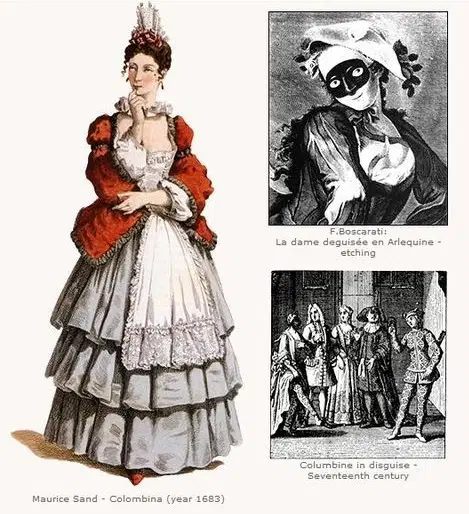
The images of typical damselette in opera and theatre.
It is likely that Columbina’s image was inspired by this archetype to create a more mystical incarnation, transforming the classical mask of comedy into a figure whose role goes far beyond simply embellishing the story.
Visual References & Symbolism
1. Closed eyes
Columbina is frequently depicted with feather-like elements, wing motifs, and a ribbon covering her eyes. This imagery can be read as a symbol of detachment from the material world — or of a different kind of vision altogether. Like figures of divine judgment, she does not look directly, yet seems to perceive more than anyone else. This naturally evokes parallels with Themis, the goddess of justice, often portrayed blindfolded to represent impartiality and higher judgment.

Columbina's covered eyes & Themis, the goddess of justice.
HoYoverse has explored similar symbolism before — most notably in Tears of Themis, where justice, responsibility, and moral choice are central themes. Against this backdrop, Columbina’s covered eyes feel intentional: she appears gentle and distant, yet unwavering, as if she observes from beyond ordinary human perception.

Image of Themis from Tears of Themis game.
2. The Dove: Purity, Sacrifice, and Finality
Across cultures, the dove symbolizes not only peace and innocence, but also sacrifice, reconciliation, and the role of a messenger between worlds. It often appears at moments of transition — after a storm, after judgment, after destruction.
In Columbina’s case, this symbolism takes on a dual meaning. On one hand, she embodies tenderness, silence, and an almost ethereal purity. On the other, she feels like a harbinger of closure — the calm that follows catastrophe rather than the chaos itself. The dove is not a symbol of war, but of what comes after it. This perfectly mirrors Columbina’s serene yet unsettling presence.

Feathers and wings further reinforce this idea. In mythology, feathers often mark divine messengers or beings who exist between realms, hinting at transcendence and spiritual authority.
3. Innocence and Danger: A Deliberate Contradiction
Despite her gentle appearance, Columbina’s character is defined by contrast. Her softness feels deceptive. This duality is reinforced by comments from other Fatui Harbingers, who consistently describe her as overwhelmingly dangerous — someone whose power far exceeds her quiet demeanor.

Harbingers voice-overs about Columbina (Tartaglia, Wanderer, Arlecchino).
This tension between innocence and threat makes her unsettling. She does not intimidate through aggression or cruelty; instead, she inspires fear through calmness, as if violence is unnecessary for someone who already holds absolute power.
4. Lunar and nocturnal symbolism
In literature and mythology, the moon is a symbol of liminality — the space between worlds, states, and truths. Unlike the sun, which represents reason, clarity, and order, the moon governs intuition, silence, dreams, and the subconscious.
Romantic poets often portrayed the moon as a companion to loners and dreamers; mythologies cast it as a guide to the afterlife or a silent witness to hidden truths. Its light does not warm, but it reveals what remains unseen in daylight.
Columbina fits this lunar symbolism perfectly. Her calm does not comfort — it disturbs. Her voice soothes, yet carries an undercurrent of menace. Like the moon, she rarely intervenes directly, but her presence alone exerts immense influence. She observes, waits, and judges from afar.

This symbolism resonates with the concept of the moon in mythology — hidden, inaccessible, and yet always present in the night sky.
Early Perception and Fear
Before Columbina received deeper narrative development, many players viewed her with suspicion or outright fear. Early appearances — particularly her singing during Signora’s funeral in “Lazzo in the Winter Night” — framed her as something ominous. Warnings from characters like Childe further reinforced the idea that she was not merely dangerous, but fundamentally unknowable.
This perception persisted for a long time. One of the earliest visual reinterpretations, the animated short “Stairway to Heaven” released during Winter HoYoFair 2025, portrayed Columbina as a terrifying and almost monstrous figure, cementing her reputation as a being to be feared.
Columbina is a character built on layers of meaning. Her design weaves together classical theater archetypes, religious and mythological symbolism, and modern fantasy aesthetics. She is not simply beautiful — she is intentional.
Every detail, from her name to her closed eyes, functions as part of a visual language that we're invited to interpret. Columbina is silence given form, judgment without words, and calm that hides something far more profound beneath its surface.