I got tired of seeing people treat the Japanese localization as the "original dub", so I ended up looking into how the different languages treat terms of address. Please don't use this to start a "dub vs. sub" argument by the way. I think all of the dubs make interesting choices in their approach to translating the CN script.
Since I'm talking about honorifics, it's important to know that Chinese society is heavily influenced by Confucianism. As such, the way you address others is determined by age and gender. Also, every time I say "seniority", it doesn't exclusively refer to someone who's older than you in literal years, unless I state otherwise. It also includes people who have more years of experience in your job field for example.
Note: My knowledge of Korean is bad, so I appreciate any corrections. My familiarity with keigo is also limited, as most of my Japanese knowledge come from family and friends. So apologies if I get anything wrong there as well 

What Trailblazer calls Sunday
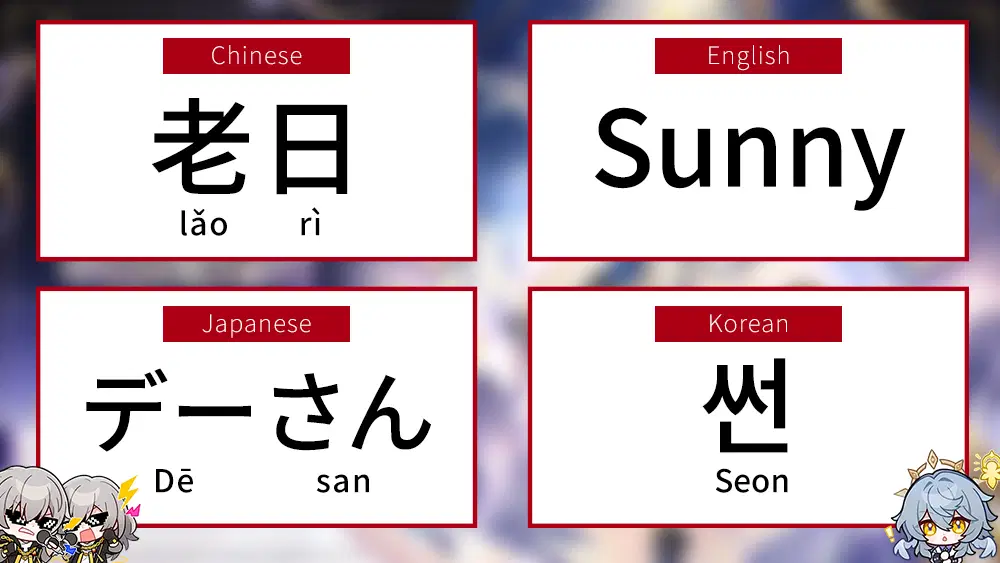
Chinese: 老日, English: Sunny, Japanese: デーさん, Korean: 썬
Chinese
Let's start with the character that made me go down the localization rabbit hole, Sunday's nickname! Sunday's name in Chinese is 星期日 (xīng qī rì). 老 (lǎo) means "old", and is used to refer to someone who has more seniority than you. When paired with a name, 老 becomes an indicator of endearment or respect. In terms of closeness, it's used among friends, neighbors, acquaintances, and coworkers.
Japanese
Sunday's name in Japanese is his English name spelled out phonetically, サンデー (Sandē), instead of the actual word for the day of the week, 日曜日 (nichiyoubi). So for Trailblazer's nickname, they took デー part of his name and added さん, creating "Day-san". さん is a very universal honorific, and can be used in both formal and informal context. Since it's a neutral form of address, it may not be an appropriate way to refer to someone who's very close to you.
Edit: thank you to a very kind Japanese commentator! "Day-san" is a pun, which I totally didn't catch ! The さん is a play on the "Sun" part of "Sunday". So "Day-san" is actually an inverse of "Sunday", and is a very playful nickname!
English, Korean
The English localization leans into the endearment interpretation. I personally find "Sunny" to be a little too cutesy, because 老 distinctively has a masculine vibe to it. It's the Chinese equivalent of calling someone "bro" in English. I prefer the nickname approach in the Korean localization where they shorten his name, 선데이 (Seondei), to "Seon".
What Dan Heng and Sunday call Welt
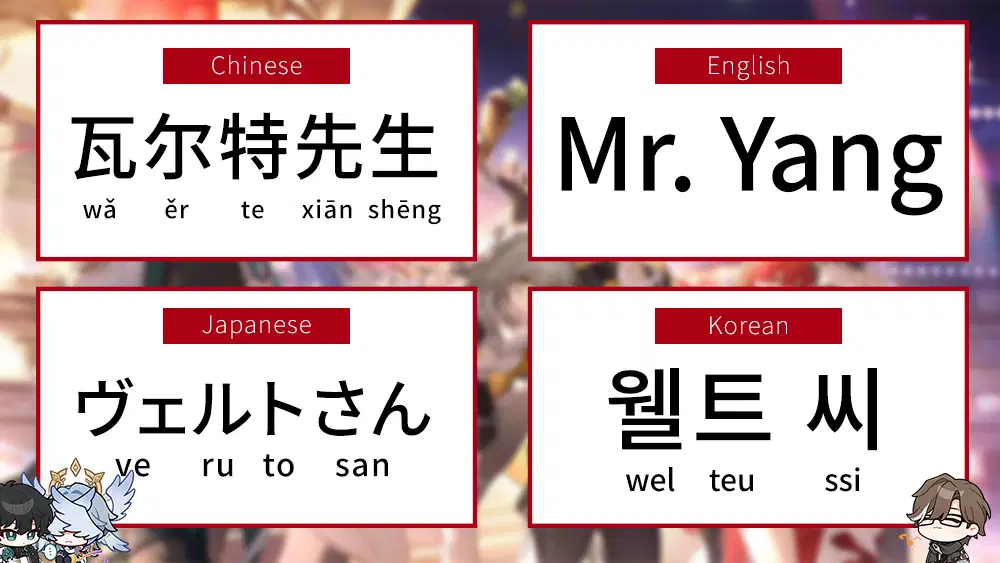
Chinese: 瓦尔特先生, English: Mr. Yang, Japanese: ヴェルトさん, Korean: 웰트 씨
Chinese, English
The way Dan Heng and Sunday address Welt have a lot of overlap with Trailblazer. In contemporary Chinese, 先生 (xiān shēng) is a polite way of addressing a male stranger, the equivalent of "Mister". In both classical Chinese and parts of South China, 先生 is a gender-agnostic term for your teacher or "master". 先生 is commonly attached to a person's last name, but if a person is being very formal, you would attach it to their first name. Both Dan Heng and Sunday uses Welt's first name in the Chinese, Japanese, and Korean dubs. The reason why the EN dub goes with "Mr. Yang" is because first name address is very informal in English.
Korean
Since 先生 can be used regardless of age, both the Japanese and Korean localizations go with age-agnostic honorifics compared to how March speaks. When added to a name, 씨 is a polite way of addressing a stranger in formal contexts, like "Mister" or "Miss". But it's only used for people who are either around your age, or in a similar or lower social status. Attaching 씨to a full name or first name is preferred, as addressing someone with their surname and 씨 comes off as saying that the listener is of a lower social status than the speaker. 웰트 씨 (Welteu ssi) makes sense considering Dan Heng's and Sunday's circumstances. Dan Heng initially joined the crew to be their archivist and bodyguard, so he doesn't feel obligated to the same social hierarchy as the rest of the Astral Express trio.
What March and Trailblazer call Welt
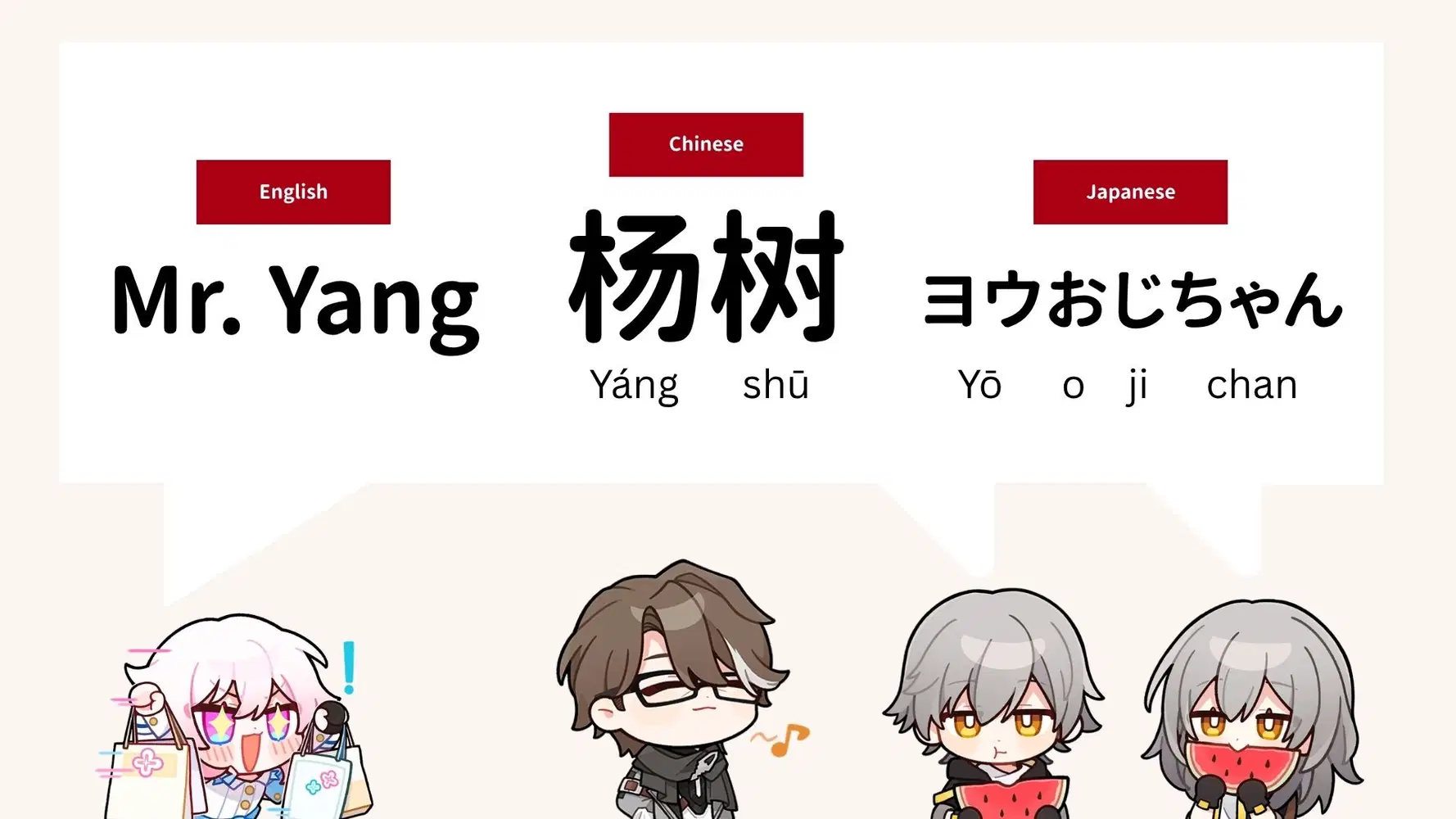
Chinese: 杨树, English: Mr. Yang, Japanese: ヨウおじちゃん
Chinese, English
叔 (shū) is used to refer to your dad's younger brother. When combined with the same character, 叔叔 (shū shū) translates to "uncle". Outside of blood and familial relations, calling an older man 叔, usually 10-20 years older, is a way of fostering kinship and demonstrating respect. Because Chinese culture places a lot of emphasis on family being the most important relationship in your life, "uncle" became a way to address an older male stranger, although it's not as formal as 先生. So the English localization's choice of "Mr. Yang" does work. But in the Cosmic Data Roaming event, I noticed that the EN script now seems to be pushing for March and Trailblazer to use "Uncle Yang" instead.
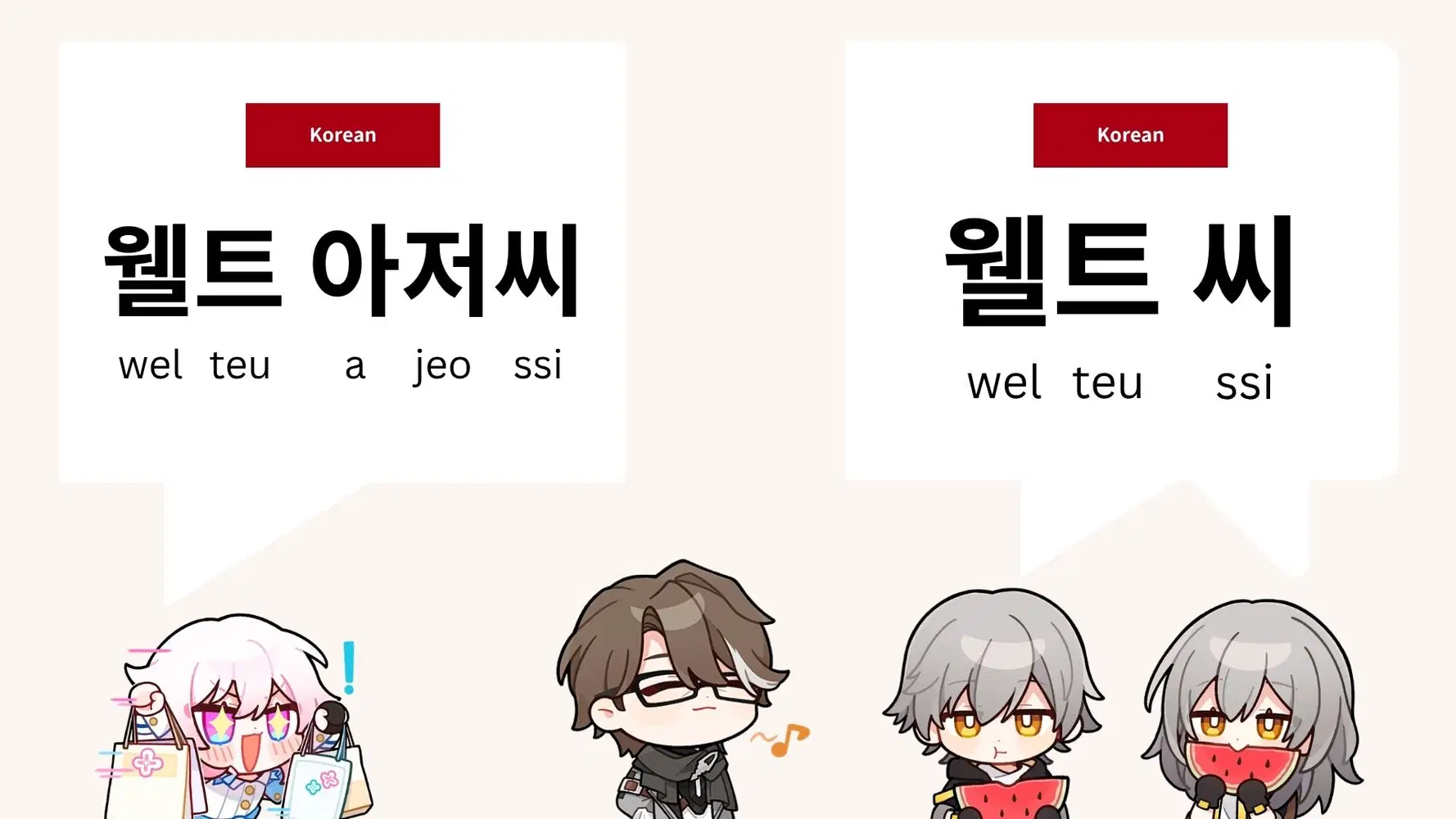
What March calls Welt in Korean: 웰트 아저씨, What Trailblazer calls Welt in Korean: 웰트 씨
Korean
Both the Korean and Japanese localizations use their respective language equivalent of politely addressing an older man. In Korean, 아저씨 (ajeossi) is used to address middle-aged men within the 40s-60s range. Like Dan Heng, Trailblazer specifically uses 씨 for Welt. This confused me at first, since the Trailblazer should be considered more junior. Typically, 씨 would not be a polite way of addressing someone much older than you or with a higher social status. You would use 님 (nim) instead.
I think a possible explanation lies in Trailblazer's team up dialogue with Welt. In Chinese, Trailblazer almost calls Welt 杨叔 "Uncle Yang", but then backpedals and addresses him as "Mister Welt". In the Korean version, Trailblazer almost calls Welt "ajeossi", before switching to 웰트 씨. All of this reads as the Trailblazer switching from a casual address to something more formal. Perhaps Welt doesn't want Trailblazer to treat him differently because of his age. But I should note that the Chinese, Korean, and Japanese scripts aren't always consistent with how Welt is addressed, as there have been many situations where he's called "uncle", "oji-chan", or "ajeossi" without incident.
Japanese
In Japanese, the equivalent of "uncle" would be おじさん (oji-san). But the localization uses おじちゃん (oji-chan) instead of "oji-san". As discussed before, さん (san) is neutral. ちゃん (chan) on the other hand, is a very cutesy and affectionate honorific. It's commonly used when addressing children, friends, pets, or romantic partners. There are 2 reasons why the Japanese localization goes with the "-chan" honorific:
- おじさん (oji-san) has evolved into a derogatory term in colloquial Japanese. Nowadays, "oji-san" could refer to a sleazy, middle-aged man who makes inappropriate sex jokes about his female colleagues. There is also an added social nuance where, like women, some men don't like being reminded of their age when you call them "uncle".
- Characterization. March is obviously an outgoing girl, and would use a more cutesy address for Welt compared to someone like Dan Heng. Trailblazer is either copying March or simply being playful.
I should note that おじちゃん (oji-chan) should not be mistaken for おじいちゃん (ojī-chan). I have seen a lot of English-speaking players who use the Japanese dub and mistakenly think March is calling Welt "ojī-chan". おじちゃん (oji-chan) means "uncle", but is stated in an affectionate way. おじいちゃん (ojī-chan) is what children call their grandpa, or to address any man in their 60s and above. The difference is the added hiragana い (i), which おじちゃん (oji-chan) doesn't have. So in the word for grandfather, the "jī" is in a higher pitch, producing a longer /i/ sound. The Japanese word for uncle has a much shorter /i/ sound.
What Dan Heng and many others call Himeko
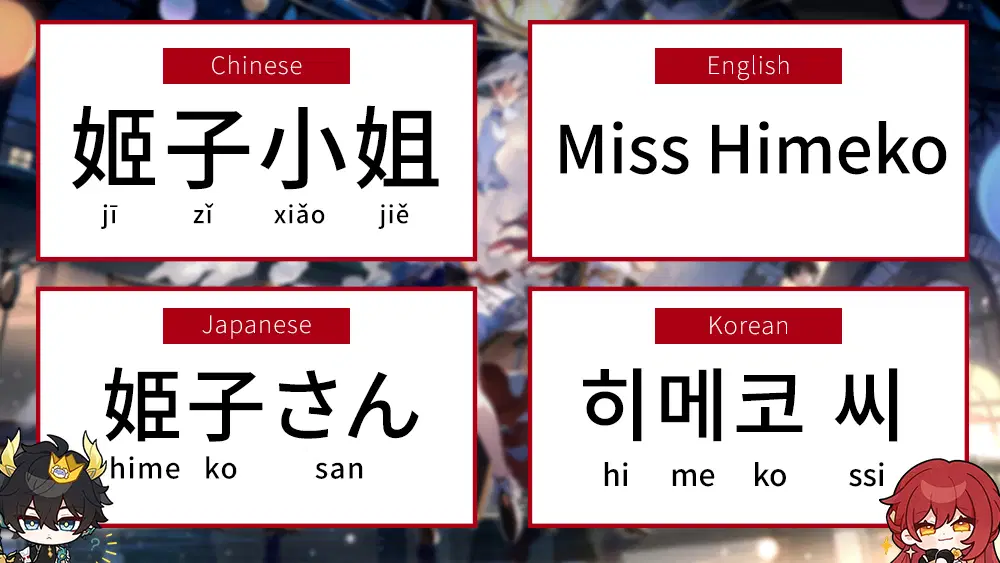
Chinese: 姬子小姐, English: Miss Himeko, Japanese: 姫子さん, Korean: 히메코 씨
We've talked about 先生, now let's talk about its female equivalent: 小姐 (xiǎo jiě). As you might guess, it's Chinese for "Miss" and the default term to address a female stranger. Like with Welt, Dan Heng addresses Himeko formally across all languages.
What March and Evernight call Himeko
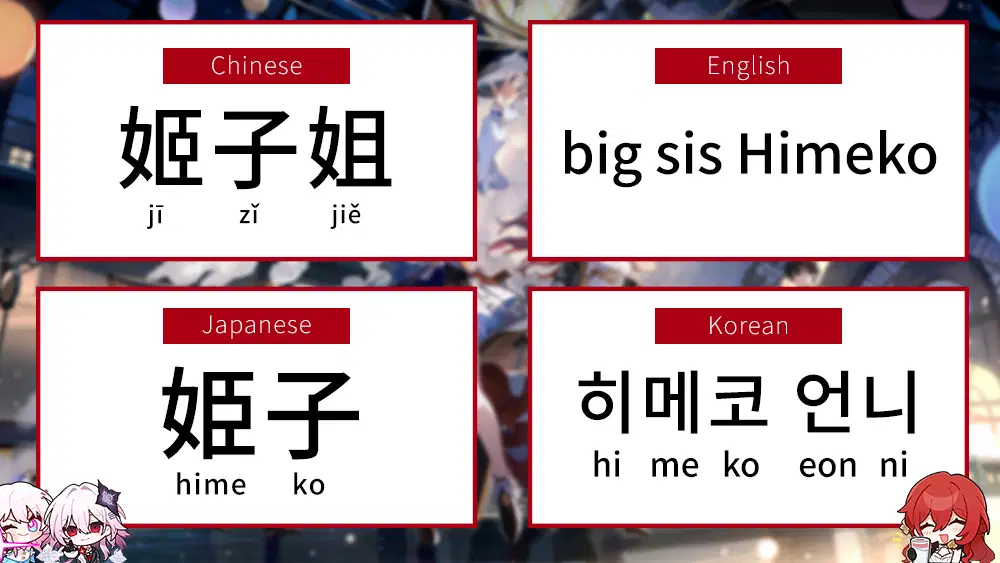
Chinese: 姬子姐, English: big sis Himeko, Japanese: 姬子, Korean: 히메코 언니
Chinese
We've talked about how "uncle" is used in Chinese. But what about "sister"? 姐姐 (jiě jiě) specifically translates to "older sister". Outside of blood and familial relations, 姐 (jiě) is a polite way to address any middle-aged women or a woman who is only slightly older than you. Like how "uncle" is used, the point of calling someone "sister" is to foster kinship and demonstrate respect. When applied to a much older woman, like an elderly lady, it becomes an overtly flattering term of address. It wouldn't be wrong to refer an older woman who you don't know as 阿姨 (ā yí), "auntie", but most women don't like being reminded of their age, so you run the risk of offending them.
English, Korean
The English localization chooses the direct, familial translation of "big sis". The Korean localization uses their equivalent of 姐姐. Korean has 2 different words for "sister", 누나 (noona) and 언니 (eonni or more commonly known as "unnie"). 누나 is used by men and 언니 is used by women. Both of these terms can be used interchangeably to refer to your relatives, friends, or romantic partners. These honorifics are very casual though, and wouldn't be appropriate in formal contexts. Both Korean and Chinese women use sisterhood as a way to describe a strong bond they feel with another woman, which is what March is doing here.
Japanese
The Japanese localization doesn't do a direct translation of this honorific at all. I think there is a reasonable explanation though. In Chinese, Black Swan refers to herself as the Trailblazer's dependable 姐姐. In Japanese, they translate it as お姉さん (onee-san). The Japanese localizers don't use it for Himeko because it sounds too formal for this context. Outside of family, "onee-san" is the default, polite way of addressing an older woman. March speaks very casually in Chinese and her attitude towards Himeko in all languages is no different.
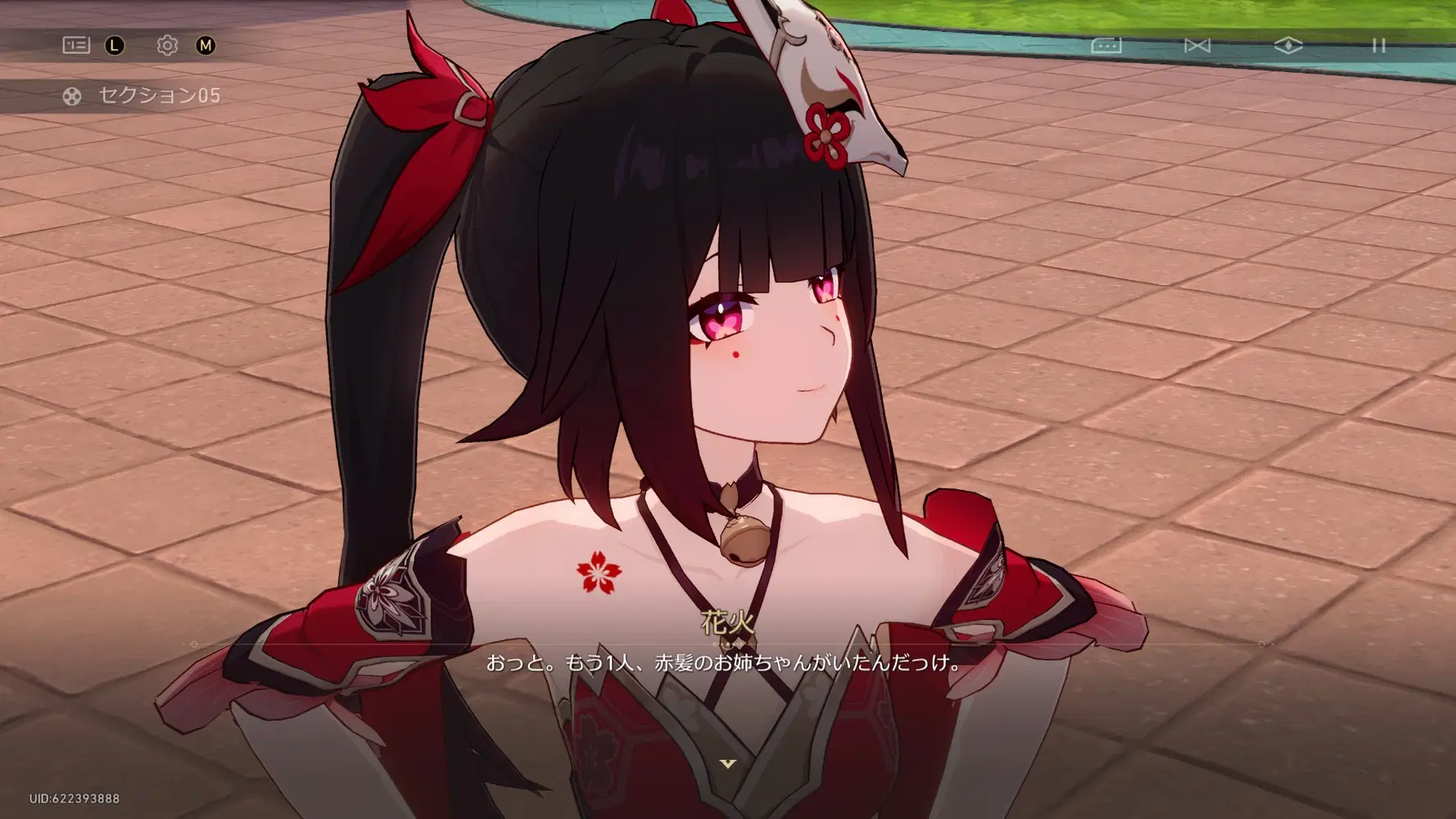
Rough English translation: "Oh! There's another person here: the red-haired big sister."
There's another Japanese term for big sister, お姉ちゃん (onee-chan), which Sparkle uses to refer to Himeko. The reason why this doesn't work for Himeko and March either is because "onee-chan" is almost too childish. Sparkle is also being overtly flattering on purpose, as calling a woman "onee-chan" is like the equivalent of calling her "honey" in English. So the Japanese localization goes with the approach of March addressing Himeko by first name, no honorifics.
What Sunday and Black Swan call March
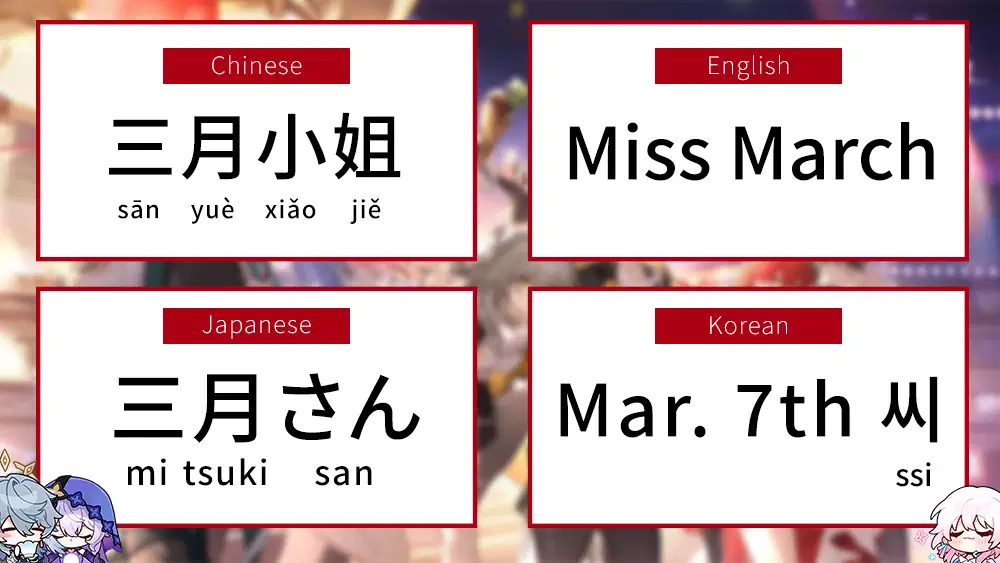
Chinese: 三月小姐, English: Miss March, Japanese: 三月さん, Korean: Mar. 7th 씨
Both Sunday and Black Swan talk very politely across all languages. To explain the Japanese localization, March 7th's name is very different than how you would normally write out the month and date: 三月なのか (mitsuki nanoka). The kanji 三月 can be read as "Mitsuki", and is a more commonly used as a name than the actual JP word for the month March "sangatsu".
What Welt calls March
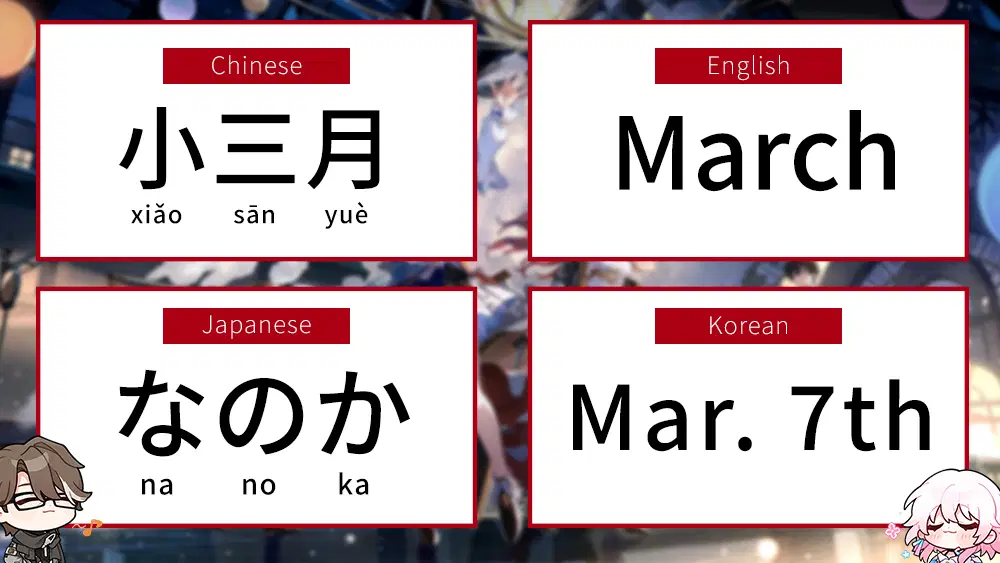
Chinese: 小三月, English: March, Japanese: なのか, Korean: Mar. 7th
We've talked about 老, which is used to address people more senior than you. For someone who's your junior, you would add 小 (xiǎo) to the person's name. But the prefix doesn't just encompass age and social status, as it can be used to address someone who's literally smaller than you. 小 is also a greater indicator of endearment and affection, while 老 has a more respectful nuance. This is why you hear Sushang call Guinaifen "lil Gui", even though they're implied to be in the same age group. Since there's no real equivalent in their respective languages, the English and Korean localizations just go with March's name. Interestingly, Welt addresses March as "Nanoka" instead of "Mitsuki" in Japanese, taking the latter half of her full name.
What Himeko calls March
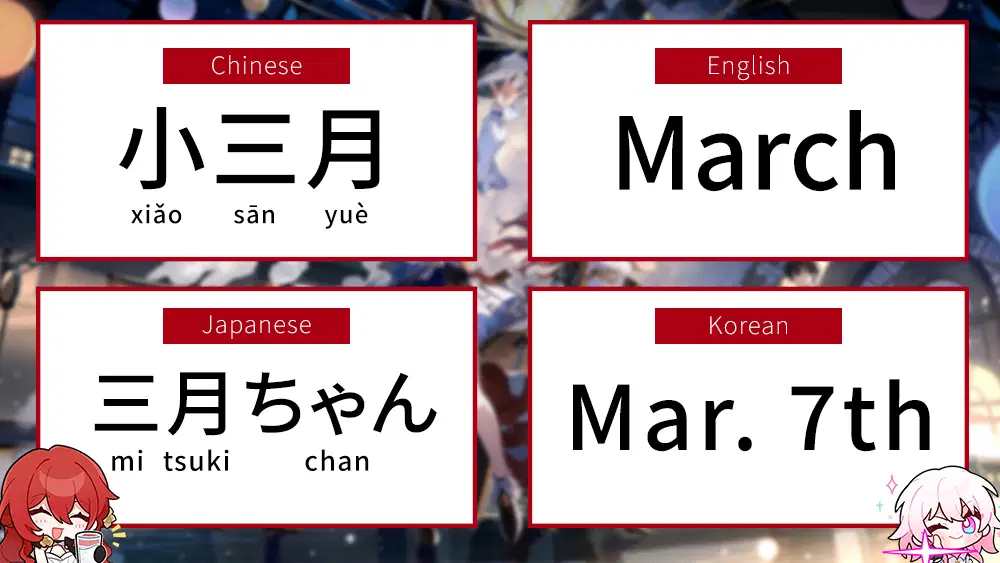
Chinese: 小三月, English: March, Japanese: 三月ちゃん, Korean: Mar. 7th
Like Welt, Himeko addresses March as her junior. For women exclusively, 小 as a prefix acts like a cute nickname. The Japanese equivalent of 小 is the "-chan" honorific.
What Black Swan calls Trailblazer
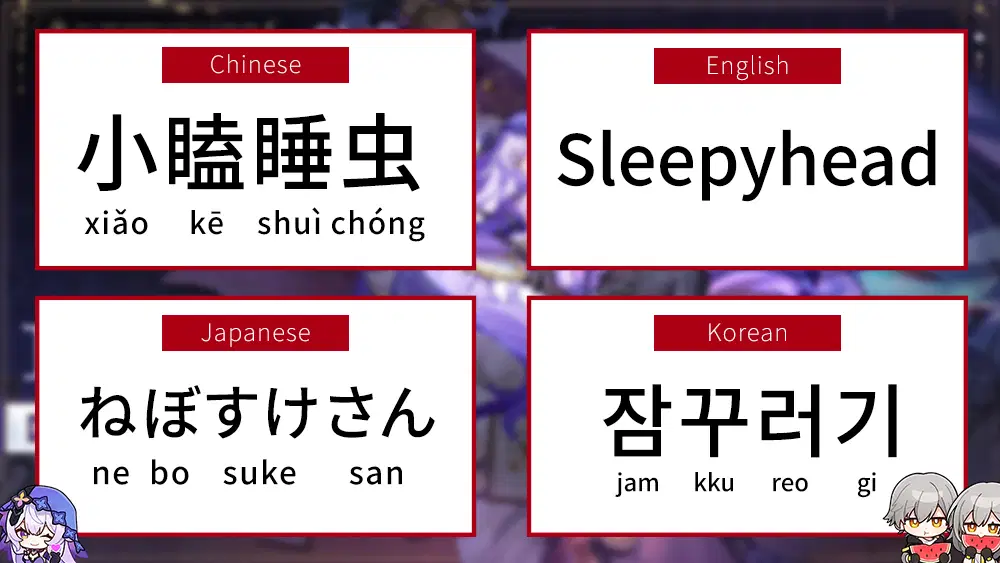
Chinese: 小瞌睡虫, English: Sleepyhead, Japanese: ねぼすけさん, Korean: 잠꾸러기
What Black Swan calls Trailblazer has the same meaning across all languages. Like how Himeko and Welt address March in Chinese, Black Swan adds 小 to 瞌睡虫 (kē shuì chóng), literally translating to "little sleepyhead". However in Japanese, she uses a more neutral honorific, "-san". Edit: While this could be interpreted as Black Swan being polite, using さん helps give her a more sophisticated and mature vibe as opposed to "-chan".
Trailblazer's other diminutive nicknames
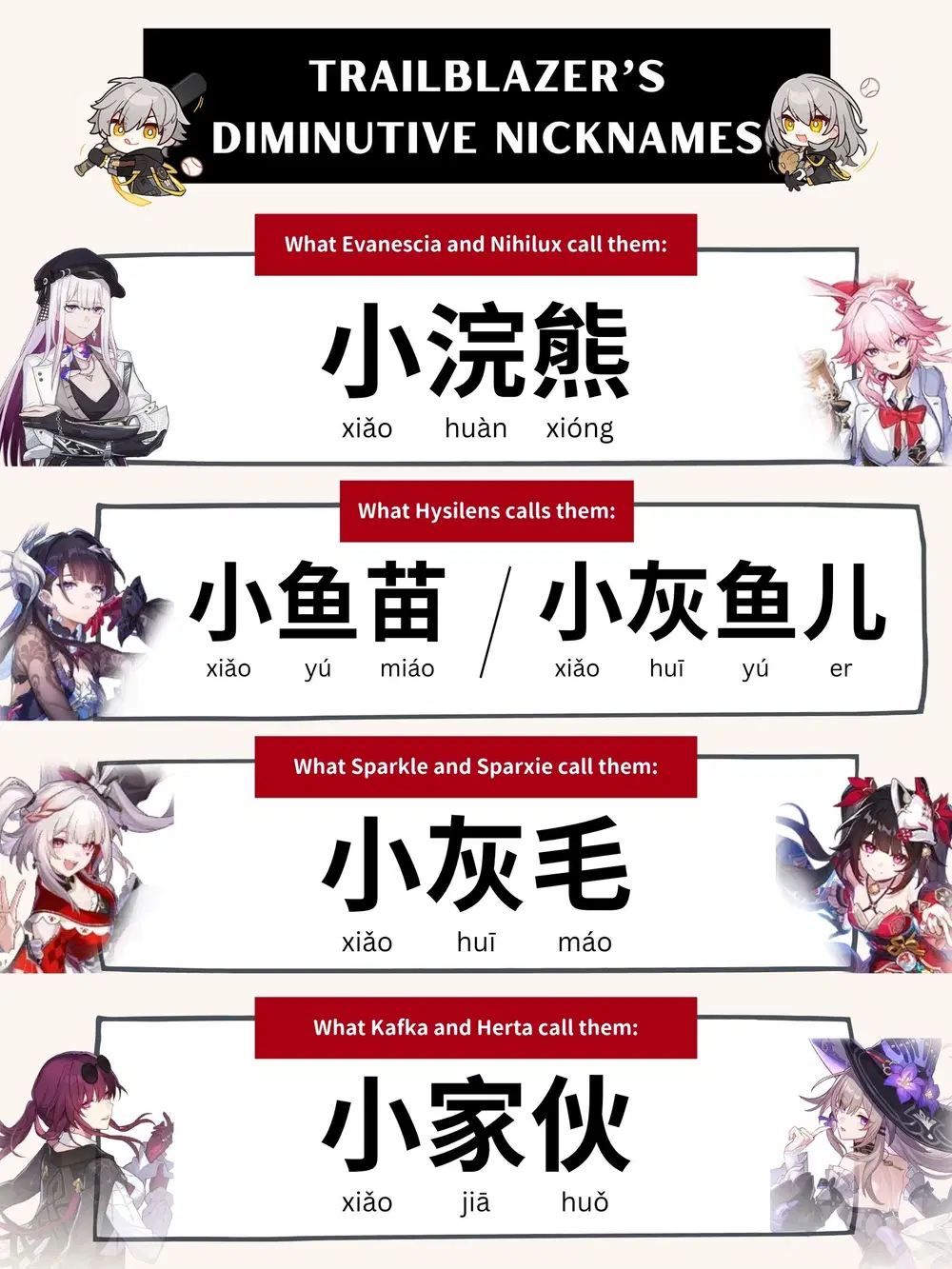
I might do a separate post on all of Hysilens' fish nicknames.
It's worth pointing out that a lot of female characters address Trailblazer with some variation of "little" in the Chinese script. Evanescia and Nihilux call them 小浣熊 (xiǎo huànxióng), "little raccoon". While the English localization translated Sparkle's and Sparxie's nickname for Trailblazer into "Gray Hair", they actually also use the "little" prefix: 小灰毛 (xiǎo huī máo). They do this because it's more socially acceptable for women to give diminutive nicknames in Chinese, as opposed to men. Nicknames are also a common trope in video game writing, as it's incredibly hard to emulate onscreen chemistry through voice acting alone. Because the 小 prefix implies a casual relationship, Black Swan's nickname for Trailblazer naturally establishes some intimacy without much set up.
Technically what Kafka and Herta call Trailblazer in Chinese isn't a distinctive nickname but a general diminutive term. I'm not explaining the exact meaning because I don't trust that people can be normal when it comes to age discourse. But the reason why I'm including it here is because I think it's a purposeful contrast to what Himeko calls Trailblazer, since 小家伙 (xiǎo jiā huǒ) is a bit more emotionally distant.
What Himeko calls Trailblazer
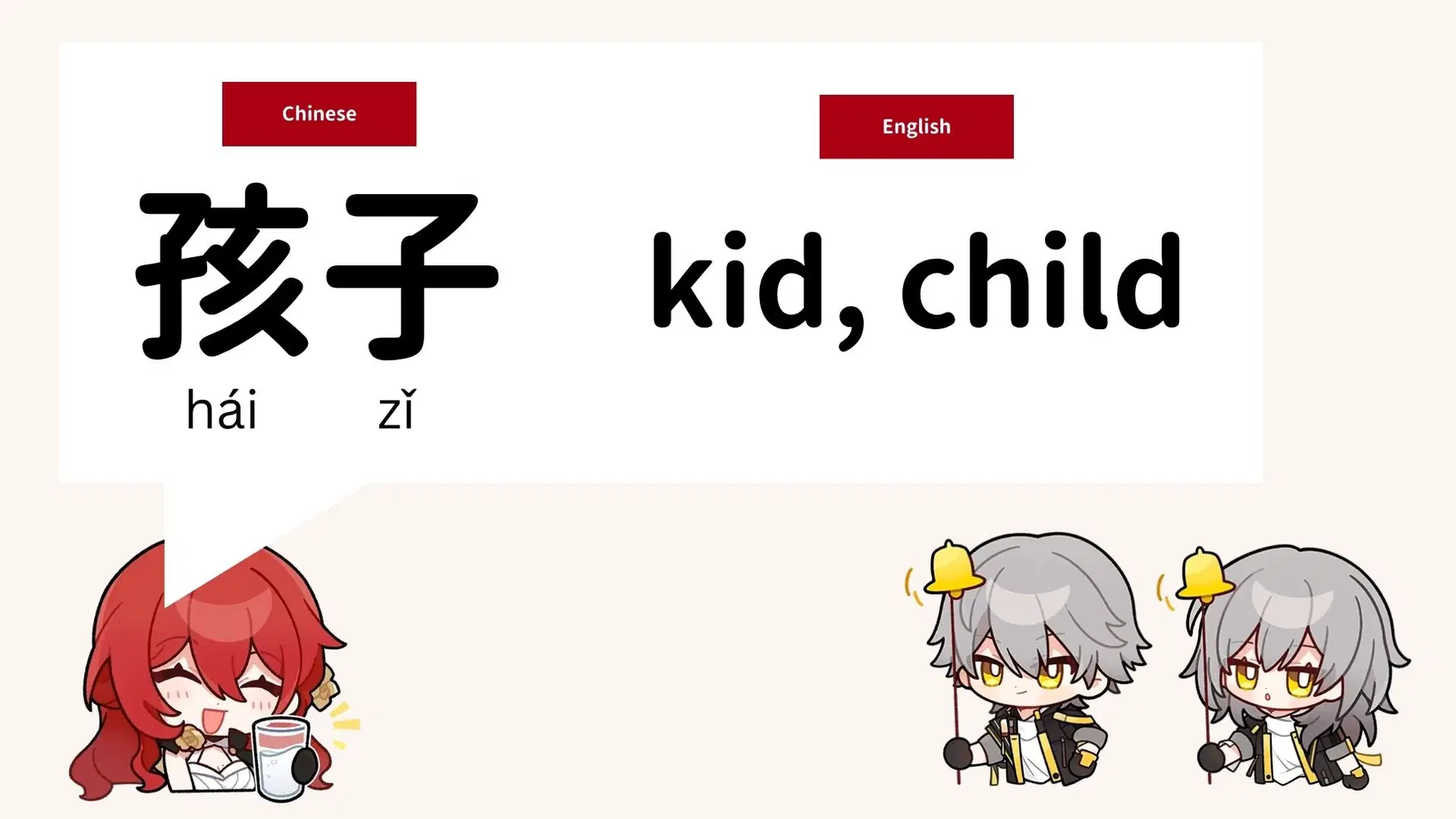
Chinese: 孩子, English: kid or child
Chinese
孩子 (hái zǐ) is a common way of addressing children, regardless of relation. When referring to the Astral Express trio collectively, Himeko calls them 孩子们 (hái zǐ mén), "kids". In Chinese, the 们 particle is used to turn a word plural, but only for pronouns and human nouns. I know she calls Sunday "kid" in the 3.6 livestream, but because it only happened in the English dub, I'm not considering it canon until I hear it in the game proper. I do recognize that she extends the same protectiveness to him though.
Japanese
The Japanese and Korean localizations doesn't translate this at all. The "moooom!" dialogue choice is still translated the same way as the English localization. But Himeko doesn't address Trailblazer as "child" in that scene or others. In Japanese, there is a word for "child", 子ども (kodomo). But unless you're referring to a group of children, it would not make sense to call someone this to their face. In Japanese, children are usually addressed by their first name, followed by the appropriate gender honorific.
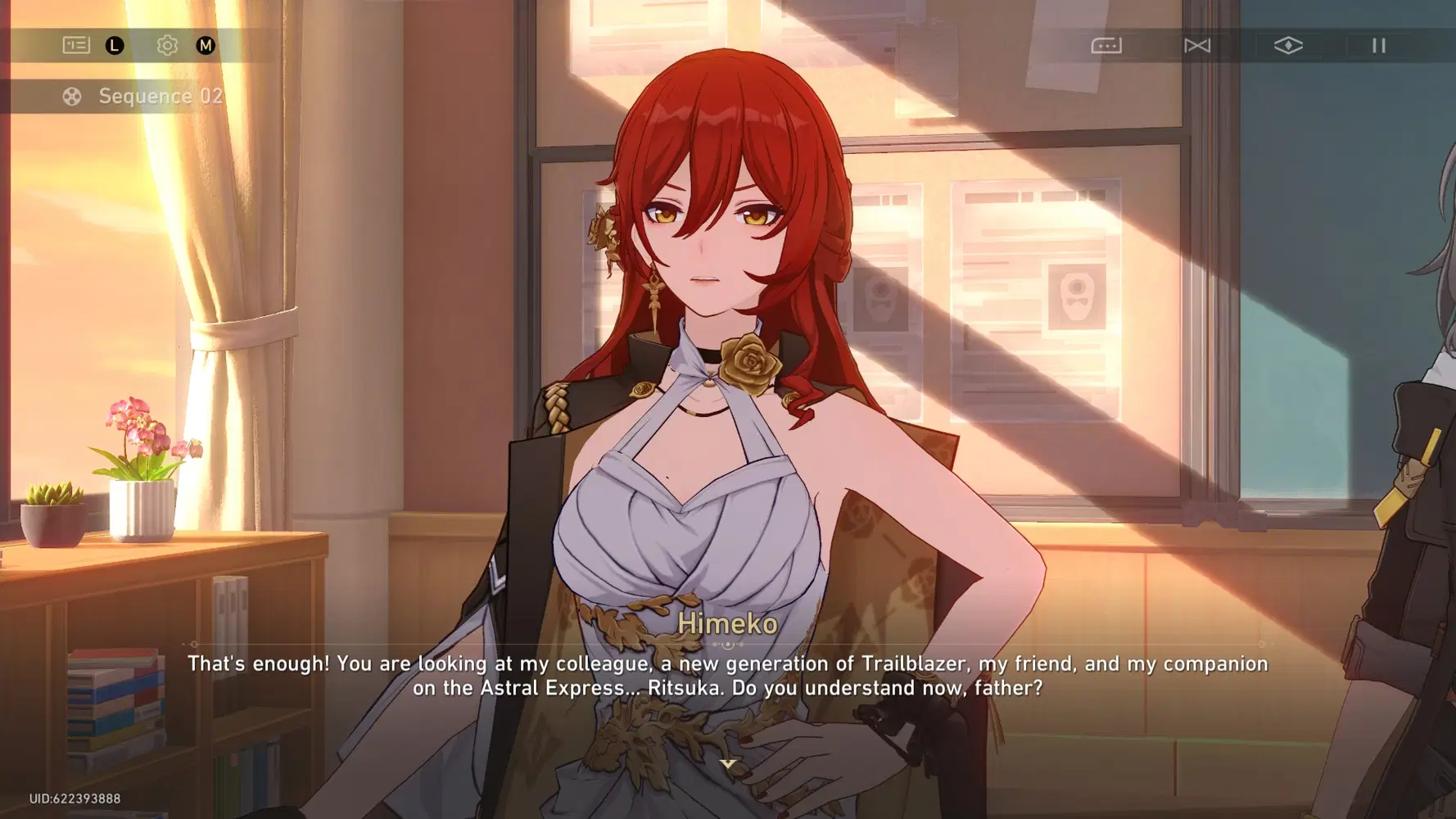
Sorry, I go on a tangent because I dislike people used this scene for virtue signaling.
Another reason could be characterization, which is supported by what Himeko tells Ryusuke. Himeko sees the Astral Express juniors as the next generation of Nameless, and feels personally responsible for giving them proper guidance. However I don't think Himeko is opposed to the maternal projection, considering that she doesn't refute Trailblazer seriously addressing her as "Mom" in the 4.1 story. It's more that she doesn't want Trailblazer calling her deadbeat dad "grandpa". There is a difference between being mistaken for someone's biological mom and being seen as a "mother figure".
Anyway, now I understand why a lot of Japanese fans think Himeko comes across more as the overcompotent "big sister" character you find in otome games than a "mom". Because even inofficial JP press interviews, she is described as an お姉さん (onee-san). It's important to note that they may be doing this because referring to Himeko as a "mom" makes her sound really old. There is a lot of social stigma in East Asian societies around being a single middle-aged woman, and it unfortunately doesn't get any better even if you're a single mom. Although I wish both the Japanese and Korean localizations were able to find some work around, because they had no problem translating Kafka's and Herta's term of address for Trailblazer.
Bonus: explaining the "mom" joke
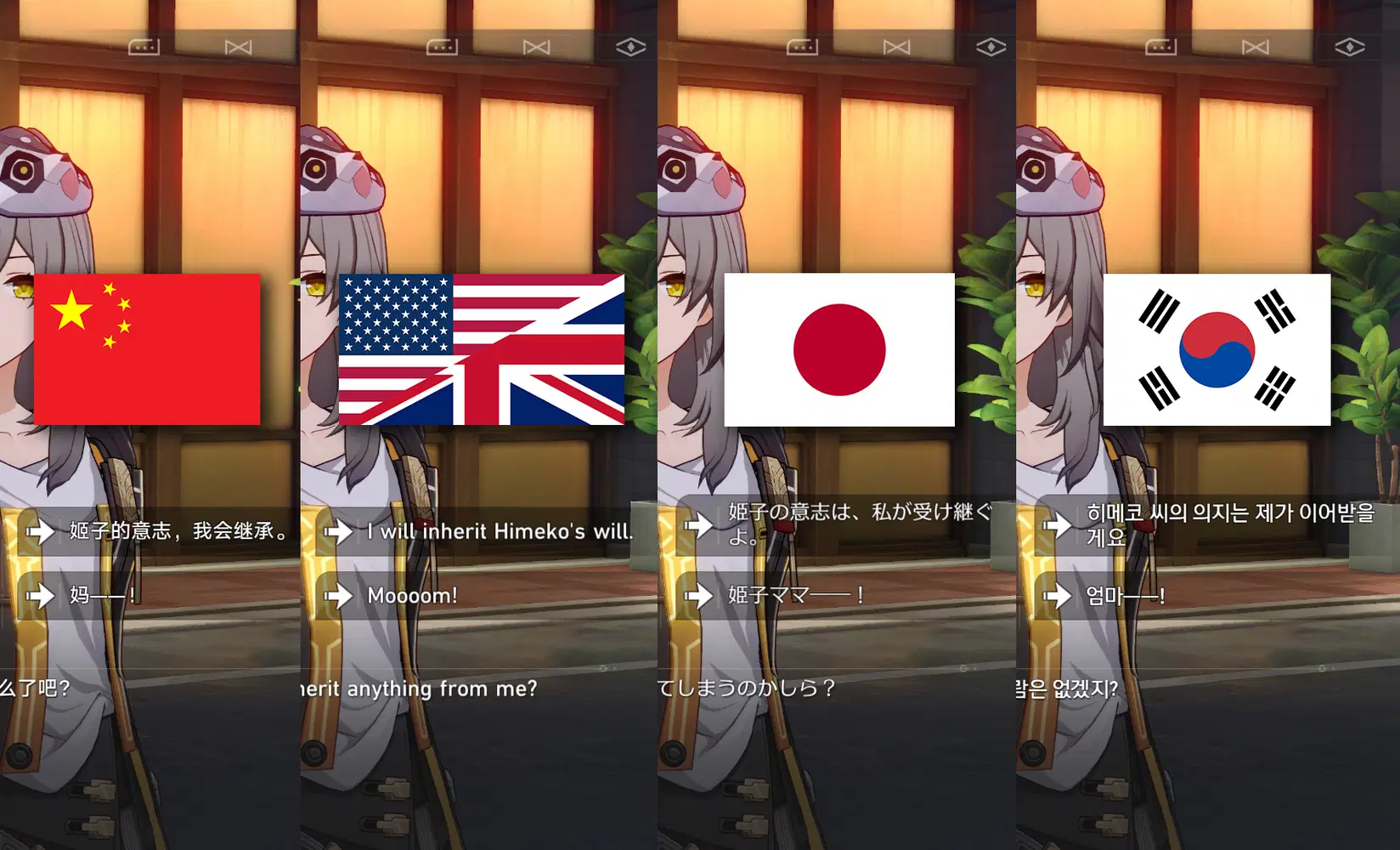
Chinese: 妈!, English: Moooom!, Japanese: 姫子ママ!, Korean: 엄마!
In Chinese, Trailblazer specifically uses the hanzi 妈 (mā) when, jokingly or not, addressing Himeko as "mom". This is a casual way of calling your mother, so the Korean localization uses the more informal 엄마 (eomma). The Japanese localization notably interprets that Trailblazer is acting childish when talking to Himeko in this way, so they translate it to ママ, "mama". Trailblazer addressing Himeko informally does align with her stated wish in her 3rd anniversary letter: for them to maintain their childlike wonder.
I will say that this exercise did gave me a bigger appreciation for the Astral Express family's dynamics. Yes, Himeko and Welt are the seniors of the Express, but their attitudes towards their juniors isn't very hierarchical. Like the Stellaron Hunters, there is no social expectation around properly addressing seniority between the Astral Express crew members.
I hope this post was educational!