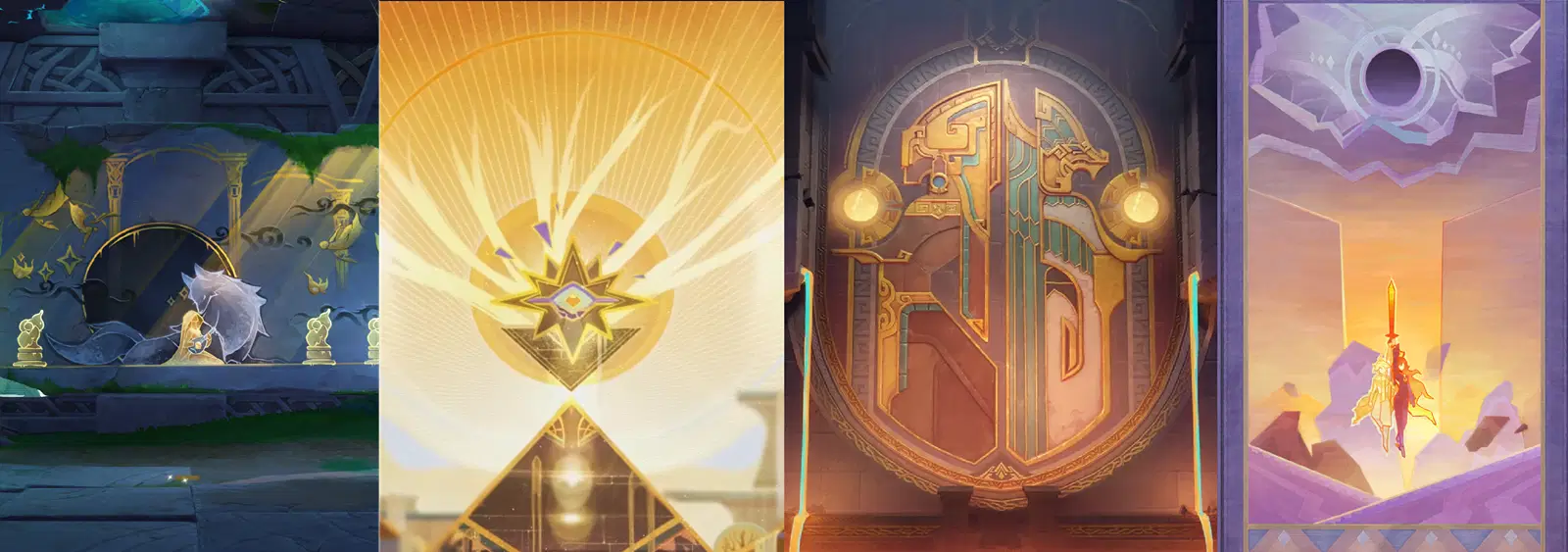
I have a revolutionary idea… If Teyvat was round, that would explain a lot of things
— Farghani, The Sumeru Akademiya
This article presents my current hard sci-fi reconstruction of Teyvat, refined over several months. It traces Teyvat’s history back to its physical engine: a chain of causes and consequences governed wherever possible by celestial mechanics and established physics
No prior reading is required
No complex math—just pure logic
No leaks: Entirely based on official lore
Links to the complete archive are provided at the end for anyone interested in exploring individual topics in greater depth
Roadmap:
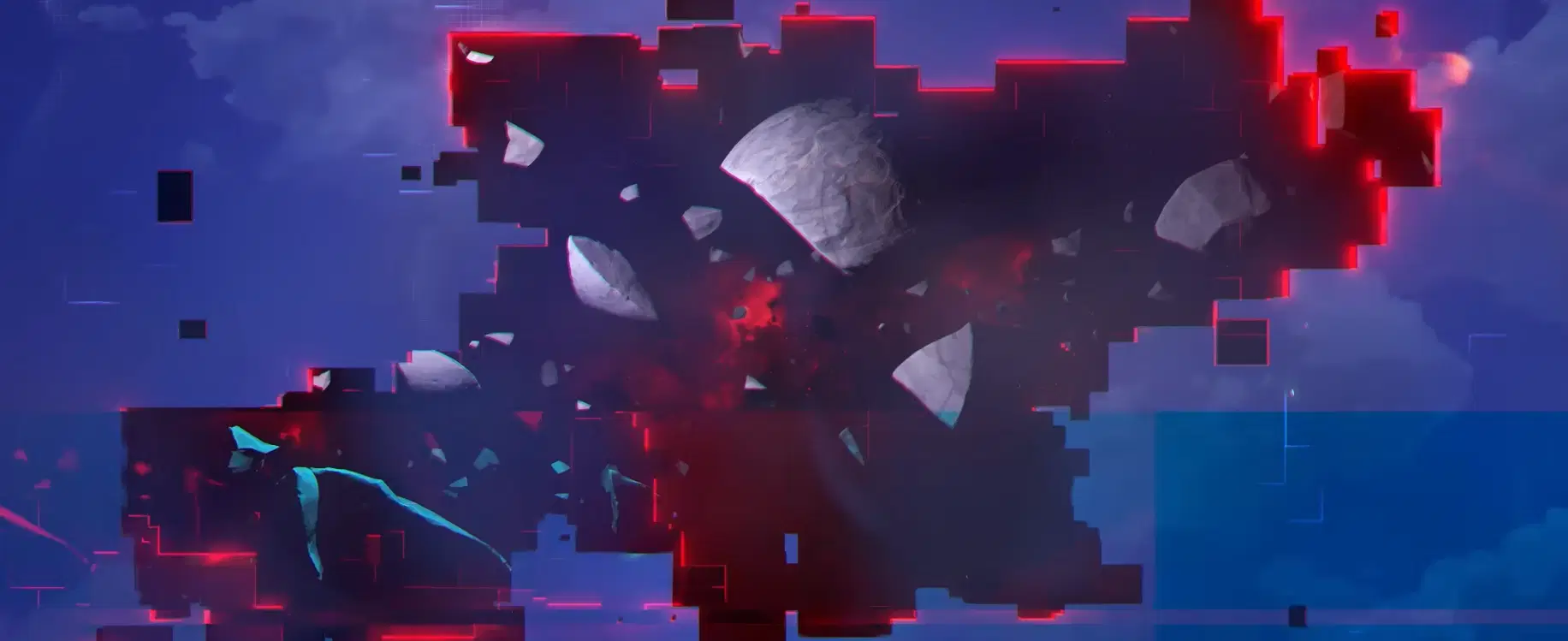
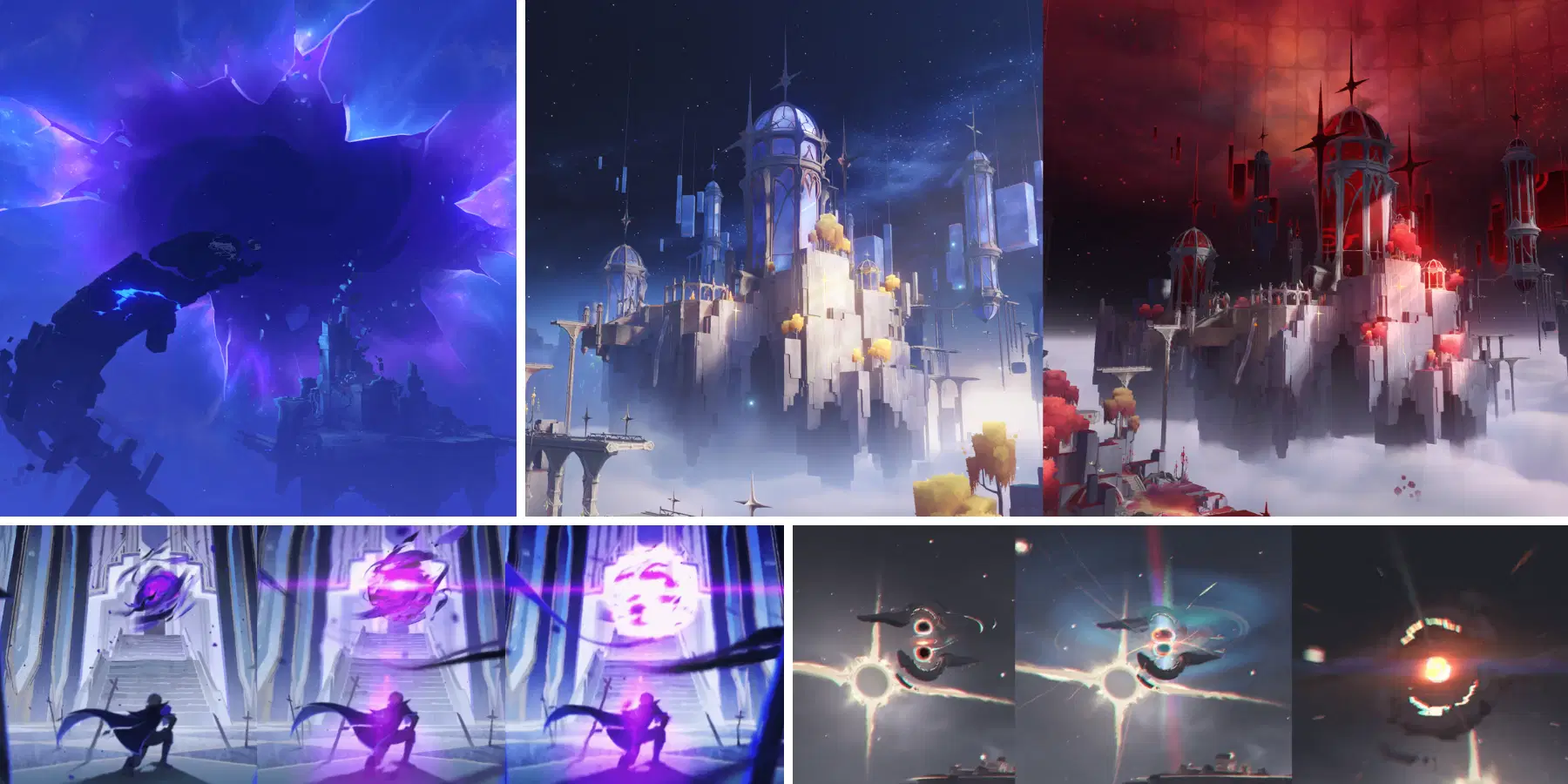
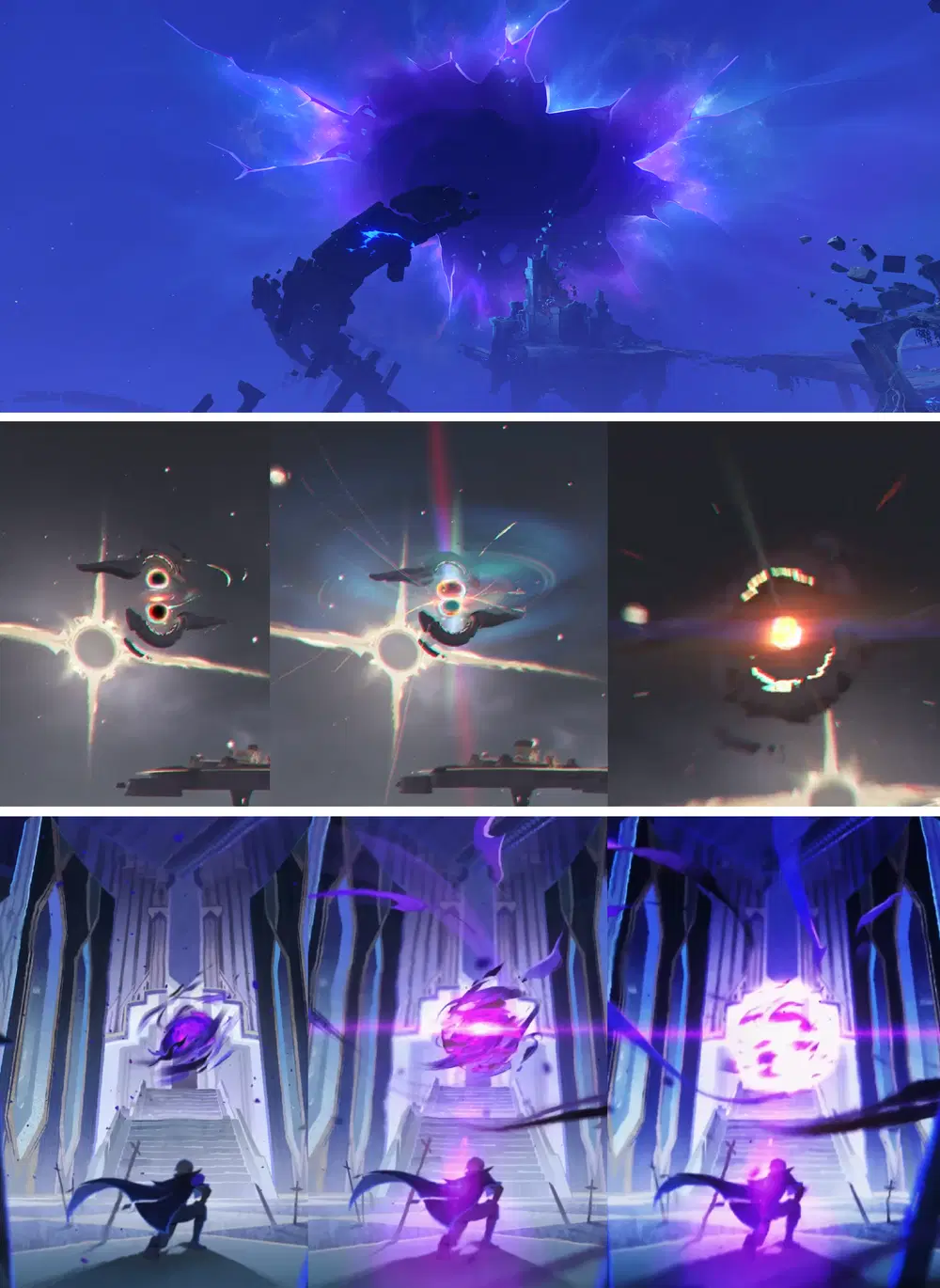
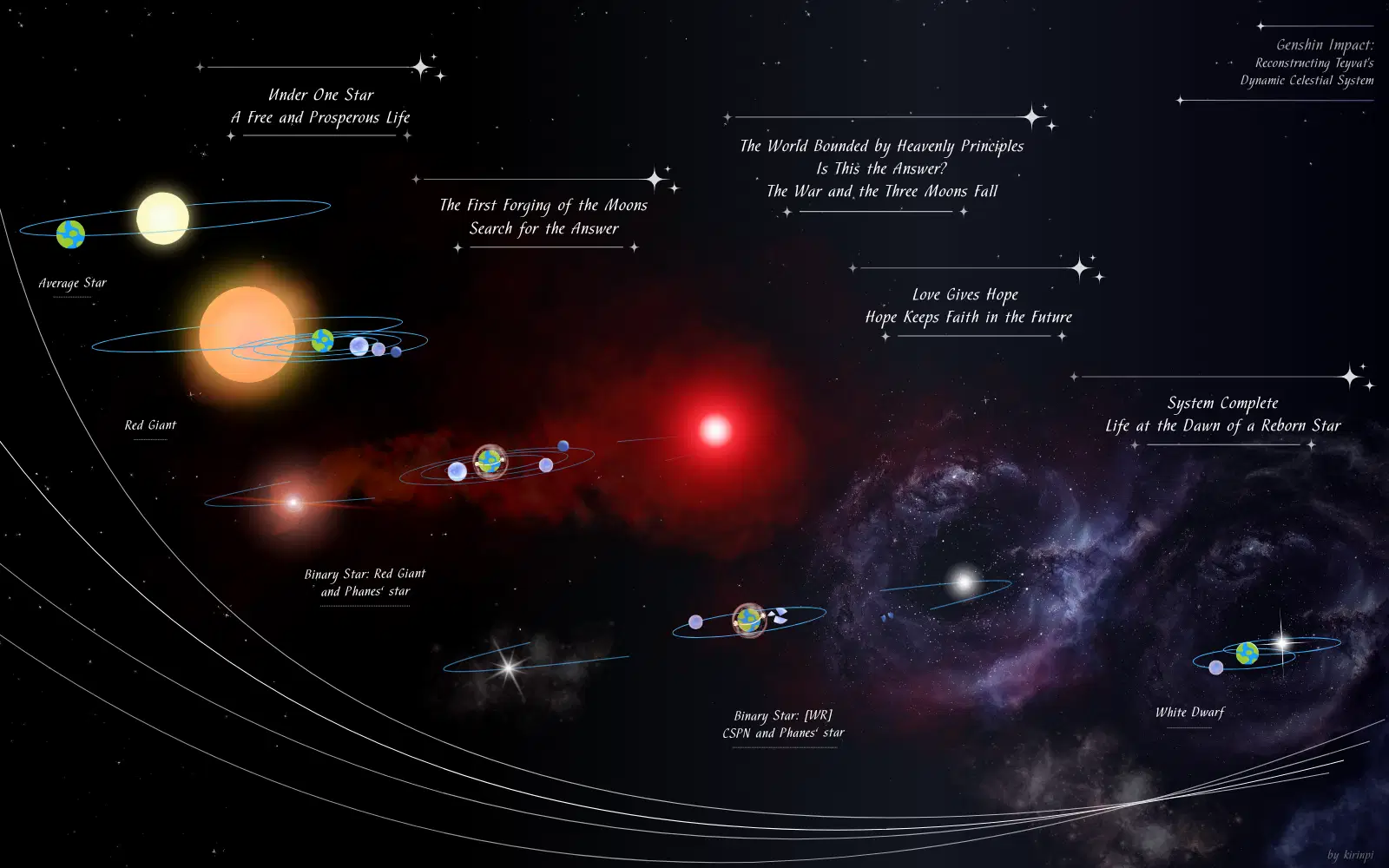
A visual roadmap through space-time, following the evolution of Teyvat’s celestial system
1. Foretelling the Death of the Universe
For all in the universe comes from a single source, and all things may be derived from a single thought
— Cinnabar Spindle
In 14 billion "years" of darkness,
It is the sum of all that is destined to happen and all that never will
[…]
In the darkness of 93 billion "years" of light,
All existence holds meaning unknown to any,
Without which this universe would seem too solitary
— Lunar Arcanum X: The Wheel of Fortune
Fourteen billion years is the age of the Universe, throughout which the life cycle of stars has repeated over and over. As they die, they disperse stellar dust across the cosmos—the building blocks of life itself and of new generations of stars. Yet the usable energy sustaining this cosmic inheritance is finite, and entropy gradually claims the void:
Despite their knowledge that the darkness which erases existence itself was an inevitable end beyond all return
[…]
That is, until the fate of the cosmos was severed thread by thread, and giants and dwarfs alike met the same end
— Celestial Gift
The collapse of civilizations, the fading of stars without the formation of new ones... This compelled the surviving civilisations to mathematically calculate the trajectory along which the fate of their Universe was following:
As starlight wheeled on and the beacons upon the star charts went dark one by one, they at last extended their probes to the very end of time.
There, all light had vanished, and all possibility was spent. Even the finest motes of dust had drifted apart.
There was no turning point, no miracle to be found. At the very end of fate, all that remained was a void of utter chaos and darkness.
Every equation they had uncovered, every constant they had defined, now stood in silent proclamation of their end.
It was in that moment that their history came to a close
— Celestial Gift
At the end of this trajectory lies not a single catastrophe, but the gradual exhaustion of every remaining source of usable energy. Even white dwarfs, whose residual glow can endure for trillions of years, must eventually cool into darkness, until the cosmos can no longer sustain meaningful structure or change. For this very reason, the fading civilisations charted a course toward preserving every precious world that still carried light—toward saving life itself:
In a universe nearing its quiet end, every world that yet glimmers is a treasure beyond compare…
— Athame Artis
After all, any habitable planet is directly dependent on the life cycle of its parent star:
The planet they passed was never a destination, since its star had already entered its twilight.
Its biosphere and atmosphere had been utterly destroyed. The surface held nothing but cooled masses of molten rock.
A supernova had caused the devastation
— As Heaven and Earth Are Made Anew
What remains for those who can calculate orbits but stand powerless before the soulless laws of the cosmos? When your own sun is preparing to devour your home, celestial mechanics becomes the sole instrument of salvation. Yet even if there is a way to alter the destiny of an entire planet, at the periphery of every equation fate still foretells the death of the Universe itself
But really, when one is faced with such a final fate, when up against the star-devouring darkness,
What weapon would be fitting for one to wield? It can only be a sword
— Sword of Descension
Why fight for the life of a planet beside a dying ember, knowing that the cosmos itself will one day burn out?

2. In the Vicinity of the Threat to Life
Every star is mortal, and each has only its allotted span of time. Teyvat’s sun is destined to enter the Red Giant stage, where its expanding envelope will consume everything around it, reducing life to ashes in the brilliance of its own star
For a star, this is merely a natural phase of evolution. For life, it is a death sentence
…the sun it gazed upon was but a fleeting ember
— Finale of the Deep Galleries
So deep were those dark mists that even the light of a thousand stars could not escape their gravity
— Aubade of Morningstar and Moon
“Star Odyssey” Animated Short
This dying world and its primordial ruler had been one and the same since the very dawn of time:
It came from an unremarkable little world at the edge of the spiral arm — and from the primeval dragon that had been born alongside that world
— Finale of the Deep Galleries
O great father of genesis, forger of the earth's bones and the tripled moons
— Hymns of the Far North
For Nibelung, his world was the sole purpose of existence, and so he refused to silently accept the inevitability of its destruction:
This will, bound though it was to its planetary crust, shone more brilliantly than all the civilizations the voyager had ever seen…
[...]
"But though in your eyes they may seem ignorant creatures, to me, they are the very meaning of this universe."
"If the tide of oblivion must come, then let my bones be the bulwark that shields this realm."
"Bear witness to the path I have chosen, for I shall lead my people onward to the stars.”
— Finale of the Deep Galleries
His mind became an instrument for delaying the inevitable—buying precious time for a fading biosphere, even if rewriting the laws of stellar evolution remained far beyond his power
2.1 The Origin and Functions of the Three Moons
To stabilize the changing world under these new conditions, Nibelung constructed an external planetary infrastructure from Teyvat’s own flesh
In the beginning, no moons adorned the sky. It was the Dragon King Nibelung who raised the three moons into the heavens, and thus were the Moon Goddesses born
— Song of the Welkin Moon Act VIII
Legend has it that long, long ago, the moon that shines in the sky above us once rose from the land of Nod-Krai. Modern geological surveys & meteorite studies conducted in the region have since supported this claim
— Song of the Welkin Moon Act I
The moons maintained the fragile equilibrium of Teyvat through three key functions:
- Rotational Stabilization. The moons maintained the dynamic stability of Teyvat's rotation, regulating:
- Its rotational speed;
- Axial tilt;
- Precession;
- The stability of its spatial orientation
The reaver from beyond the skies replaced the primordial creator, and gained possession of the vows upon which the three caused the world to turn
— Fractured Halo
- Tidal Dynamics. The moons governed tidal processes, sustaining a continuous exchange of energy and matter between the ocean, atmosphere, and planetary crust:
- Smoothing out temperature contrasts;
- Redistributing heat within the climate system;
- Supporting its dynamic equilibrium
…the now-nameless ruler raised the heavenly moons to govern the cyclical tides of the world in their stead
— "Song of the Welkin Moon" — Nod-Krai Concept Overview/Story
He raised three bright moons from the ground and bound this tiny world tightly with the chains of the tides
— Aubade of Morningstar and Moon
- Peak Tidal Interaction. Periodically, the satellites aligned in a straight line relative to the planet, entering a state of syzygy:
- The tidal forces of the three moons combined;
- Gravitational pull reached its maximum;
- The system shifted into a state of peak tidal resonance
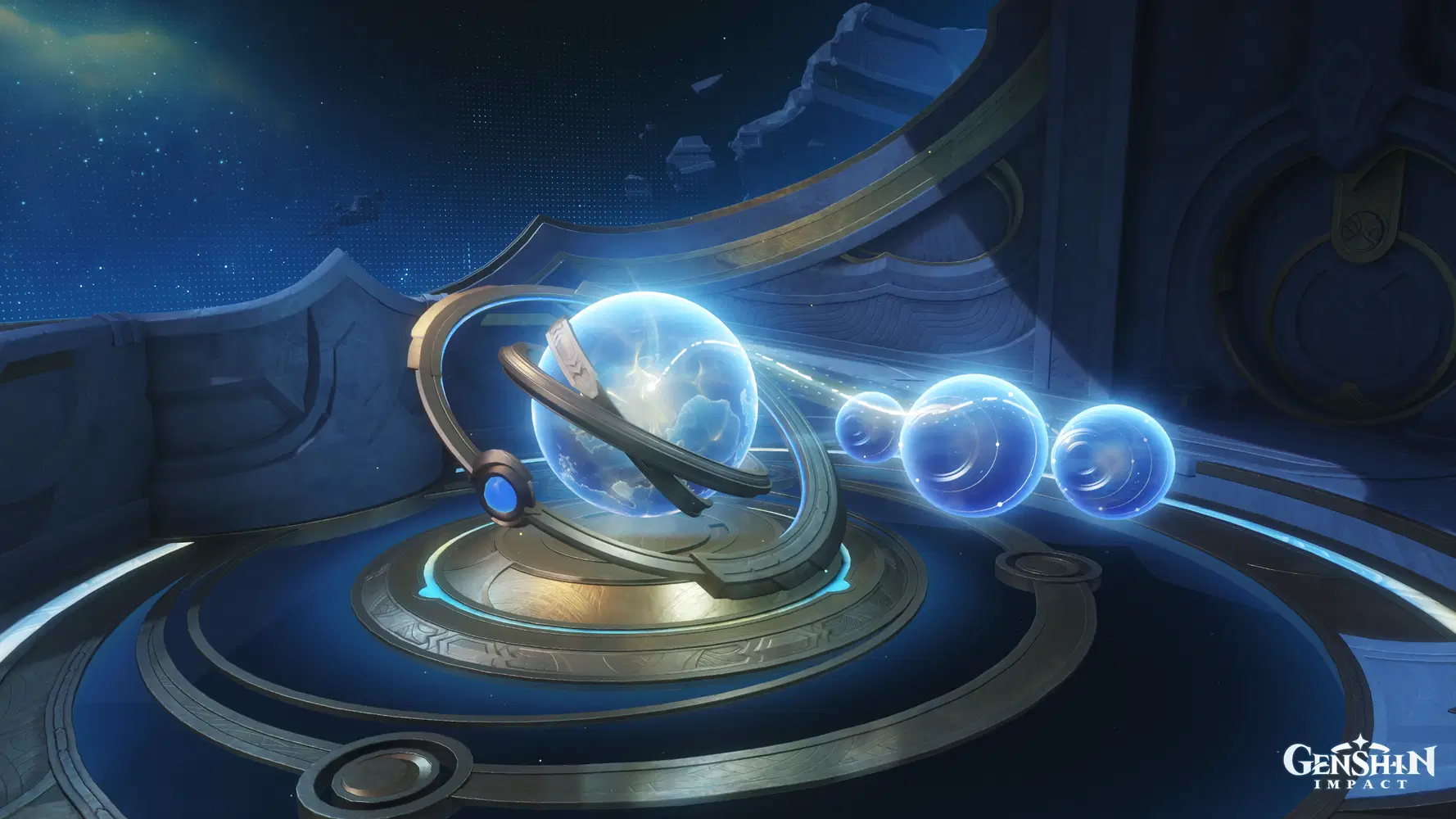
This engineered system supported Teyvat’s autonomous existence—only then could Nibelung depart from the world to seek a way to save it:
To find the answer before this planet was also consumed, the great dragon embarked upon an arduous quest alone
— Aubade of Morningstar and Moon
His goal lay in the far reaches of the Universe, hidden beyond the boundaries of his home system:
…the primeval dragon nurtured by the perfumed sea sailed deep into the skies, disappearing into the mists among the stars
— Aubade of Morningstar and Moon
…he left this world and traveled into the dark universe beyond, to explore worlds vaster still
— Song of the Welkin Moon: Act VIII
3. The Arrival of the First Descender
The dragons could masterfully manipulate the celestial mechanics of their home, yet saving a dying world called for external intervention:
Perhaps their former lord, shrouded in mist, would never find the answer. Or perhaps that answer was already at hand
— Aubade of Morningstar and Moon
One day from the depths of the cosmos came an architect of an entirely different cosmic order:
Until the day that the winged Descender arrived, treading upon the morning star...
— Aubade of Morningstar and Moon
The capabilities of interstellar architects allowed them to reshape the very world itself:
The fine details of the lithosphere, atmosphere, or biosphere ultimately mattered little.
Reshaping terrain, adjusting the air, rebuilding an ecosystem, these were simple tasks for a pioneer vessel meant to bear the spark of civilization.
A star's position, its distance, or its lifespan might pose a minor challenge, yet even those had solutions
— As Heaven and Earth Are Made Anew
Yet, such cosmic engineering couldn’t save every world; its power was limited only to those inherently suited for survival:
The true difficulty lay in finding a world with potential. Without that, destruction would catch up all too soon
— As Heaven and Earth Are Made Anew
The arrival of the First Descender marked the beginning of a monumental project to reconstruct Teyvat, where the former cosmic order had to yield to the new for the sake of humanity's survival:
But whether by submission or rebellion, by battle or by death, the Lord of Hosts would mercilessly crush all that stood in its way.
For this was the new world it had chosen for the children of humankind, and according to its design, both earth and sky would be reborn
— Aubade of Morningstar and Moon
3.1 Phanes: Not a God, but an Architect
The book Before Sun and Moon contains a basic contradiction to classic creation myths:
But for the world to be created, the egg's shell had to be broken. However, Phanes, the Primordial One, used the eggshell to separate the "universe" and the "microcosm of the world”
但是世界如果要被创造,蛋壳必须被打破。
法涅斯——原初的那一位——却用蛋壳隔绝了「宇宙」和「世界的缩影」。
In Chinese, Phanes doesn't "create" but isolates. Rather than breaking the shell to bring the world into being, he uses it to "cut off" (隔绝) the "microcosm of the world" (世界的缩影) from the "universe" (宇宙). In cosmological and philosophical terms, he is the ultimate Demiurge: an architect who doesn't create matter ex nihilo like the Creator God (创造神) praised in the ancient Hymns of the Far North, but reshapes what already exists and locks it within a protective eggshell as the Primordial Lord (原初之主). Teyvat was therefore isolated not by a magical barrier, but by a technical one
The Ark was moored, the matter of creation complete.
[...]
…The Lord of the World within the eggshell drew a false veil to shut out the true, bedeviled skies
— Aubade of Morningstar and Moon
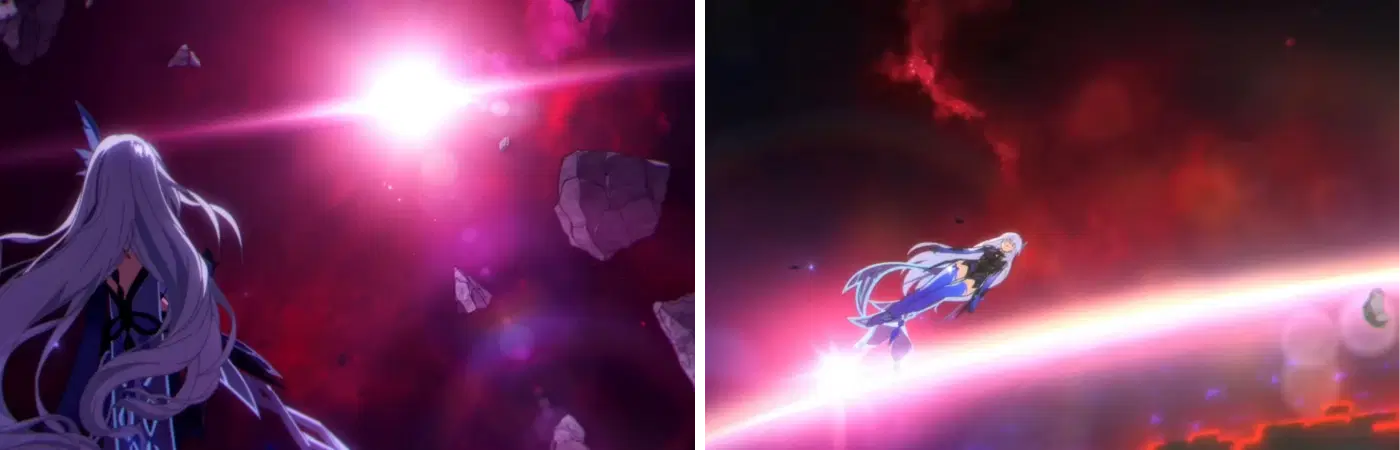
“Star Odyssey” Animated Short
4. Life Bound Between Two Stars
It was not the great enemy that would extinguish the stars, nor did it seem intent on plundering the wellspring sustaining the world's existence
[...]
…Before the conquest of the day reached its fated close
— Aubade of Morningstar and Moon
Phanes gravitationally captured the red giant, forming a bound binary system. As a result, Teyvat was trapped at the Lagrangian point L1
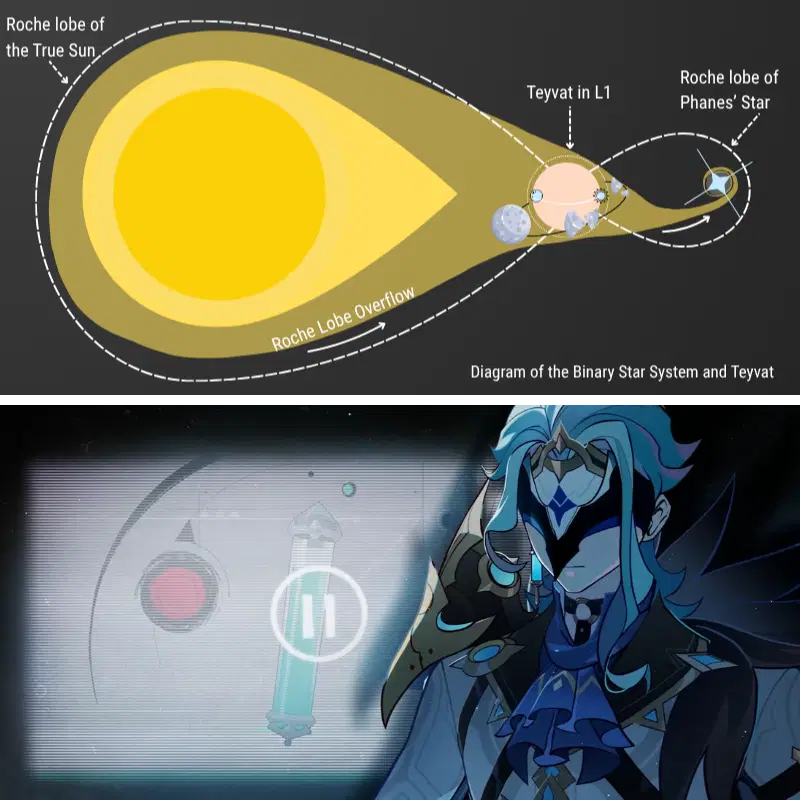
Story Teaser: Whose Who Shun The Light
However, the L1 point is gravitationally unstable and demands continuous, active orbital correction. Teyvat’s open biosphere was doomed to perish in the raging accretion stream—the stellar matter overflowing from the expanding red giant toward its companion star. That’s why Phanes enveloped the planet in the False Sky—an isolation barrier
In close binary systems, the components perpetually exchange mass, and the rate of this transfer dictates the final outcome of their evolution. This inherent instability gave rise to three different future scenarios, calculated by researchers across different eras:
- Collapse into a Black Hole (Rene’s Calculations): Gravitational collapse into a singularity, ending in Teyvat’s thermal death
- Supernova Explosion (Huitzilopochtli): A supernova destroying all life in planetary orbit
- Cooling into a White Dwarf (The Temple of Space): The natural endpoint of an intermediate-mass star—and Phanes’ chosen path to preserving life
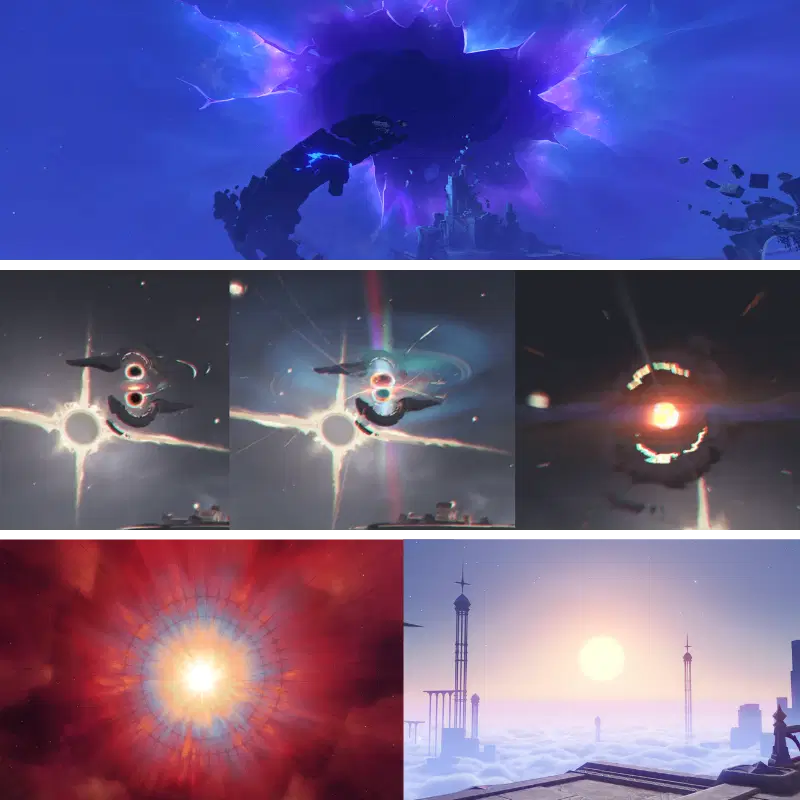
Such balancing on the edge of cosmic disaster exposes the vulnerability of the Descender's risky plan:
…The heavenly throne has deceived us. Our sovereign is neither all-knowing nor all-powerful. Nor are his plans without flaws
— Character Teaser - “Nicole: The Silenced Golden Strings”
4.1 On the False Sky
The stars, the sky… It’s all a gigantic hoax. A lie
— the Event “Unreconciled Stars”
Teyvat’s inhabitants don’t see the real cosmos, but a highly complex simulation of it
Through the layers of the sky's veil, the people of the earth could not bask in true moonlight
— Aubade of Morningstar and Moon
The False Sky is a multifunctional, dynamic engineering system that performs several complementary functions at once:
- Isolation and Artificial Light Cycle. The shell completely cut off the planet's surface from the outer environment, turning the false celestial bodies into elements of a controlled lighting system:
From the heavens fell a stellar spike that stirred the very stars, its brilliance dimming even the light of the false sun
— Celestial Gift
…the confines of the shadowmoon are gradually disintegrating
— the Event “A Lanternlit Ode to the Silver Moon”
- Climate Buffer. The veil ensured the overall stability of the environment (though it didn't manage the climate directly). Inside this isolated cocoon, even the rain became part of a global engineering network:
In fact, not every occurrence of rain can be ascribed to me
— Neuvillette’s official birthday message
- Dynamic Access Port. When necessary, it creates controlled transit corridors between Teyvat and open space
The false sky used to conceal Teyvat has also been opened more than once
— WQ “Moon Gazing”: Act III
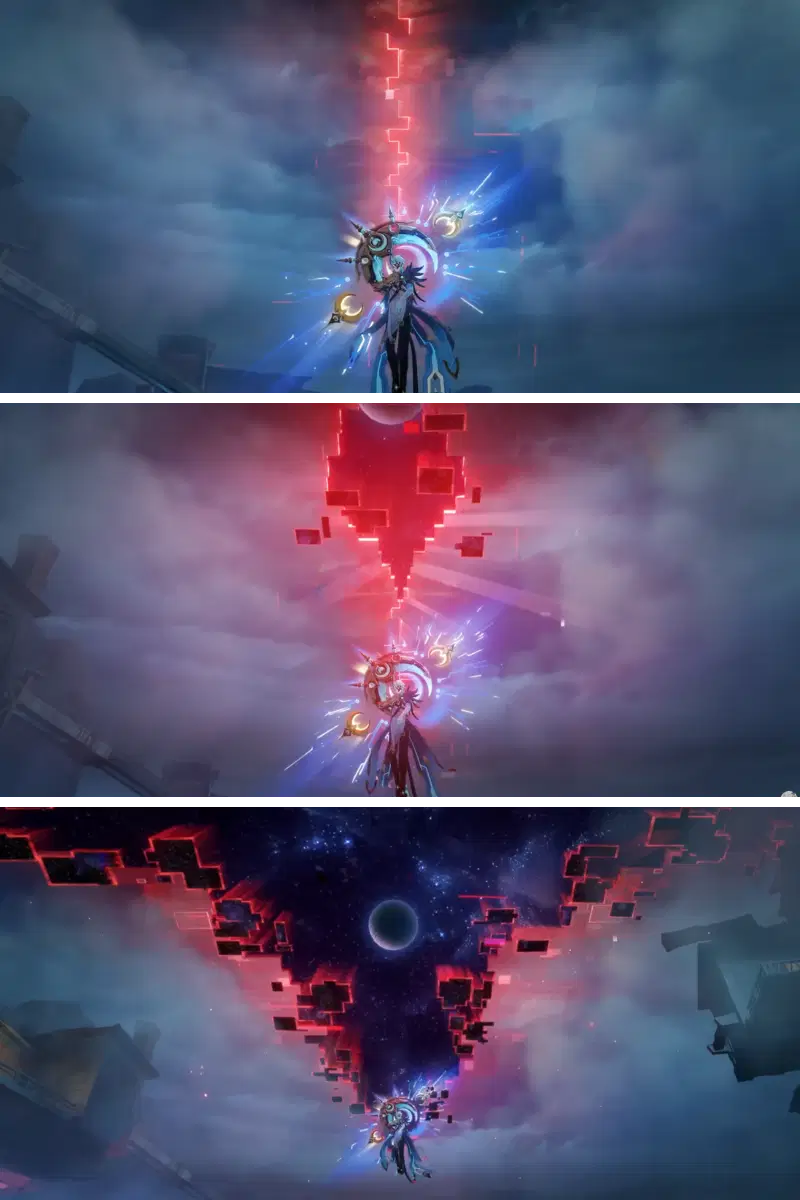
Cutscene Animation: The Experiment Begins
- Optical Masking. The system of force fields didn't just protect Teyvat; it completely hid the planet from external observation:
One detail diverged, however — a single point of light absent from the star map, where the image departed slightly from what was foretold.
In the memories she had archived in the library of her distant home world, it was a newly born, habitable planet.
But now, it lay shrouded behind several impenetrable fields, its primordial flame stripped of the radiance it was meant to bear
— Celestial Gift
- Gravitational Corset. An external force framework serves as a dampening system, stabilizing the planetary structure against extreme tidal forces
4.2 The Breath of the Planet: Teyvat's Thermodynamic Cycle
In a thermally sealed planetary system, this continuous forced energy inflow would inevitably overheat the biosphere
Beyond natural heat exchange mechanisms—such as surface oceans, the atmosphere, ice sheets, volcanism, and thermal radiation—the system received an additional internal cooling loop powered by a planetary-scale coolant
4.2.1 The Primordial Sea as a Nanofluidic Coolant
Once upon a time the Primordial Sea rested on the planet's surface:
There used to be a special sea on the surface of this planet… But today, the Primordial Sea no longer exists on the planet’s surface
— AQ Chapter IV: Act II
The properties of the Primordial Sea are fundamentally different from ordinary water, which is evident in both its physics and visual behavior:
- Non-Newtonian Fluid: Small objects are supported on its surface, indicating rheological properties distinct from ordinary water;
- Rheoscopic Fluid: A suspension of shimmering nanoparticles forms a highly conductive nanofluid. During the All-Devouring Narwhal's emergence and submergence, its free surface behaves as a rapidly self-restoring boundary layer
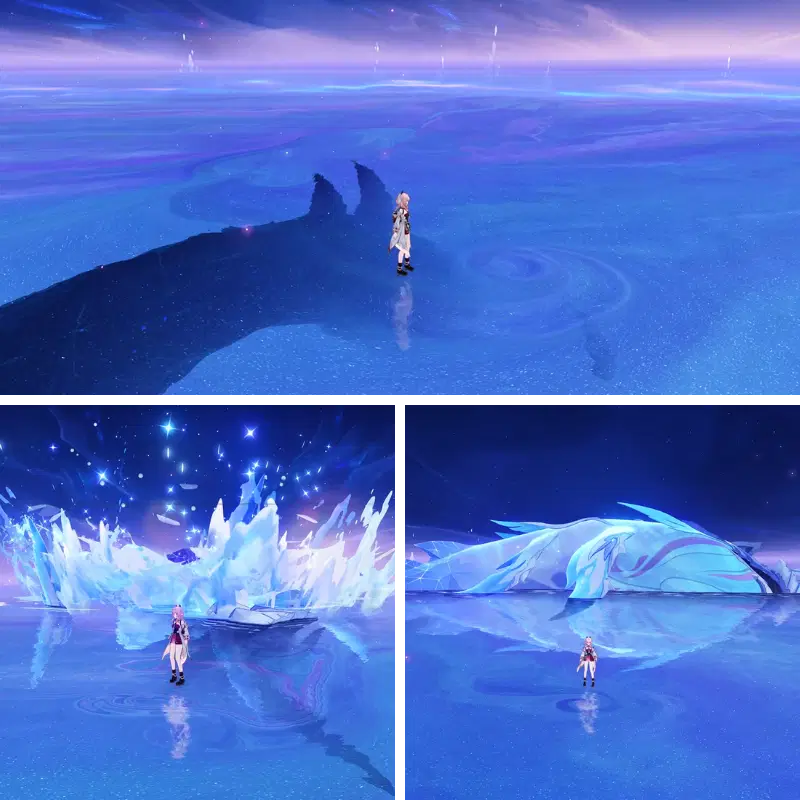
The Primordial Sea functioned both as a planetary coolant and as a hydrodynamic damper, absorbing and redistributing Teyvat's internal heat. If the False Sky protected Teyvat from the outside, the Primordial Sea stabilized it from within
4.2.2 Volcanism as a Surface Pathway for Heat Dissipation
If heat is redistributed through the planetary interior, volcanism provides a natural pathway for transporting it toward the surface. Natlan may therefore serve as one of the primary regions of long-term internal heat release, while its persistent volcanism indicates that Teyvat’s mantle and core remain geologically active
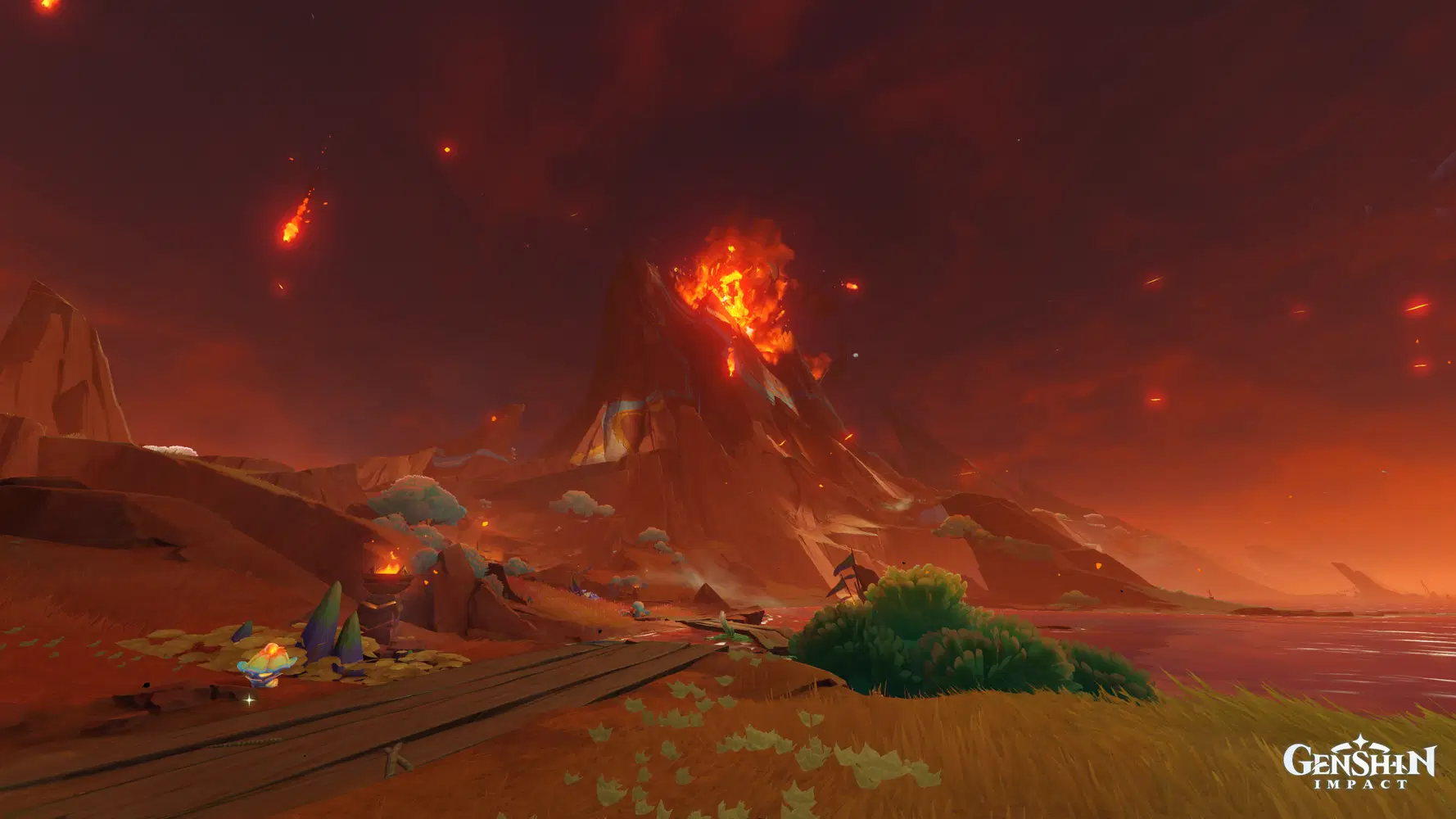
Whatever its optical functions, the False Sky cannot behave as a perfect thermal barrier. It must either allow Teyvat’s outgoing infrared radiation to escape or function as an active radiator itself
4.3 The Catastrophe
We did not reject them at first, nor did they seem to harbor ill-intent towards this world. We co-existed in peace
— Song of the Welkin Moon: Act VIII
Before Nibelung’s return, the existence of the three moons didn't contradict the plans of the First Descender. Nicole details the history of their peaceful coexistence up until their tragic death in Song of the Welkin Moon – Act VI:
And although the Heavenly Principles and the three moon sisters had once been at peace…
[...]
Essentially, the three moons existed to keep this planet alive and operational, which did not directly conflict with the Heavenly Principles' aims
In fact, the moons continued to fulfill the exact function they'd been created for: maintaining Teyvat's stability and sustaining life. The turning point came only after Nibelung returned:
Especially since their creator had returned bearing the perilous power of the Abyss.
Nibelung would eventually discover their disloyalty. He had all three imprisoned before transforming the moons into weapons with which to fight against the Heavenly Principles.
The very moons that had once defended the planet became instruments of death and destruction, striking terror into the hearts of all living things
The moons had become an existential threat to Teyvat. The response of the Heavenly Principles was radical and devastating:
Regardless of who knew what when, the Heavenly Principles shattered two moons, and flung the other beyond the skies
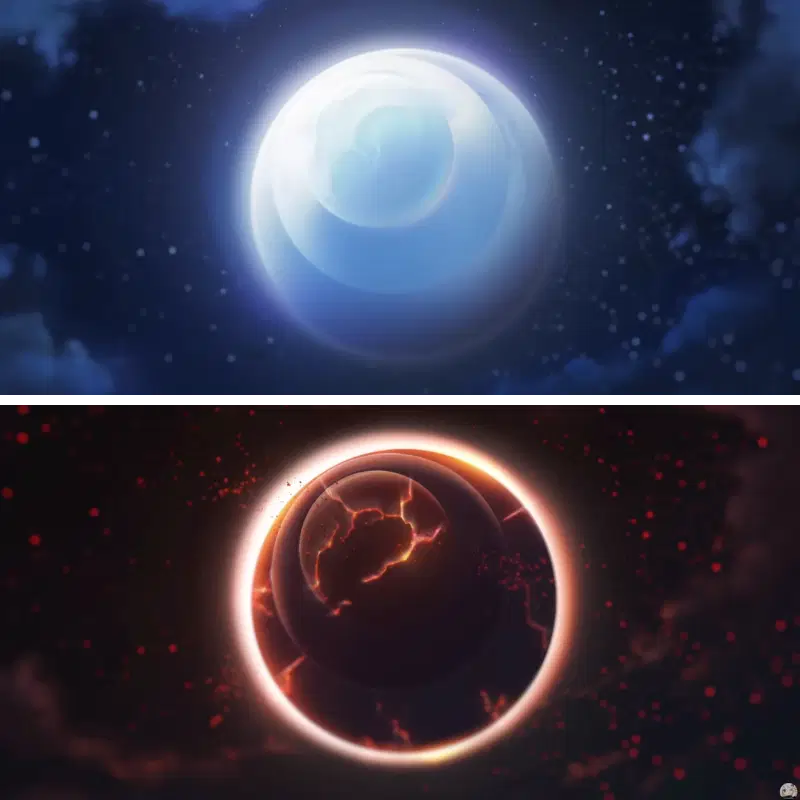
Story Teaser: Nightmare of Yore
The loss of the moons likely amplified the already catastrophic fallout of the war between Nibelung and the First Descender:
“The Funerary Year"
The second throne of the heavens came, and war was rekindled, as it was in the world's creation. That day, the heavens collapsed and the earth was rent asunder. Our ancestors and their ancestral land fell into this place during that conflict.
The era of darkness had begun
— Before Sun and Moon
When the 'Eternal Moon' fell, the heavens and earth were thrown into chaos."
"When the 'Iridescent Moon' shattered, the crimson shadow sank into the abyssal sea."
"When the 'Frost Moon' ceased to turn, nations faltered and fell into ruin."
"The world, no longer sheltered by 'Eternity,' marches toward its final breath."
— Nightweaver's Looking Glass
Some of the shattered remnants rained down onto Teyvat’s surface, while others remained in orbit:
It is also said that when the moons shattered, most of their fragments rained down upon this land like stardust
— Song of the Welkin Moon: Act I
Millennia later, the consequences of this cosmic disaster still echo. In this case, the Fatui’s systematic deorbiting of massive fragments—which had become hazardous orbital debris—is a calculated preparation for a final, total reconstruction of the planetary system
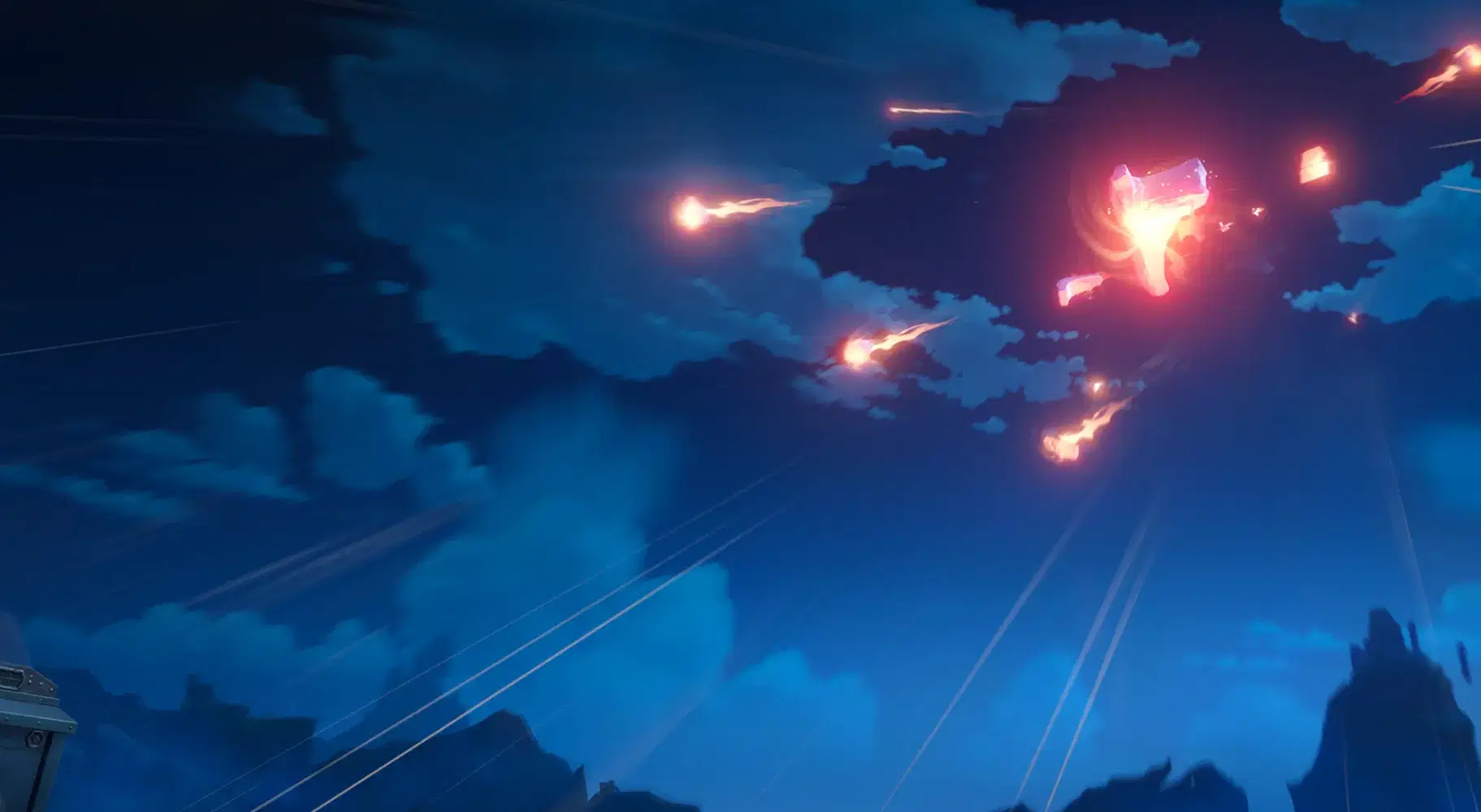
Song of the Welkin Moon: Prelude
As for the remnant that the Fatui recently pulled down... that belonged to the Eternal Moon
— Song of the Welkin Moon: Act I
4.4 The Birth of the False Moon
Before the war, three real astronomical bodies orbited Teyvat. The inhabitants must have witnessed a chaotic dance of shifting phases, frequent eclipses, and the simultaneous appearance of multiple moons during the day. Yet, the ancient myth describes a strictly structured, artificial system instead:
在久远的过去,夜空曾挂着三轮明月。
她们驾着银色的高车巡游,每过一旬,便由一位姐妹接替另一位的王位。如是周而复转,直至大灾祸降临的那一天。
「三轮皓月有同一个爱人,是司晨的星辰。只有白昼与夜晚相交的一刻,三姐妹之一才得以穿越渐隐的星斗,临幸晨星的寝宫。之后,随着曙光初现,夜的君王又匆匆驾着高车隐去。
— Moonlit Bamboo Forest
This precise rotation every ten days (每过一旬), explicitly described as a repeating cycle (周而复转), coupled with the luminaries meeting only at the strict boundary between day and night (只有白昼与夜晚相交的一刻), points to a highly synchronized, engineered cycle rather than arbitrary orbital mechanics
Anyway, after that war ended, the three moons retreated to beyond the false sky
— Song of the Welkin Moon: Act V
When the physical moons were destroyed, their projections could no longer fulfill their purpose. Their loss was concealed by replacing them with an artificial projection, preserving a familiar sky for the survivors. Thus, the False Moon was born:
Alas, nothing lasts forever, and an unforeseen catastrophe descended from beyond the world — a devastating war erupted above the skies… To secure a glimmer of hope for the people she watched over, Zibai defied the will of the heavens
— Zibai character story 1
…It was at that very moment that the shadow, which had long been watching her, would cast upon her a cage wrought of pity — and damnation
— Zibai character story 2
4.5 The Limits of Engineering
Teyvat's history is a chronicle of civilizations trying to buy time from the laws of the cosmos. Nibelung reconstructed the planet. Phanes restructured the planet
Yet, all of this unfolds within a single planetary system. If the inexorable rise of entropy is one of the primary drivers of the universe’s ultimate death, it raises a question: can we stop fighting the cosmic order and learn to harness it instead?
Perhaps. But no engineering solution can abolish the laws that govern the Universe itself
Ultimately, in the First Descender's plan, the White Dwarf will end the war with the Red Giant—but it won't win the war against the Universe
5. The Transition to the White Dwarf
The system's evolution is complete. The star doesn't need to fight an endless war for its own survival anymore. Now the binary system must be dismantled, and Teyvat must execute its final gravitational maneuver—settling into a permanent, stable orbit around the sole remaining source of light
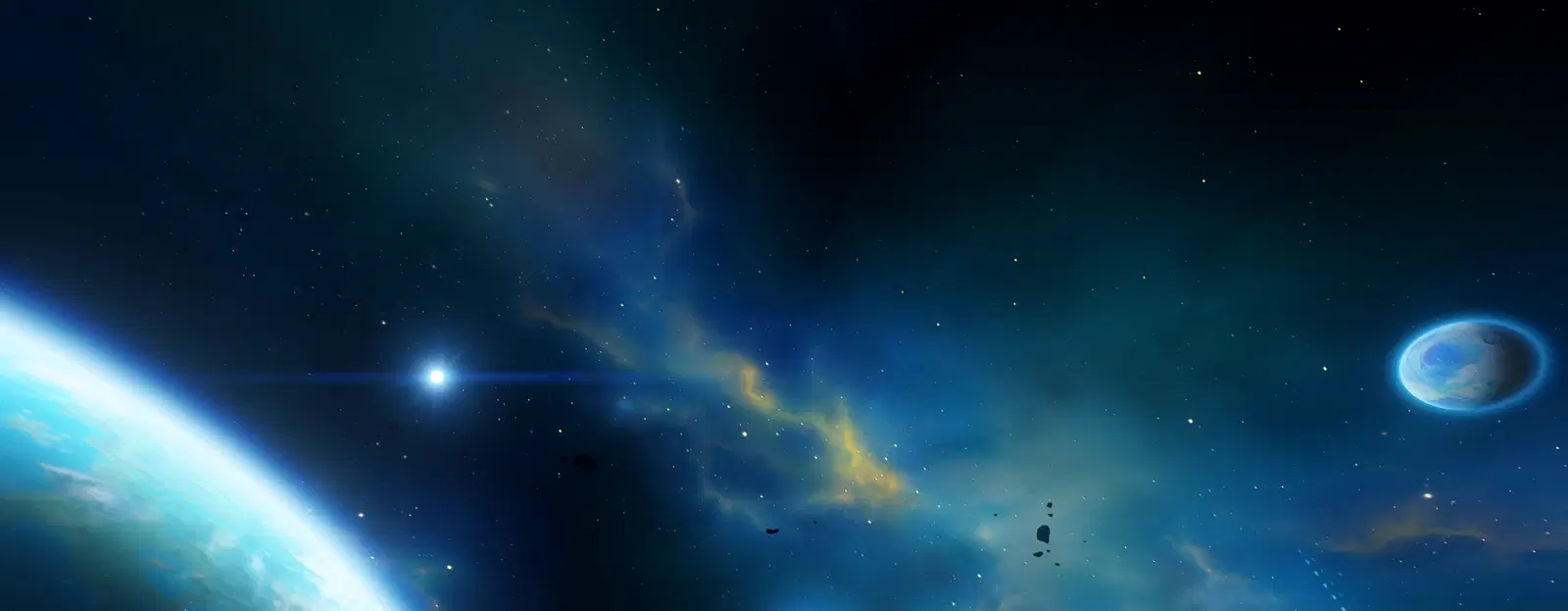
The cosmic storm subsides. The era of the young White Dwarf begins—a time of cold, serene, and truly independent radiance
5.1 The Four-Moon Architecture
The planet now enters a phase of prolonged dynamic restructuring, permanently altering its rotation, tidal interactions, and orbital configuration
In this critical period, the lonely Frost Moon remained Teyvat’s sole surviving physical satellite. Now, this controlled infrastructure must shoulder the burden of stabilizing the planet on its new orbit around the white dwarf entirely on its own
5.1.1 The Frost Moon
A space weapons complex was built on the dark side of the Moon, and it remains operational to this day. Has this weaponry ceased to be an instrument of death, transforming instead into the Moon's own propulsion engine?
Today, the Moon isn’t merely a passive satellite; it's an active component in the planetary system's new architecture
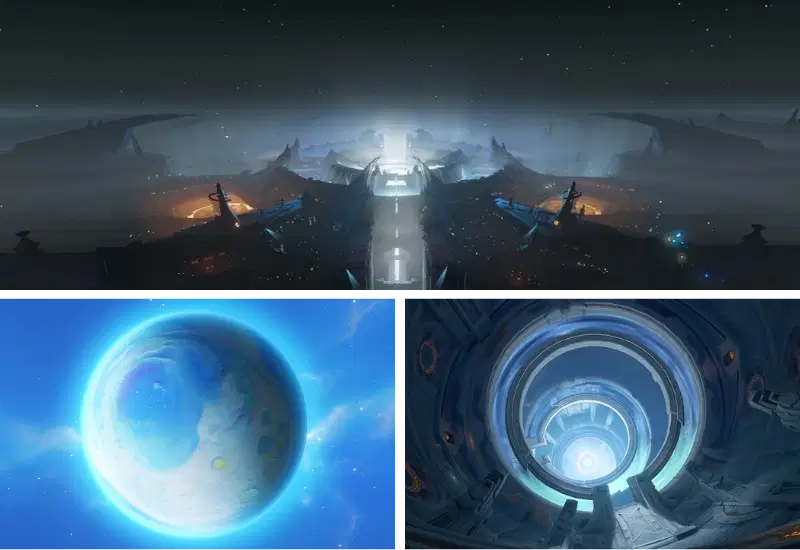
- Orbital Stabilization
Using the complex situated on its far side, the Moon can adjust its own orbital parameters. This allows it to steer Teyvat into a new, long-term configuration once stellar evolution is complete
At the same time, such a massive satellite serves as a natural reservoir of angular momentum, smoothing out fluctuations in the planet’s rotational dynamics during the system's restructuring and subsequent existence
- Maintaining Planetary Dynamics
While the primary energy source for the planetary geodynamo remains the internal heat of the core, tidal interaction can actively sustain the dynamics of the liquid outer core. This helps preserve the magnetosphere—the planet's natural shield protecting the atmosphere from the stellar wind of the young white dwarf
- Optical Reflector System
As the white dwarf cools, it remains intensely hot, but its luminosity is significantly lower than that of a main-sequence star. Yet, all light remains unseen until it touches matter through which it can manifest. The Frost Moon serves as an ideal mirror for this stellar light. It becomes an optical element of the planetary system that redistributes a portion of the incoming radiation to preserve Teyvat’s hospitable light cycle
5.1.2 The Welkin Moon
In the quest Sealed Site of Sacrifice, there's a mention of an achievement comparable to the reconstruction of the Welkin Moon. This crucial nuance was lost in the English localization, so let's look at the Chinese original:
恭喜你,居然真的造出了能与微缩星球等价的东西…「象拟聚星」呵呵,简直就是能和重铸空月相媲美的伟业。
Truly, a grand achievement, comparable with lunar reconstruction
The exact same characters (空月) appear in the Chinese name for the Blessing of the Welkin Moon (空月祝福).
During the War of the Funerary Flame, the process of moon-forging was interrupted by Xiuhcoatl, though he seemingly completed it later:
He stopped the lords and the regent from their exploration of the stars and their attempts to replicate the great miracle of moon-forging
— Fractured Halo
At the same time, Nibelung sealed Aria, Sonnet, and Canon inside a specialized dimension:
...This is where Teyvat's original ruler, the Dragon King Nibelung, imprisoned the moon goddesses
— Song of the Welkin Moon: Act VIII
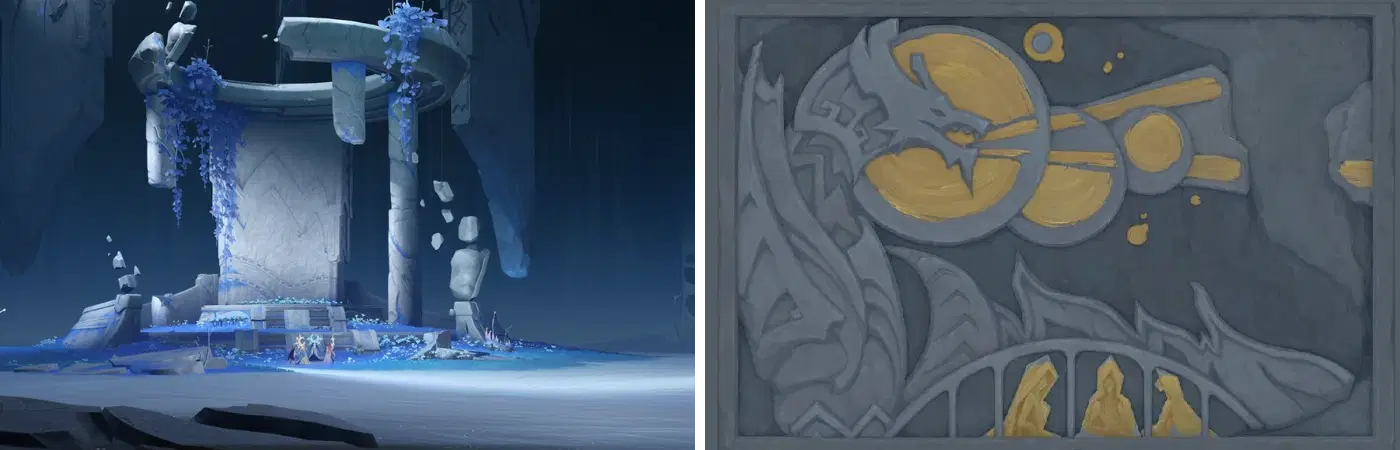
It's named "The Moon's Reflection" — the internal space of the Welkin Moon. Within it, the preserved consciousness, memories, and authorities of the three sisters take on a form that can be perceived and interacted with
The name 空月 reveals how this system is built. The character 空 doesn't just mean "empty" or "hollow"; it also denotes "void," "vacuum.” A vacuum minimizes the absorption and scattering of light by the medium. However, a vacuum alone can't trap light. To keep the light from dispersing, it needs closed boundaries that reflect it back into the system:
In a prison beyond the reach of both Time and Wind, the one who traverses backward beholds the eternal slumber of three sisters
— Nocturne's Curtain Call
The Moon's Reflection becomes the manifested interface of this architecture: the Welkin Moon preserves, while its reflection makes what's preserved visible
(To put it simply: the Welkin Moon is the operating system, and the Moon's Reflection is the UI that we can actually see and interact with)
This is exactly how the rules of the lunar prison function:
So perhaps this space is specifically designed to imprison divinity, soul and authority, but not the physical body...
[...]
A moon goddess cannot live without her moon, Columbina
[...]
...Then we shall disappear the moment we depart from it
— Song of the Welkin Moon: Act VIII
Within "The Moon's Reflection," they are fixed as the footprints of completed lunar cycles:
We know we are but remnants of a bygone age
— Song of the Welkin Moon: Act VIII
Thus, the Frost Moon remains the physical satellite and Columbina’s home—the material host of the lunar system. The Welkin Moon represents its reconstructed internal layer, merging the legacy of the three previous moons
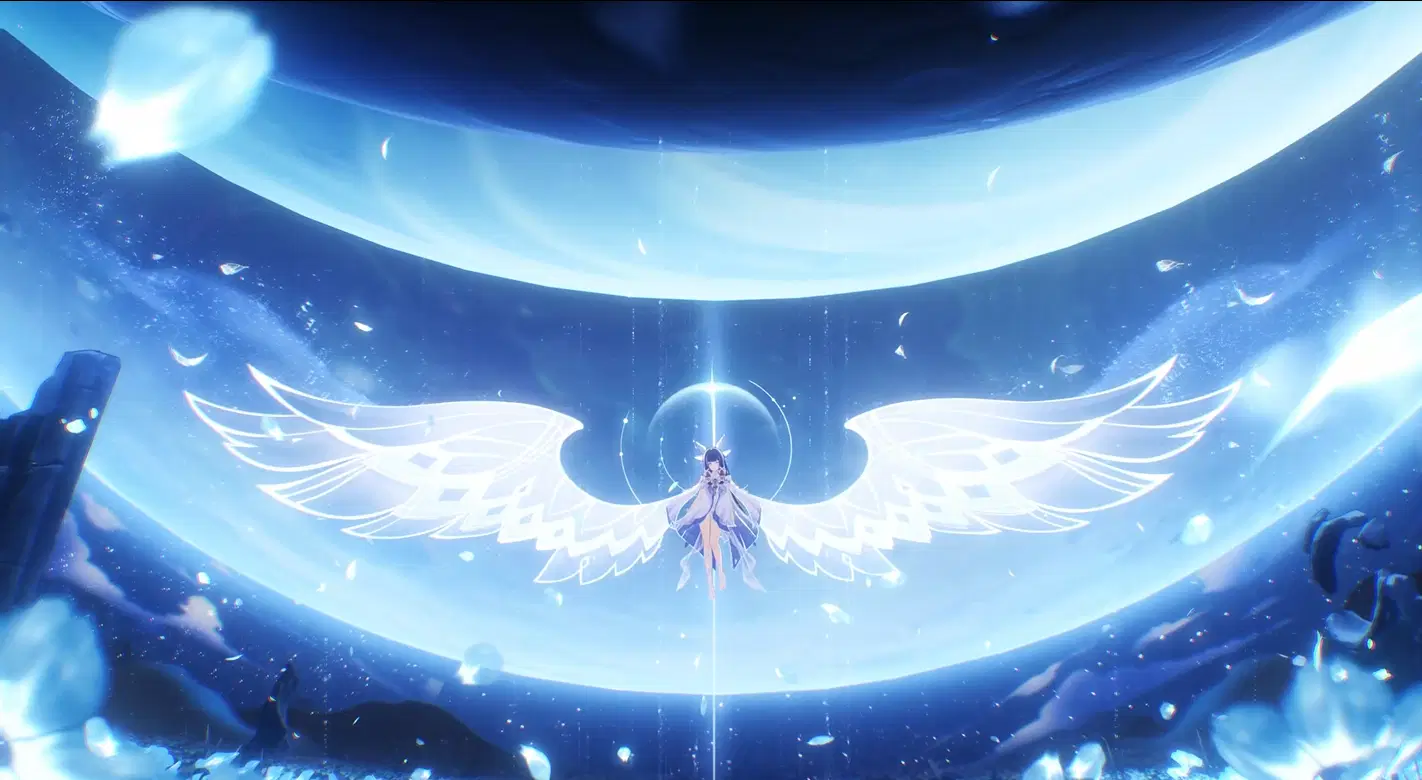
After absorbing the three authorities, Columbina becomes the Trilune Goddess. The scattered authorities of Aria, Sonnet, and Canon reunite within a single host, restoring the integrity of the lunar system. The Welkin Moon ultimately serves as the fourth moon—a container and the unified infrastructure for Teyvat's entire lunar network
5.2 The Birth of the New Moon: Coordinate Spoofing
The mechanism behind creating the False Moon is first revealed in detail during Song of the Welkin Moon: Act VI:
The Savior promised that he would create a new Moon beneath the False Sky
Later, the Wanderer explains exactly how this was achieved:
祈月之夜」的夜晚…他用这些知识,真的创造了一轮「伪月」
Then, he harnessed that knowledge on Moon-Prayer Night... to truly create a "false moon."
To be precise, he exploited a weakness in the way the spell works.
The spell senses kuuvahki to detect the moon's location. So, as long as the "false moon" more strongly resembled a moon than the Frost Moon beyond the skies…
That gate would teleport Columbina to the false moon's location...
This very sentence is the key. Dottore creates an empty record—a null placeholder—in the system. It remains an empty template until the real Frost Moon crosses the False Sky in Act VIII: At that moment, the system records its parameters and generates a new False Moon—an artificial projection of the real satellite within the False Sky’s infrastructure. Hence the Wanderer’s term 「伪月」—a False Moon, a copy of the real Frost Moon
Following the War of Funerary Flame, a False Moon already existed within the False Sky—Zibai’s prison, serving as the projection of the old lunar system
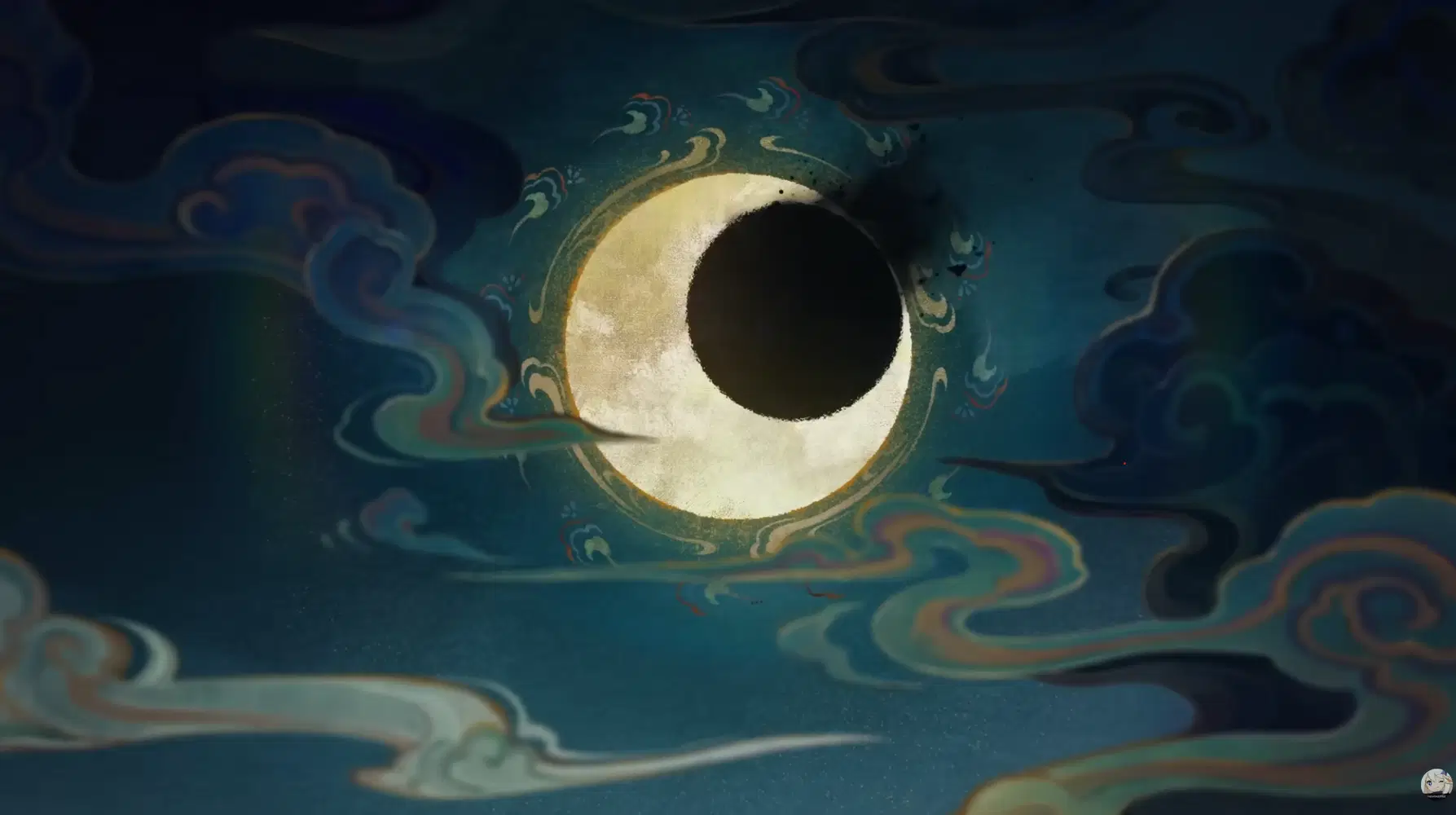
Story Teaser: Nightmare of Yore
During the climax of A Lanternlit Ode to the Silver Moon, these projections overlap, visually echoing the ancient Chinese myth of a lunar eclipse. Rather than one moon devouring the other, however, the scene depicts two duplicate projections competing for the same coordinate role within the False Sky. As the old False Moon becomes redundant, it is gradually phased out of the system:
The world outside is changing. With the new moon's birth, the confines of the shadowmoon are gradually disintegrating
To put it simply: the entire process was about crafting an empty picture frame first, taking a photograph of the Frost Moon, sliding it into that frame, and hanging it on the wall to replace the old painting
5.3 Unity of the Information System
As the cosmic restructuring of the world’s physical architecture nears completion, equally profound shifts are taking place within its informational infrastructure. Until recently, Teyvat operated on several independent information layers simultaneously. For a long time, the primary system was Irminsul:
Isn't Irminsul a repository for all the information and memories of Teyvat?
— AQ Chapter III: Act V
The Heavenly Principles usurped and refashioned Irminsul, made it serve humanity, and used it to anchor the fate of the world
— Song of the Welkin Moon: Act IX
However, the events of the recent chapters have exposed a fundamental flaw in this architecture. If all critical data is concentrated in a single central node, any damage to it becomes an existential threat to the entire system:
Irminsul is vital not just to the safety of Sumeru, but to all of Teyvat
— Song of the Welkin Moon: Act IX
This is exactly why another independent information infrastructure—the Night Kingdom—has existed alongside Irminsul since the end of the War of the Funerary Flame:
To aid the people of Natlan, the Lord of the Night used the fragments of the old Ley Lines to reconstruct a similar network
— AQ Chapter V: Act IV
As long as the Night Kingdom remains disconnected from the Ley Line cycle, The Doctor has no way of knowing my movements
— Song of the Welkin Moon: Act X
While Irminsul remained the primary information system, the Night Kingdom maintained a completely independent environment. It was designed to ensure the system's survival even in the event of a total failure of the central node
When Irminsul became corrupted, its core data was migrated to a newly established platform—Aaru—which now operates independently of the original tree:
The Pyro Gnosis burned down the corrupted Irminsul. Now, Aaru shoulders the responsibilities that once belonged to Irminsul… so Teyvat's most vital information has largely been preserved
— Song of the Welkin Moon: Act X
But once the planetary system's physical reconstruction is complete, the engineering priorities change completely. Now, with the launch of Aaru, the continued isolation of these operating environments creates a critical risk of state divergence. The same events can now produce conflicting records, and even observable world states across different regions
The final phase of the reconstruction must therefore establish a unified information architecture, with Aaru serving as Teyvat's new authoritative information system. Following the engineering precedent established by Irminsul, the Night Kingdom would no longer need to persist as an independent physical infrastructure. Once its essential data have been consolidated within Aaru, the original storage medium can be retired
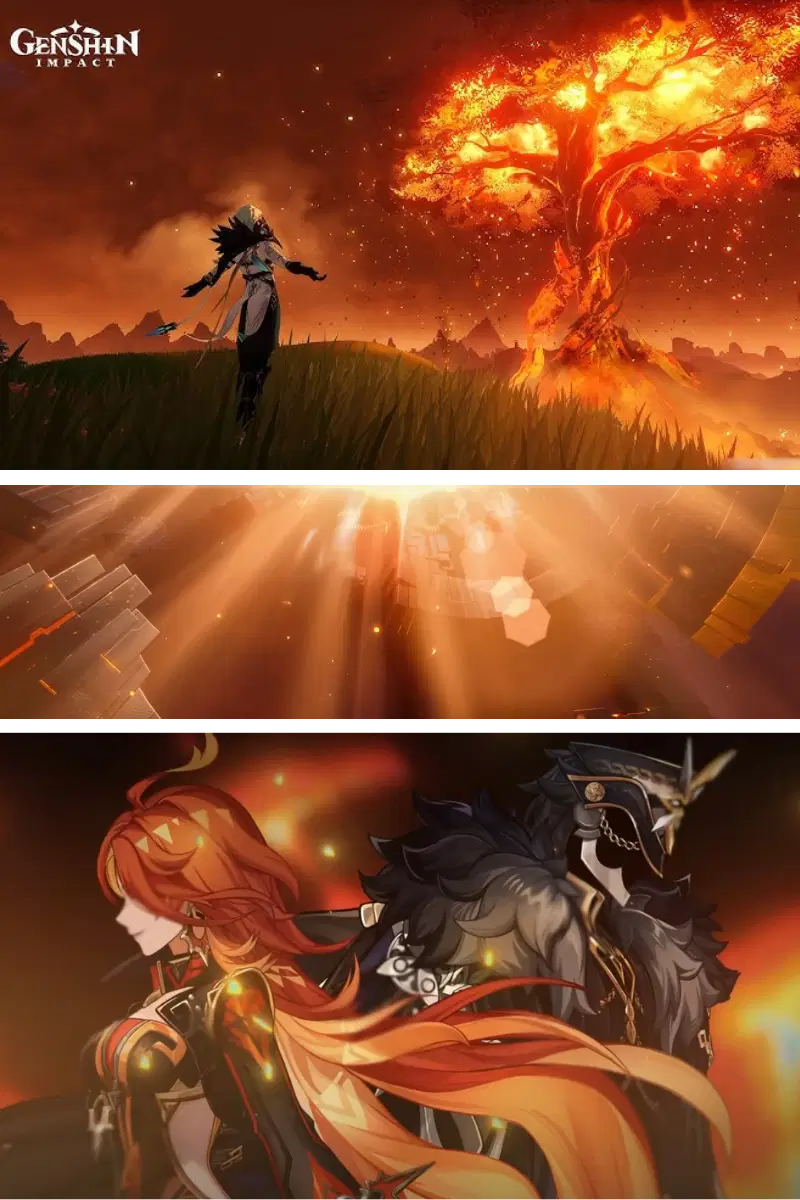
Song of the Welkin Moon Act X; Crucible of Causality; Ignition Teaser: A Name Forged in F
The first flame. The pure cleansing fire
— Cutscene Cruicible of Causality
The desperate struggle for sheer survival is finally replaced by a different engineering task: achieving absolute, uncompromised data integrity across Teyvat
5.4 The False Sky: A Flat Earth Simulation
Today, the False Sky is already partially dismantled. From the Frost Moon, Teyvat’s continental curvature is clearly visible, showing that the visual masking layer has been deactivated
One of the clearest demonstrations of how the False Sky operates is the simultaneous observation paradox. At a fixed moment (e.g., 22:41), an observer on the Frost Moon sees dawn already reaching the Desert of Hadramaveth, while an observer on Teyvat at that same instant finds the entire world still in deep night, with the Moon near its zenith
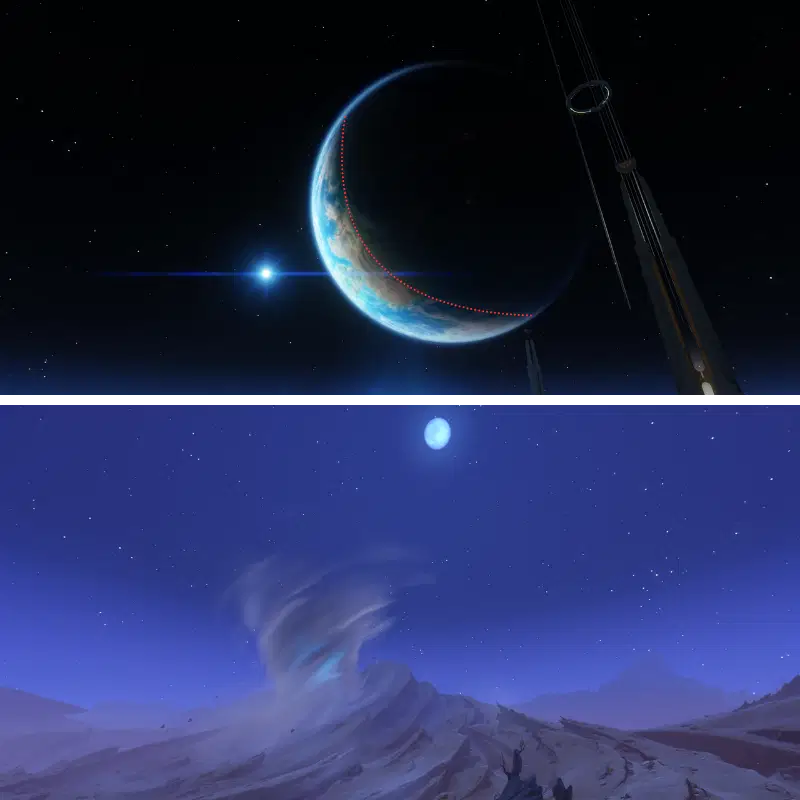
Frost Moon — 22:41; Teyvat — 22:41
At the same instant, an observer on the Moon and an observer on Teyvat’s surface encounter mutually incompatible lighting conditions. Surface illumination therefore isn’t determined by the planet’s physical position relative to its star, but by the False Sky’s rendering pipeline
From an engineering standpoint, this design is far more efficient. Rather than reproducing the continuous day–night distribution implied by the planet’s visible terminator, the False Sky imposes a globally synchronized cycle across all of Teyvat, with the Sun and Moon following separate predetermined paths and each appearing only within its assigned interval, while maintaining conditions suitable for the biosphere
The flat geometry of this celestial projection is what originally led to the "Flat Teyvat" theory. In fact, only the False Sky's display system is "flat," whereas the planet itself retains its natural spherical shape
5.5 Life and Death
A young white dwarf is extremely hot. Despite its comparatively low luminosity relative to the star it once was, its spectrum contains a far greater proportion of high-energy UV radiation. If the False Sky were dismantled immediately after the system’s transition to the white-dwarf phase, Teyvat’s surface would be left defenseless against this new radiation environment
This is precisely why destroying the old infrastructure is impossible without first preparing the new one:
The First Line of Defense: The Magnetosphere
Preserving the planet's rotation allows the planetary geodynamo to keep running. The resulting magnetic field deflects stellar charged particles, preventing the atmospheric erosion and shielding Teyvat from the stellar wind of the young white dwarf. However, a magnetosphere offers virtually no protection against UV radiation
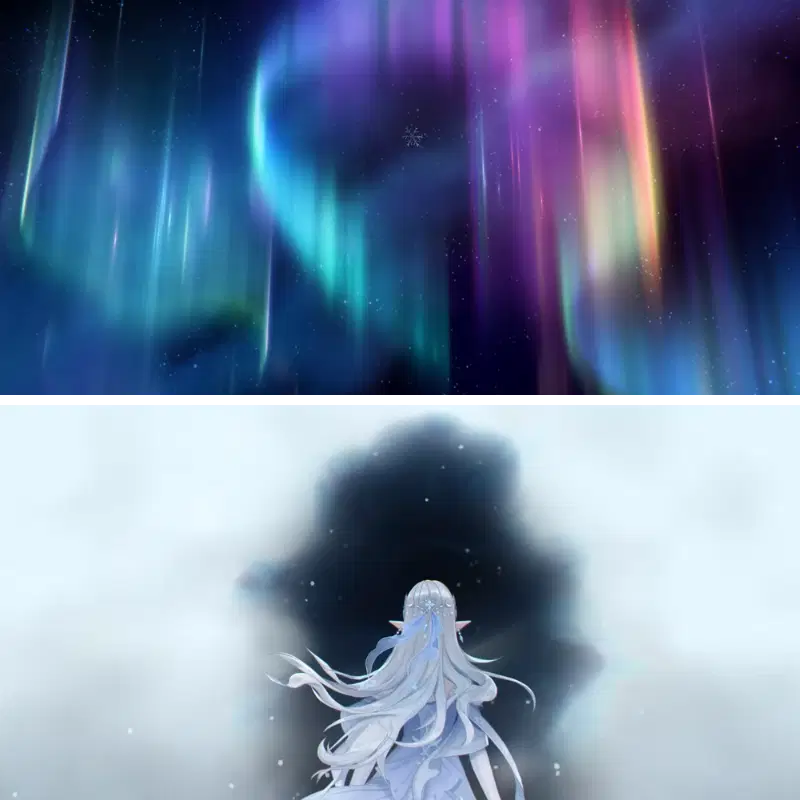
“The Song Burning in the Embers” Full Animated Short; Transcendence Trailer - “Sudden Snow
The Second Line of Defense: High Albedo Ice Crystals
One engineering solution is to leverage the high albedo of ice
Much like Earth's thin cirrus clouds, microscopic ice crystals could remain virtually invisible to an observer on the ground. They'd preserve the natural illumination of the surface while simultaneously scattering and reflecting the most hazardous UV wavelengths back into deep space
Only once this protective shield is fully established can the False Sky be dismantled, its functions gradually assumed by the world’s own natural mechanisms
The moment shall come when the ruler who stands against love is shaken, And once the veil is sundered and torn, a new day over this land shall dawn
— Azurelight
Dismantling the False Sky is the final phase of the world’s restoration—the moment the planet no longer requires artificial life support. Teyvat becomes capable of surviving in the open cosmos once again, resting beside its sole remaining star
Every engineering solution described here ultimately serves a single purpose
Nothing can preserve a star forever
Nothing can preserve the sky forever
All of this exists to preserve life
Love chose life
Life reflects death