Hi everyone! I just recently watched the Teybat Chapter Storyline Preview again and saw the ancient symbols beneath the titles for each nation/act. I've always noticed them but decided to do some research and see if I can find out what they mean, since I couldn't find any posts about it but I could be wrong!
I knew that the language in Teyvat had already been transcribed into the English alphabet so I figured it wouldn't be too hard, but I realized that the symbols are actually those of the ancient carvings that we saw most prominently in Dragonspine, rather than the current language that Teyvat uses. This didn't prove to be a problem though, as I found the translation of the alphabet on another Hoyolab post by whoon 'What the writing on the wall in the Entombed City - Ancient Palance secret room translates to', and with that, I set to work translating!
I was aware that Mihoyo has used Latin within Genshin before and therefore, I used that as the basis of my research in terms of translation. In saying that, I do not know Latin and it is not a very commonly used language as the predecessor of English, so, it was a bit difficult trying to translate, therefore these are not 100% accurate and I would love to know what you guys may think below!
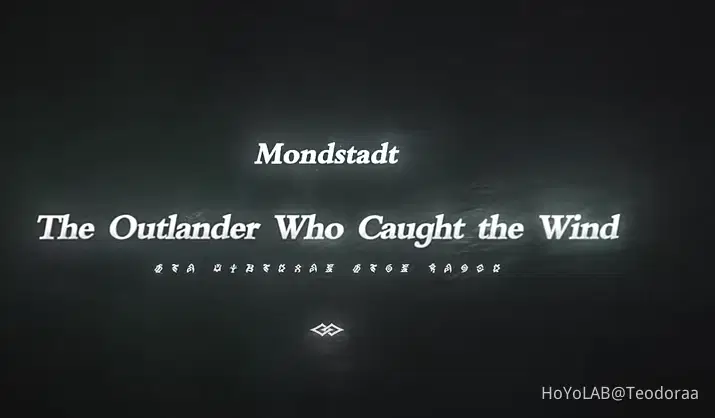
"Mea libertis meus canor" - "My freedom, my song"
This one was probably the easiest to translate, though the word "canor" can also mean tune or poem, all definitions are based around music. I believe this one is fairly straightforward, we are aware that Barbatos is acting as Venti the Bard, and bard's as they are, are very common throughout Mondstadt. When speaking the truth, Barbatos often talks in limerick, so I feel as though this line represents the tale of Mondstadt's freedom within their most prominent tradition of song.
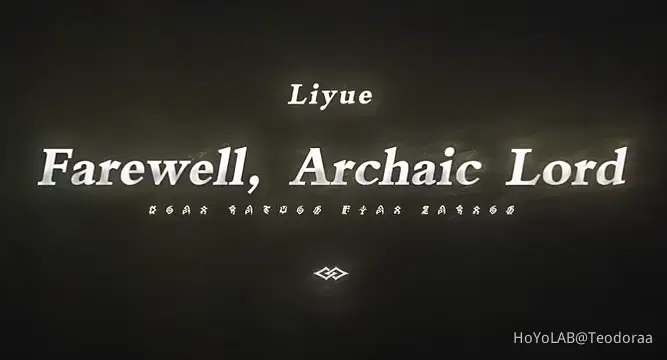
"Ruat caelum fiat pactum" - "Let the sky fall with this agreement"
This one was a difficult one, when translating the words seperately they came out as "ruat" - fall, "caelum" - heaven/sky, "fiat" - let/let it be done and, "pactum" - agreement, i.e. contract. When translating all together it came out as "let the sky fall agreement". This altogether translation makes sense but doesn't quite integrate the agreement, which is crucial as we know Liyue is the city of contracts and "the contract to end all contracts" was the contract Morax/Zhongli in human form made with The Tsaritsa for his gnosis. Due to this, I tried to understand what these translations all seem to insinuate which I came to understand meant "Let the sky fall with this agreement". As we know, by Morax agreeing to this contract and his own internal desires, he has essentially lost his place as an Archon which can mean that he's fallen from the sky i.e Celestia. Not only that, Celestia has lost one of its original 7 Archons and due to the agreement that Morax with the Tsaritsa, who has all but confirmed to be waging a war against Celestia, it's essentially insinuating Celestia's fall, and that this contract has begun what may be the next great war and potentially the end of Celestia as it is currently. However! This is completely up to debate as I am not 100% with my definition therefore any other ideas are super welcome!
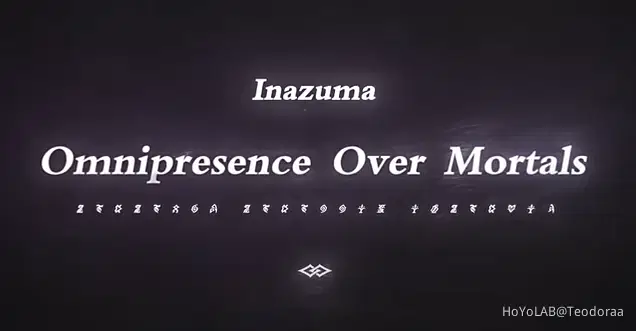
"Perpetua Perennis Impervia" - "Eternal, Perennial, Impervious"
This one is also a questionable translation to me, as all other subtitles seem to be sentences. However, when attempting to translate this as a full sentence it didn't truly make sense as all words depicted are adjectives. It could theoretically translate to "Perennial, impervious eternity" but that doesn't change much about what the phrase seems to mean anyway. In terms of meaning, I feel this one is quite straightforward as well as it is essentially providing us with adjectives describing both Inazuma and its Archon, Baal. "Eternal" obviously meaning forever. "Perennial" essentially means everlasting, describing something that is lasting for a very long or infinite time which is in line with Baal's ideal of Eternity. "Impervious" means the inability for something to pass through or the inability for something to be affected by another, this has also been a very clear theme within Inazuma so far with the closed borders and the removal of visions to try and retain Eternity and, remove any threats to the Eternity that Baal is striving for.
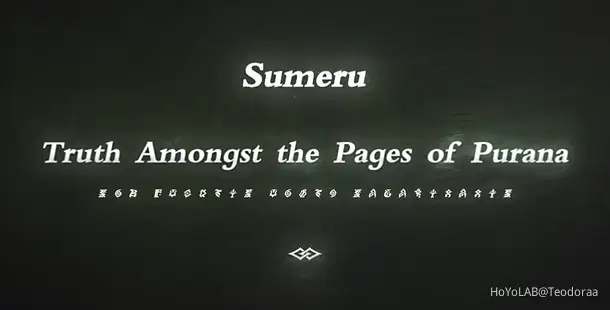
"Sub floreis lumen sagacitatis" - "Under the flowers, light shows/knows"
This one was difficult to translate due to grammar differences between Latin and English. When translating the words individually, they come to mean "sub" - under, "floreis" - flowers, "lumen" - the light, "sagacitatis" - sagacious. These words altogether don't make much sense, but, we can assume they mean that there is some sort of light coming from beneath these supposed flowers. What made this even more difficult is the word "sagacious" and its meaning. We already know that the ideal of Sumeru/Sumeru's Archon is wisdom, therefore, the word itself makes sense in that context as it means having/showing keen mental judgement/discernment i.e. wise or shrewd. However, in the context of this sentence, it's quite hard to create a proper translation. The way that I have come to understand it is that beneath these flowers there is a light (I'd assume it is a figurative light, not literal) and this light is what is sagacious. So perhaps this light is all-knowing and shows us the truth as wisdom can also be synonymous with wisdom, as wisdom is perceived to mean truth as well. Would love to hear your thoughts about this one though! Perhaps this "light" is a person, or, as we know there is a group of scholars in Sumeru, it could be an archive of knowledge such as the great library that is known to be in Sumeru. Definitely curious as to what this would mean in the context of the actual story in Sumeru though! Maybe the "flowers" refer to Sumeru as a whole as we know that it is the dendro nation i.e. plants & vegetation, and the "light" is maybe a secret that the scholars of Sumeru or the Dendro Archon are keeping hidden from the general population!
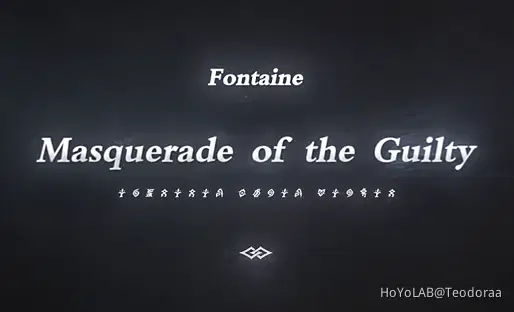
"Iustitia omnia vincit" - "Justice Conquers"
This one was also was one of the easy ones to translate thankfully, haha. When translating the words individually they came to mean "lustitia" - justice, "omnia" - all and "vincit" - wins, together this came to be "justice conquers" which makes sense as we know the ideal for Fontaine and its Archon is Justice. In context of what Dainsleif says in the trailer, we know that the Hydro Archon loves the courtroom, especially when it comes to judging the other Archons. However, this same justice seems to not be given to the divine, which I would assume to mean Celestia. Perhaps the story will follow corruption within justice/the Hydro Archon, as Celestia may be the center of many issues occurring but, the Hydro Archon may be turning away from this obvious injustice that Celestia is bringing? Maybe there will be an internal conflict within the Hydro Archon deciding whether her ideal is worth losing her place in Celestia. The idea of a "masquerade of the guilty" also seems to insinuate that the "guilty" are perhaps playing innocent which also somewhat aligns with this idea. However, this is a complete theory and we won't know for a while!
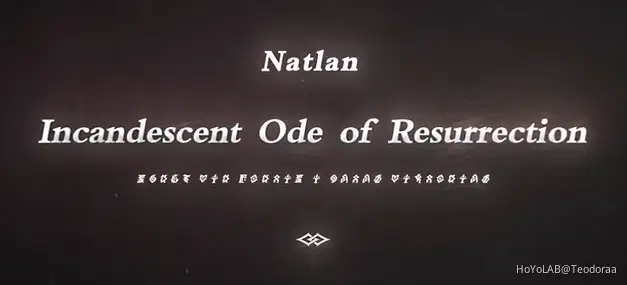
"Surge vir fortis i natam victoram" - Rise, strong man, go -"
This one as you can see above, I have not fully come to translate as I have found multiple translations and am unsure of what may be correct. When translating the words individually they come to mean, "surge" - rise, "vir" - man, "fortis" - strong, "i" - go, "natam" - daughter, "victoriam" - victory. Looking at it like this, I came to understand it meant something like, "Rise, strong man, Go, daughter of Victory". This perhaps insinuates, as Murata's ideal is war, that maybe this daughter will bring victory in a war, but I don't feel 100% confident about that one. Dainsleif also said that the rules of war are woven in the womb which insinuates something of feminine origins where the word "daughter" could make sense, but I am quite unsure about this one. When translated altogether though, it came to mean "rise, strong man, go pretend victory". This one makes a little more sense and perhaps is alluding to this strong man, which I believe is more of an army than a single man" believing that he has won a war, when perhaps that is a distortion of the truth or an illusion of sorts. Dainsleif mentions that the victors of war burn bright, whilst the losers are turned to ashes, so maybe this illusion of the winner burning bright is just the fire's light before this "winner" is turned to ash, though I believe this is more figurative than literal. Would love some further ideas about this one!
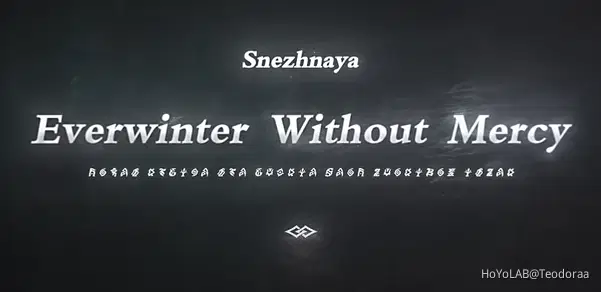
"Ducam regina mea gloria haud pluribus impar" - "The queen leads me to glory -"
Similar to the Natlan phrase above, the Schneznaya subtitle was a bit hard to decipher as well. When translating the words individually as I have done so for all previous regions, they came to mean, " ducam" - lead, "regina" - the queen, "mea" - my, "gloria" - glory, "haud" - not, "pluribus" - more, "impar" - odd/unequal. Presented like this, the words seem to make some kind of sense until reaching the word "impar". The word impar insinuates both odd and unequal depending on the context. When we think about unequal and the current state of the Tsaritsa and her desires having left her presumed ideal love behind, we can take a look at history and what "odd" and "unequal" or "inequality" has led to in the past: oppression. We know currently that after the cataclysm, that occurred 500 years ago, the Tsaritsa was never the same. She has essentially declared war against Celestia, in the present trying to get each Archon's gnosis. We could think of this as The Tsaritsa bringing her people glory and not more oppression by Celestia and perhaps the other Archon's as well. Dainsleif mentions that the Tsaritsa has no love for her people and they do not have any love for her, yet they hope to be on her side when she decides to begin her time of rebellion against the divine [celestia] begins. So we can assume that though her people do not love her, they still believe in her, or perhaps they are simply scared of her, more so than they are Celestia which implies that she has a very menacing and perhaps promising plan to bring Celestia down.
When I translated the phrase altogether it came to mean "The queen is not more odd (strange? unequal?) [but] brings glory." In this way, the sentence is more so describing the Tsaritsa rather than what she is doing. Perhaps by "not odd" it is more so describing that the queen, i.e. the tsaritsa, is not strange or maybe not a tyrant/dictator as she is currently being portrayed as in the story, but she is actually bringing glory to her nation, through Celestia/the Archon's defeat. I feel both these definitions make somewhat sense but I don't know Latin so could be wrong!
All in all, this was super fun to think about and research! I think I got the gist of what each of the subtitles mean but since I don't know Latin these are 100% up for interpretation by anyone else! I would love to hear your thoughts on these ideas I brought up and if you guys have your own theories or translations for what these subtitles might mean! Honestly, it's just so interesting, I love looking deep into the lore and I cannot wait to find out what Mihoyo has in store for us!
Thanks so much for reading all this, I know it was a lot [emoji] but I hope to see everyone else's theories!