Continuing from part two, we bring you more character card origins. Since the Genius Invocation TCG card mechanics are mostly ported from their counterparts in the open world, many information can overlap. The number on the upper left corner of the card shows HP and the number of Elemental Dice needed, we’ll keep everything simple from here on.
This time we’ll take a look at the skills of [Anemo] and [Hydro] characters, let’s jump right into it!
① [Jean]
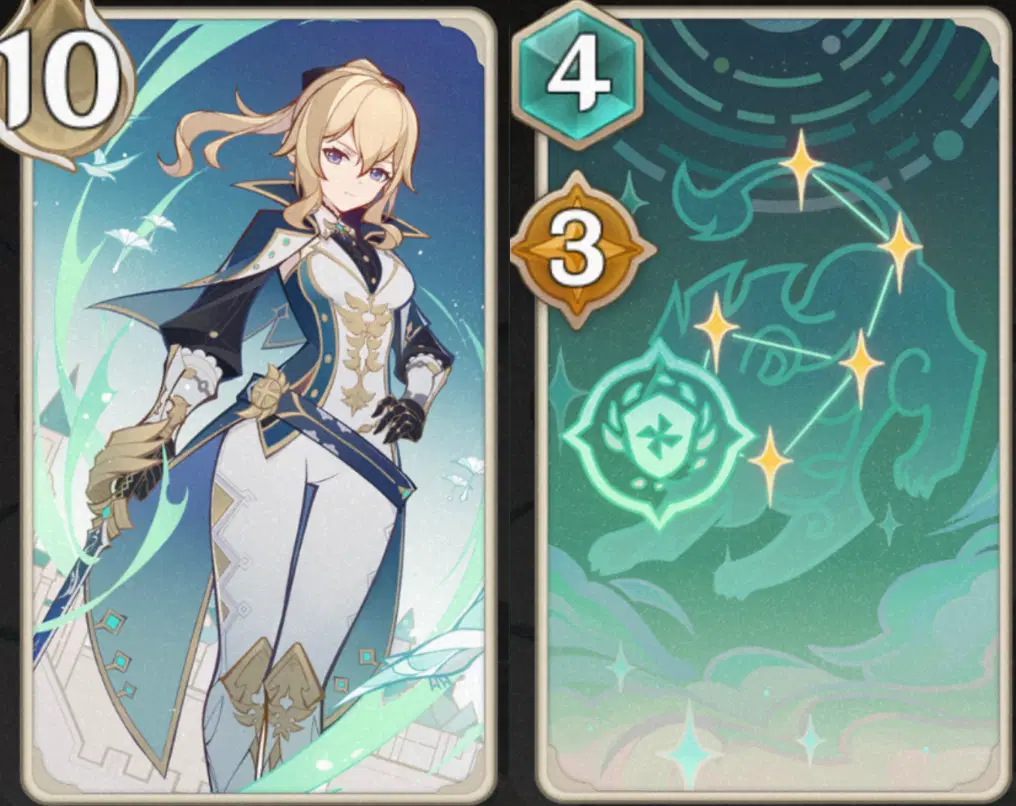
[Character and Talent Card]: On the Character Card we see Jean’s Constellation, with the Lion’s head made of Mondstadt’s windmill and elements of the Knight Order’s crest.
Jean will immediately use her Elemental Burst on play of this Talent Card, adding 1 point of Anemo DMG to the [Dandelion Field]. The name of the Talent Card reflects Jean’s Level 4 Constellation [Lands of Dandelion], and the original effect that lowers enemy Anemo RES within the field has been adjusted here.
[Normal Attack]: Deals a fixed 2 points of Physical DMG.
[Elemental Skill]: Force the opponent to switch to the next character, which is handy in disrupting the opponent’s strategy and tempo. The Elemental Skill is capable of displacing and grouping enemies in the open world, here in the TCG, it’s been changed to a forced character switch on the opponent (loss of choice), a reasonable conversion.
[Elemental Burst]: Almost exactly the same as the open world version, minus the knockback effect.
② Sucrose
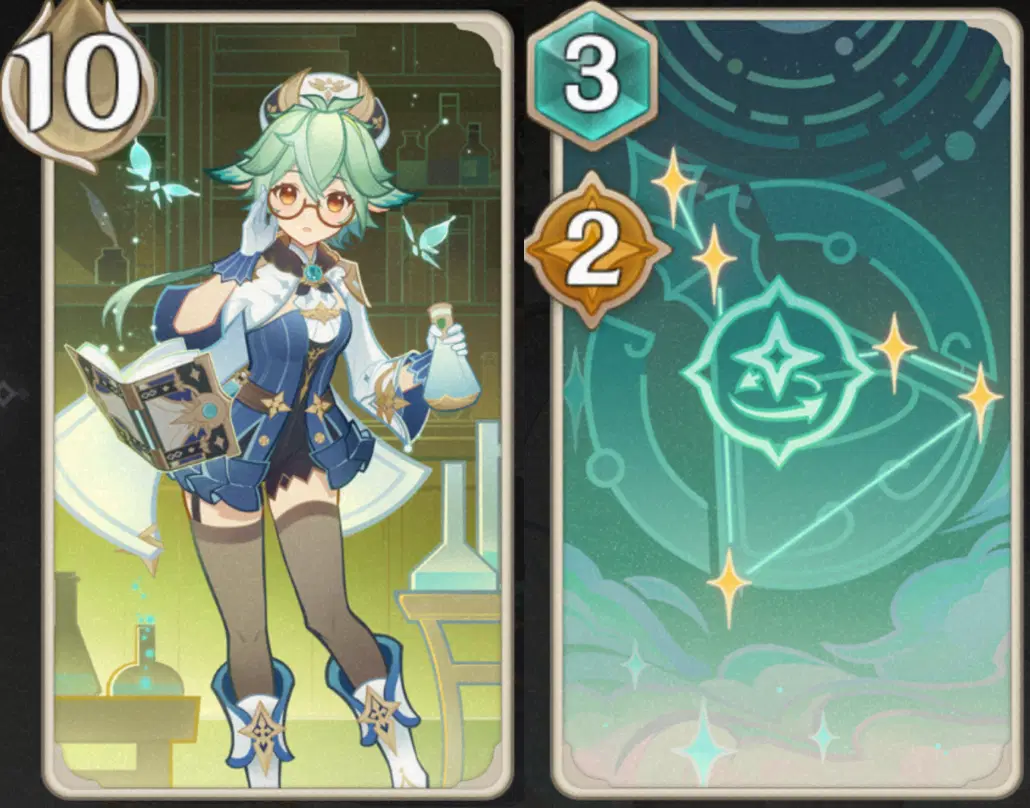
[Character and Talent Card]: On the Character Card we see various alchemical equipment in the background as well as in Sucrose’s hand, there are also two Wind Spirits reflecting Sucrose’s skills. The Talent Card shows her Constellation and the Level 6 Constellation icon.
Sucrose will use her Elemental Burst immediately when the Talent Card is played, and if the summoned Large Wind Spirit tri***** a Swirl Reaction, the Element affected by Swirl will have +1 DMG. The card matches Sucrose’s Level 6 Constellation passive, both have to do with increasing DMG on Swirl.
[Normal Attack]: Deals 1 point of Anemo DMG, because only Catalyst users in the open world deal Elemental DMG with their Normal Attacks (not counting the Level 2 Charged Attack on Bow characters).
[Elemental Skill]: Forces the opponent to switch back to the previous character. In the open world, the skill attracts and knocks up enemies at the location of the Wind Spirit, so the conversion makes logical sense.
[Elemental Burst]: The summoned Large Wind Spirit can also trigger the Swirl Reaction. This is pretty much the same as its original effect, minus the continuous pull effect on enemies and the knock up.
③ Mona
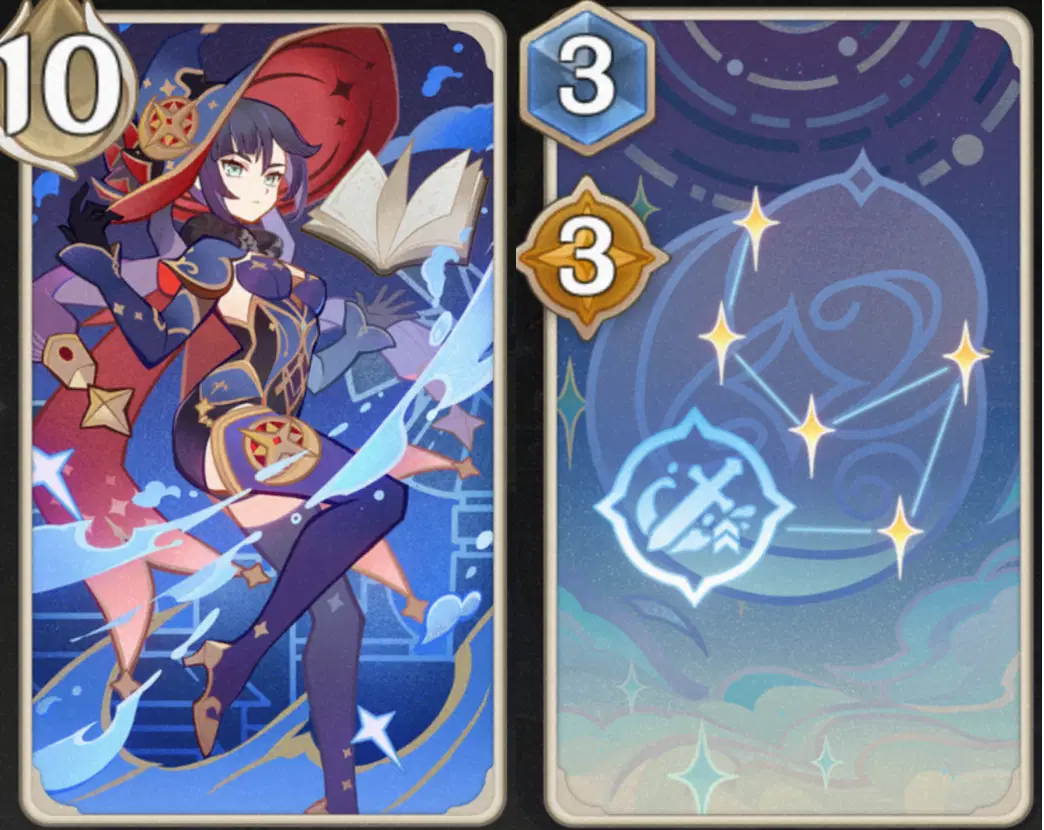
[Character and Talent Card]: Not much to elaborate here, the Talent Card shows her Constellation and her Level 6 Constellation icon.
The Talent Card takes the name of Mona’s Level 1 Constellation and its passive effect. Mona uses her Elemental Burst immediately when the Talent Card is played, and the friendly party’s Hydro-related Reaction DMG is increased, this effect takes inspiration from Mona’s Level 1 Constellation in the open world.
[Normal Attack]: Deals 1 point of Hydro DMG, same as the original.
[Elemental Skill]: The summoned [Reflection] can block 1 point of DMG for the active character. This skill is similar to how the summoned Phantom in the open world continuously taunts nearby enemies.
[Elemental Burst]: The summoned Illusory Bubble doubles the DMG done by friendly skills. This reflects the massive amount of bonus DMG gained from Mona’s Elemental Burst in the open world.
[Passive Skill]: When switching Mona out for other characters, the action is counted as a Fast Action. This one perhaps takes inspiration from Mona’s alternative sprint, which cloaks her in water’s flow for faster movement.
④ Xingqiu
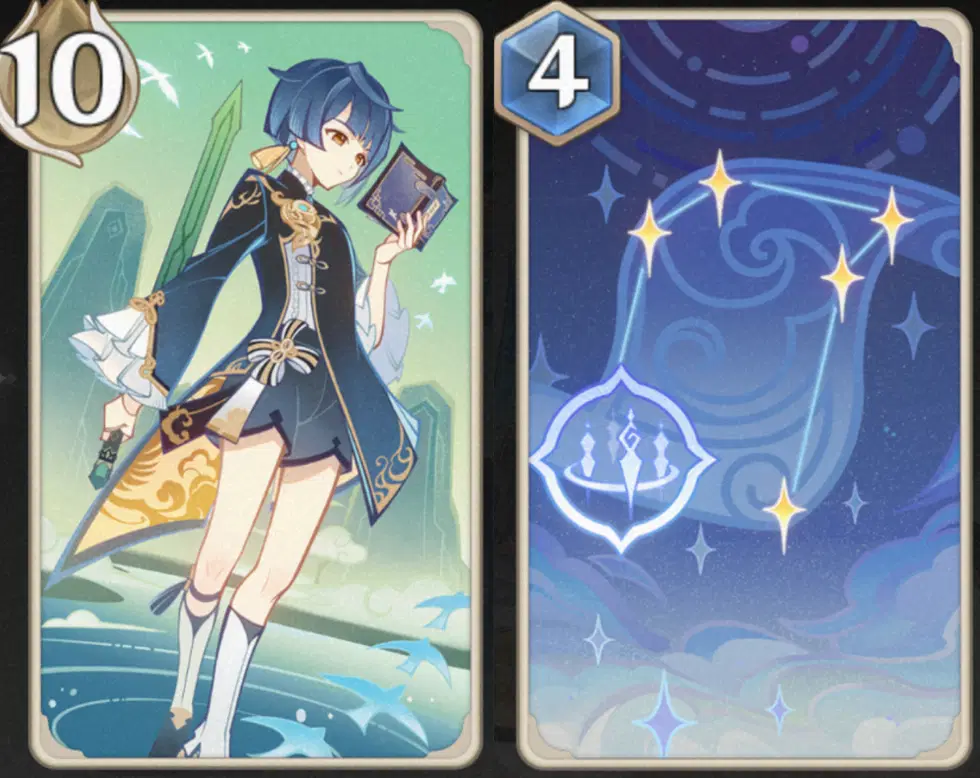
[Character and Talent Card]: Xingqiu carries the Skyrider Sword with him on the Character Card, while the Talent Card shows his Constellation and Level 1 Constellation icon.
The Talent Card reflects Xingqiu’s Level 1 Constellation passive. In the open world, it increases the maximum number of Rain Swords by 1, whereas in the TCG it has been adjusted to +1 to Starting Usage(s), making it 3 times total. Additionally, the [Rain Sword] retains its effect of blocking DMG for the active character as it does in the open world.
[Normal Attack]: Deals a fixed 2 points of Physical DMG.
[Elemental Skill]: Removed the Interruption RES passive from the Rain Sword. Another difference is that in the open world, you can have at most 3 Rain Swords active, this has been changed to at most 2 usages in the TCG, probably out of concern for overtuned support…
[Elemental Burst]: Normal Attacks dealing additional Hydro DMG on hit, as well as the number of usage on Rainbow Bladework, all directly reference the open world skill effects and the setting of having maximum number of Rain Swords.
⑤ Barbara
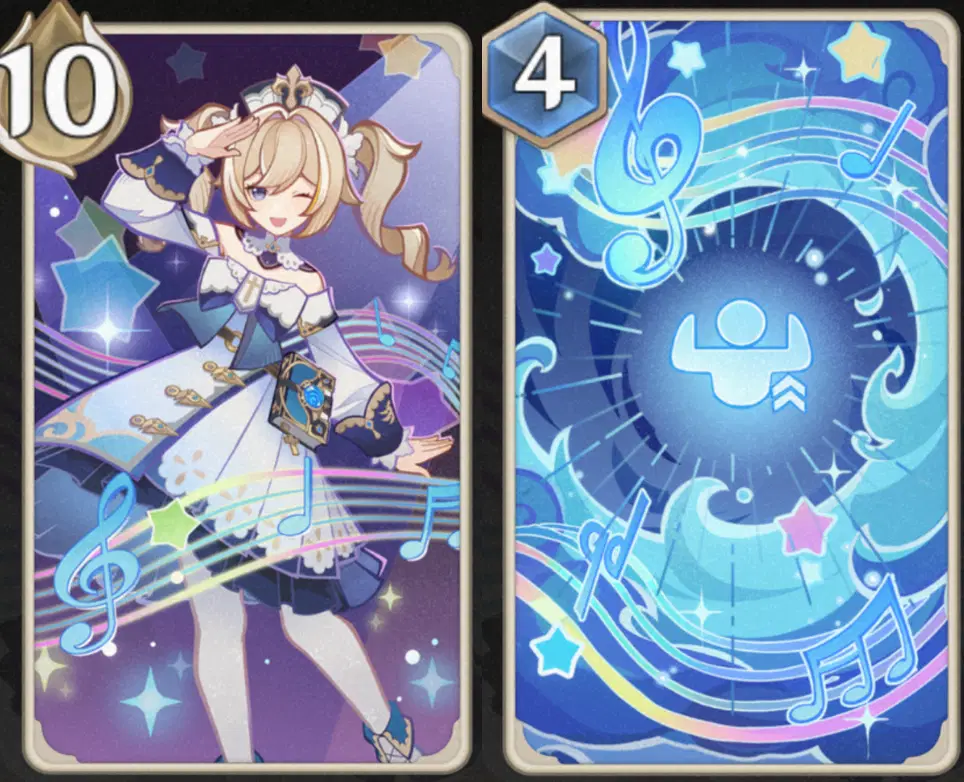
[Character and Talent Card]: The Character Card is business as usual, while the Talent Card is made up of elements from her Elemental Skill and Burst effects in the open world, as well as her 1st Ascension Passive icon.
The Talent Card name and effect are both directly taken from her 1st Ascension Passive. The original effect reducesStamina consumption after using her Elemental Skill, while in [Genius Invocation], Barbara will use her Elemental Skill immediately when this card is played, and her subsequent attack costs are lowered by 1 point. This is in line with her open world design.
[Normal Attack]: Deals 1 point of Hydro DMG.
[Elemental Skill]: Here the skill is somewhat different from the open world, in which Barbara deals DMG to enemies and continuously heals her teammates with Normal and Charged Attacks after summoning the Melody Loop with her Elemental Skill. In the TCG, it has been changed to healing teammates on round end for two rounds, her Normal and Charged Attacks no longer come with the healing effect.
[Elemental Burst]: Same as the open world version, provides massive healing to the team, a crucial emergency heal ****on.
With limited space, this concludes our part three character skill origins guide, for other cards, please follow the link for quick access:
[V3.3]“Genius Invokation TCG” Support Cards Origin | A Foolproof Card Analysis (1)
[V3.3]“Genius Invokation TCG” Support Cards Origin | A Foolproof Card Analysis (2)

Version: en-uszh-cnzh-twja-jpes-esru-rutr-trit-itth-thvi-vnid-idfr-frde-dept-ptko-kr